Current AI systems excel at parsing words, but they remain largely oblivious to the unspoken dimensions of human interaction. Interhuman AI, based in Copenhagen, is working to bridge this gap by developing technology that recognizes the social signals embedded in how we communicate—hesitation, confidence, uncertainty, and agreement—rather than just what we say.
The startup is among a small cohort of European AI companies building proprietary models from scratch. Its Social Intelligence technology interprets non-verbal cues that shape how humans understand one another but remain largely invisible to existing AI. The company's newest offering, Inter-2, processes social signals across text, audio, and video simultaneously and in real time.
From ChatGPT to social intelligence
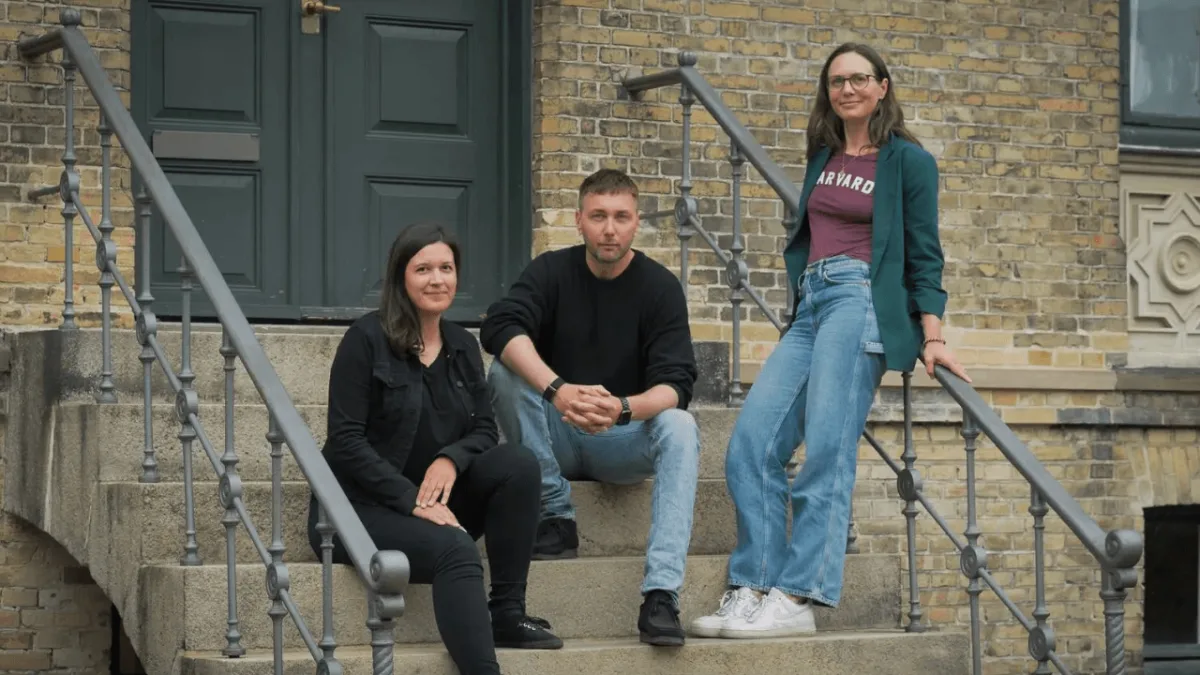
CEO Paula Petcu and COO Frederik Sally traced the company's origins to the moment large language models like ChatGPT entered mainstream use. While these systems transformed human-AI interaction, they remained deaf to body language, tone, facial expressions, and other contextual cues. Petcu was then working in pharmaceuticals, investigating how AI might better comprehend patients enrolled in clinical trials.
That's where the idea came from: could we combine large language models with models analysing video and audio from a camera and microphone, and add another layer of sensing to understand what the user is actually communicating?
Paula Petcu
Petcu connected with co-founder and CRO Line Clemmense during a webinar; Clemmense had been researching this domain. Together they developed a prototype: an AI coach that reacted not merely to words but to how they were delivered. The team later expanded when Sally joined through Antler's matchmaking programme, bringing operational and product expertise.
The user experience of AI depends enormously on how the model reacts to you and how well it understands you.
Frederik Sally
Inter-2 represents the first model in a new generation. It examines facial expressions, tone of voice, body language, and behavioural cues such as gaze shifts, posture changes, and head movements to identify 12 social signals in real time—engagement, hesitation, uncertainty, confusion, agreement, and disagreement among them. The company reports that Inter-2 achieves up to four times faster inference while improving benchmark performance, making real-time signal detection more feasible at scale.
Today's models are remarkably capable and still socially deaf. They respond to the words, not to the person who wrote them. A correct answer delivered at the wrong moment is still a bad answer.
Frederik Sally
Working towards artificial social intelligence
Inter-2 advances what Interhuman terms Artificial Social Intelligence—equipping AI with the perceptual capacities humans rely on to navigate social exchanges. The company merges behavioural science with machine learning, converting how people perceive and interpret each other into structured signals that machines can process. Interhuman is constructing its own models rather than relying on third-party systems.
Petcu observes that leading AI research labs concentrate on general intelligence and productivity gains, devoting less effort to human communication and social-signal recognition.
If you don't account for this layer in future AI systems, there's a risk of over-optimising workflows and productivity without considering the potential consequences.
Paula Petcu
She highlights AI-powered healthcare triage as a cautionary case. If someone is frustrated or distressed while speaking to an AI system by phone, and that system cannot detect such signals, it might misread the situation and make incorrect decisions about emergency intervention. Similarly, in robotics, a humanoid robot unable to perceive when it should halt an action risks causing physical injury.
The problem of interpreting human behaviour
Human behaviour is inherently complex and deeply personal. Individual quirks mean that a single social cue can convey different meanings depending on the person or context. A pause, for instance, might signal uncertainty, but it could equally reflect someone gathering their thoughts before speaking.
Interhuman is deliberately designing its models to make their conclusions traceable, enabling end users to see which cues produced a particular assessment.
We thought it was important to include the rationale behind the model's outputs. You should be able to trace what caused a particular signal to be identified. We're trying to make the model as transparent as possible so you can understand what was behind an assessment.
Paula Petcu
Why did the model identify hesitation at that particular moment? As a human being, if an AI is determining something about my future, I want to be able to question it.
Paula Petcu
Accounting for differences in culture, language, age, neurodiversity, and individual communication patterns presents a further obstacle. Sally emphasizes that addressing this variation requires gathering sufficient diverse data and annotating it with appropriate care. Interhuman initially relied on publicly available datasets to understand the challenge and refine its annotation methodology.
The company now collects its own data, with staff recording various conversation types, and partners with external data providers to broaden its datasets. Interhuman engages expert annotators—including psychologists and behavioural scientists—to label the behavioural data underlying its models.
Our approach is grounded in behavioural-science literature, and we're trying to make it as rigorous as possible from the beginning.
Frederik Sally
The responsibility of building AI
As AI grows more powerful, questions of privacy, manipulation, and human agency grow more urgent. Petcu stresses that social intelligence should not serve to judge people or claim insight into their thoughts; instead, it should furnish AI with greater context for understanding human communication while preserving human control over how that information is deployed.
When asked how Interhuman ensures responsible deployment of its technology, Sally acknowledges this is a frequent internal discussion. The company has already established certain boundaries, including declining investment from parties interested in defence applications.
Imagine adding our technology to that and using it to analyse strangers as you move through the real world — potentially even using those insights to manipulate people or gain an advantage over them.
Frederik Sally
As adoption spreads, Interhuman intends to establish a comprehensive framework of rules governing acceptable uses of its models, complementing restrictions already mandated by European regulation on certain AI applications. Petcu notes that the company's current size allows it to maintain oversight of how customers deploy its systems and engage with them directly.
That lets us learn more about their business, answer questions about the EU AI Act or data privacy, and potentially tell them, 'You can't use this technology for the purpose you're intending.'
Paula Petcu
Interhuman meets GDPR requirements and is currently undergoing security certification audits. Its commitment to process transparency proves valuable when engaging with corporate customers and their legal teams.
Where social intelligence could be used
Interhuman operates sector-agnostically through an API that grants companies access to its model. The company already has customers developing AI-powered role-play applications for corporate training—scenarios like practising difficult conversations, salary negotiations, or job interviews with an AI. The system can deliver feedback not only on content but on delivery.
That makes the feedback much more actionable because it can also assess how you present yourself.
Frederik Sally
Interhuman is also active in digital health, collaborating with clinical psychologists at Denmark's Centre for Mental Health for Children and Adolescents on an app teaching parents more effective communication with their children.
For example, if a child doesn't want to go to school and is screaming, how do you handle that situation? How do you make sure you're using the right body language, tone of voice, and words?
Paula Petcu
Digital-health coaching represents another application: an empathetic AI coach that perceives how something is said and might ask whether deeper concerns underlie the surface statement. Sales training and sales intelligence—including meeting transcription and coaching—constitute additional markets.
Then there are applications in sales training and sales intelligence, including meeting note-takers and sales coaching.
Paula Petcu
Market research is yet another domain. An AI interviewer might ask a customer's opinion on a product's taste; when they respond "it's sweet," the AI can detect signals around that answer and probe further: is it excessively sweet?
Looking ahead, Interhuman expects social intelligence to become a foundational layer for robotics, elder care, AI companions, and other physical applications. The company is also in discussions with organizations seeking to humanize their avatars—addressing questions like how an avatar should behave while listening.
That's actually a difficult problem. How should it react while another person is speaking? Companies are approaching us about using our technology for that.
Frederik Sally
Making AI socially aware in more complex conversations
Although Interhuman has concentrated on sales training, coaching, and intelligence, many sales calls and customer-support interactions occur over the phone, where visual information is absent.
That's voice-only, so you don't have visual information.
Frederik Sally
Interhuman is developing a model suited to this constraint. Sally notes that working with datasets containing both video and audio is naturally simpler.
When you have only the voice, understanding what is happening becomes more difficult.
Frederik Sally
Yet voice-only capability unlocks many additional applications. Sally anticipates voice becoming the dominant interface for AI interaction.
We've spent a lot of time interacting through chat, but we're already seeing developers speaking to their AI coding agents.
Frederik Sally
Moving forward, Interhuman is refining individual signals and strengthening the model's resilience with noisy data. The company also aims to handle conversations involving multiple participants.
What is the relationship between those two people? How should the AI approach person A versus person B? What do they know about each other?
Paula Petcu
Power dynamics represent another frontier. A job interview differs fundamentally from a casual conversation, and identical signals carry different meanings depending on context. Interhuman plans to announce two additional models in October.
Building AI models in Europe
For Petcu, it matters that Interhuman is constructing its own AI models within Europe.
Building an AI lab and developing your own models that could have an impact on society is quite unusual here.
Paula Petcu
She contends that developing within Europe's stricter regulatory framework could ultimately provide Interhuman with a competitive edge as it expands internationally.
If we can build this technology successfully here and meet those requirements, I think we'll be well positioned to meet regulatory requirements elsewhere as well.
Paula Petcu
Source: Tech.eu