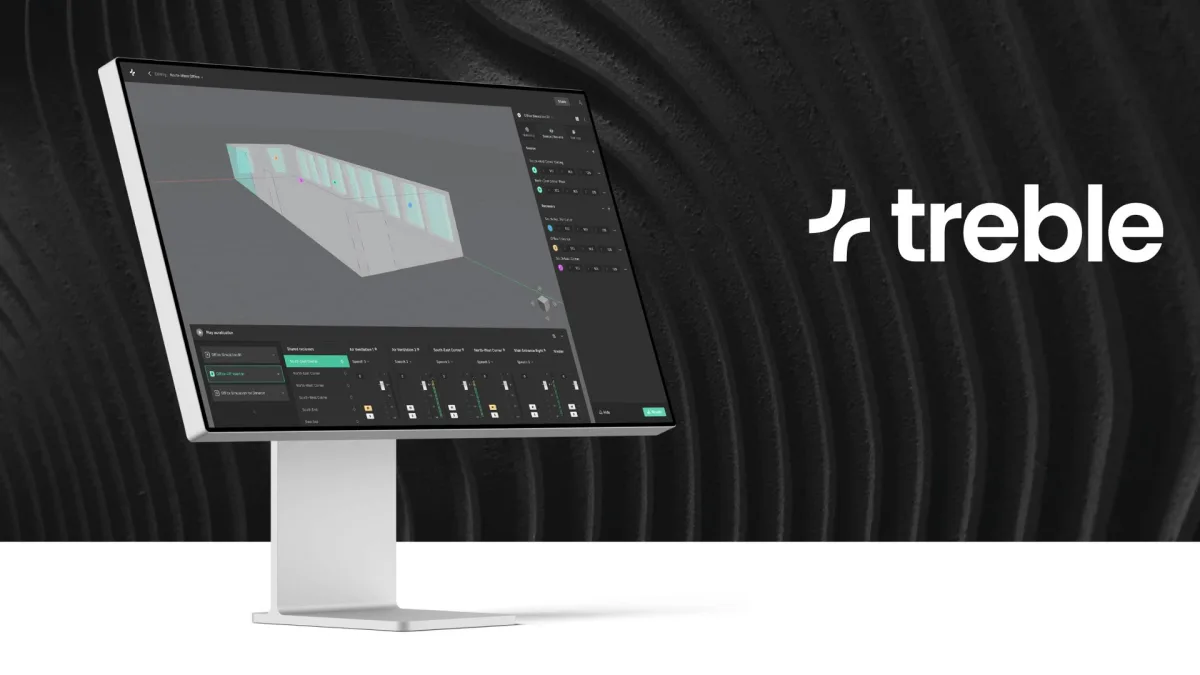
Treble Technologies, which specializes in generating synthetic acoustic data and sound simulation, has closed an $18 million Series A-2 funding round aimed at broadening its reach into consumer electronics, enterprise audio, and physical AI applications. Paladin Capital Group anchored the round, joined by returning backers KOMPAS VC, Frumtak Ventures, and the European Innovation Council (EIC) Fund. The fresh capital brings Treble's cumulative funding to €36M.
The timing reflects a broader shift in how intelligent devices interact with users. As voice and sound emerge as critical interfaces between humans and machines, developers face a mounting challenge: audio systems trained in controlled lab settings often falter when exposed to real-world acoustic complexity. Wearables, robots, autonomous vehicles and head-mounted displays all encounter unpredictable sound conditions—reverberation, ambient noise, varying microphone placements and room acoustics—that can degrade AI model performance.
Treble's platform tackles this by using physics-based acoustic modelling to simulate sound propagation through physical spaces. The system combines acoustic simulation, digital twins and synthetic data generation, allowing teams to recreate diverse acoustic scenarios—different rooms, materials, vehicles, devices, speakers and noise environments—without building physical prototypes or running expensive recording campaigns. Developers can generate labelled training data, test hard-to-reproduce edge cases and compare product variants under identical conditions.
According to the company, this approach compresses prototype testing and audio data collection timelines from months down to days, while strengthening the robustness of audio AI models and enabling new product capabilities.
Audio and voice interaction is becoming a fundamental interface for the next generation of intelligent products, but the physical world is acoustically complex. AI models and devices that perform well in a laboratory can struggle when they encounter reverberation, background noise, or an unfamiliar physical environment,
Finnur Pind, co-founder and CEO of Treble
Pind noted that Treble's technology equips device makers with a more efficient path to modelling acoustic conditions, producing training and validation datasets, and predicting real-world product performance in the spaces where customers will actually use them.
The new capital will accelerate development of Treble's simulation and synthetic data tools while extending adoption across audio-enabled consumer and enterprise applications. The company is also deepening its focus on physical AI use cases as voice and audio capabilities proliferate in intelligent machines.
Source: Tech.eu