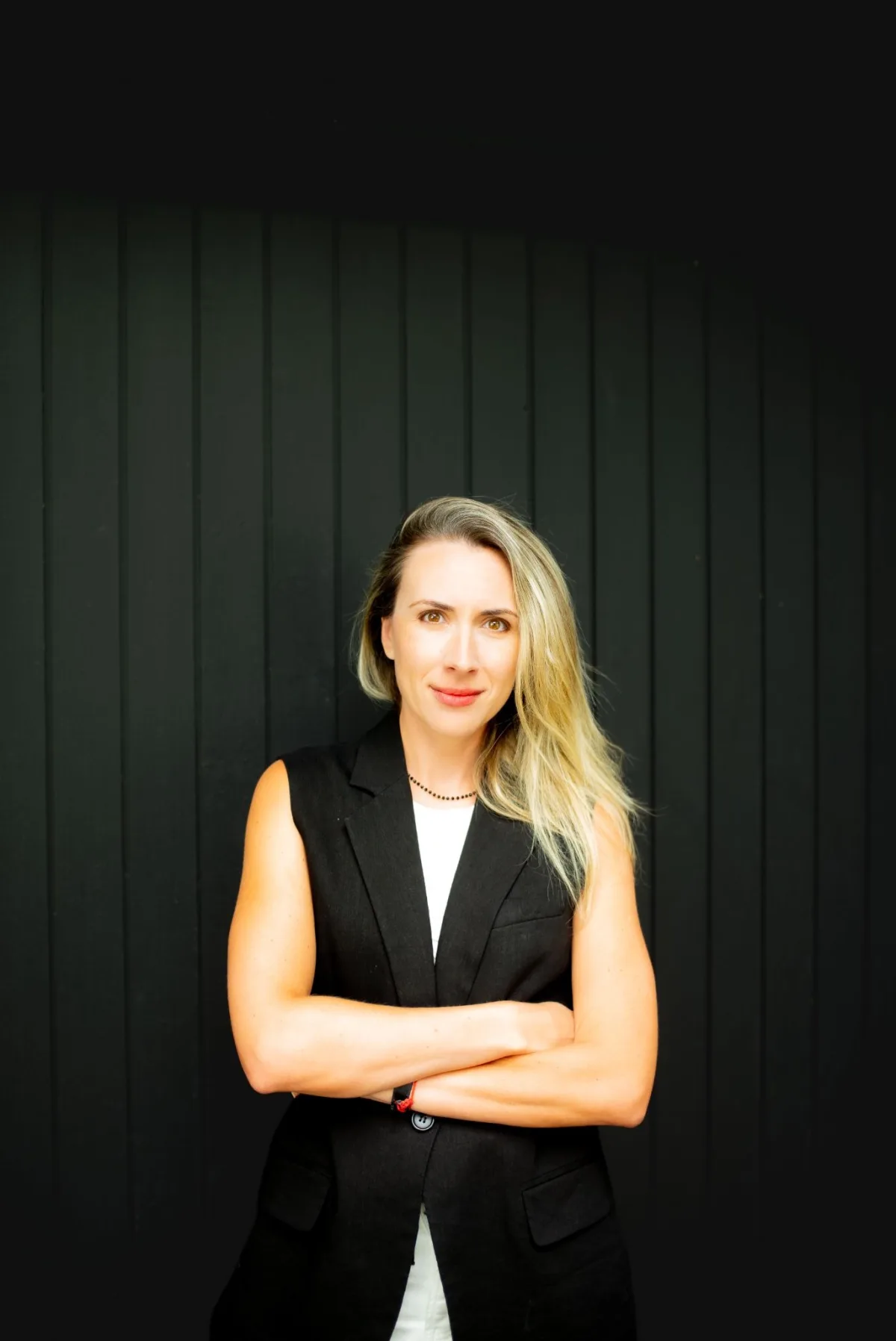
Inna Bondarenko's path to founding Kalei wound through corporate finance, venture capital, and her own hands-on work guiding large organizations through AI adoption at Deloitte. The insight that drove her to leave after nearly two decades was deceptively simple: companies aren't failing to find AI tools. They're failing to structure how those tools fit into their operations. Kalei's platform, now live with clients including Babel PR, treats workflow design, context, and governance as the foundation—not an afterthought to technology selection.
The decision to leave
Bondarenko spent her Deloitte years moving between M&A advisory, venture investing, and leading transformation initiatives across the UK and Europe. When asked what made eighteen years the right moment to depart rather than five years earlier or later, she points to three converging factors. "The first was around personal readiness: a certain level of professional maturity, which gave me more confidence and, hence, comfort taking a risk. The second was the vision for the problem I'd like to solve, and the intellectual excitement to actually solve it. Last but not least was the market momentum around AI transformation and the AI diffusion gap. Five years ago, I didn't have all three elements, and the impulse was too strong to wait another five years."
Working across strategy and execution taught her to move fluidly between big-picture thinking and tactical delivery—a skill she now applies to building Kalei. But staying long at a large firm carries hidden costs. "The longer you stay, the harder leaving gets," she reflects. "That sounds counterintuitive, because you're accumulating experience and professional maturity the whole time. But the security umbrella affects different aspects of your life. Your capability grows, and at the same time, the certainty you need before you move grows faster."
Inside a major corporation, certain moves get recognized and rewarded while others don't. Bondarenko's pivots—switching from M&A to technology, taking an academic break, diving into hands-on delivery work—fell into the second category. "The trade-off I haven't heard people talk about enough is that the two lists aren't the same list, and you need to make conscious choices about what you are optimising for."
The first venture
Before Kalei, Bondarenko launched SBon, a sustainable fashion brand focused on high-quality, long-lasting clothing and conscious consumption. The venture also carried a social mission: helping Ukrainian women build steady income and community. Started eleven years ago during her maternity leave, SBon struggled with the unit economics of direct-to-consumer retail. "From a purely commercial perspective, the path to break-even was longer than expected mainly because of higher customer acquisition costs in a direct-to-consumer model, on top of the cost of living in London. I had to close the venture after a few years."
That experience taught her about energy allocation and timing. "Running your own venture takes a lot of energy, and it's not infinite," she says. "My main reflection now is that you have to be very honest with yourself about the energy you have at different stages of life, how you want to allocate it, and what's left after that allocation." Yet the feeling of building and launching something meaningful stayed with her. "What's stayed with me all these years is the feeling of being alive when I built and launched something, and I kept thinking that I'd come back to entrepreneurship when the timing was right."
The academic detour
Between leaving Deloitte and founding Kalei, Bondarenko pursued a master's degree in Digital Anthropology at UCL. The move raised eyebrows in corporate circles. She studied anthropology, philosophy, and history, immersing herself in ethnographies—situated studies of unfamiliar environments worldwide. The questions driving her research were foundational: what does it mean to be human from a cultural perspective? How does human identity shift in an AI-saturated world? What impact does technology have on global power dynamics?
That year shaped Kalei's design philosophy directly. "I translated it into what we call human-by-design. If a part of a workflow is being automated, the question is always: what's the human implication of that? How do you preserve human creativity and agency when you design AI-enabled workflows? Ethnography teaches you to observe people and connect what you see to a broader context. I apply that same zoom-in, zoom-out ability both when designing AI processes and later, during adoption and change management."
The name
The kaleidoscope metaphor—fragments of people, technology, culture, and process shifting into coherence—wasn't something Bondarenko discovered while naming the company. It was already in her head. While working on transformation at Deloitte, she kept returning to a central insight: connecting siloed streams—people, data, technology, governance—into one flexible, evolving structure. "I'm a very visual person — that was the image already in my head. It took about a day to actually land on the name, because the idea and the image were already there. It was just calibrating the words to match an image I'd already visualised."
What Kalei does
Kalei's work with Babel PR, a technology-focused PR and marketing agency, illustrates the problem the platform solves. Three-quarters of Babel's team was already experimenting with AI, but the value wasn't translating into company-wide gains. People saved prompts in Word documents and shared them informally. There was no shared context, no shared standard, no shared memory. "So value was being captured individually and never translated into company value or new ways of working."
Closing that gap involves two components. The first is structured onboarding that looks like traditional AI consulting—strategy, value drivers, workflow mapping, redesign, governance, adoption—but delivers something different. Instead of static documents or one-off agents, clients get a platform where those elements work together as a system. Context embeds into workflows. Governance and design principles build into human-to-AI handovers. Strategy shows up as prioritized processes measured against baseline performance.
The second component is continuous maintenance. "None of those elements is static. The technology moves, the market moves, the team's AI maturity grows, priorities shift. So the platform and everything inside it has to be maintained, not just installed."
For Babel, preserving human creativity was non-negotiable. The design principle became: "AI helps with the ingredients, but the person still cooks the dish." When the initial research workflow over-automated and left too little room for creative thinking downstream, Bondarenko and her team redesigned it. "We had to go back and redesign that first step so the output doesn't lead the process and keeps that space open. It was a very deliberate, very nuanced AI-human handover."
Results have been positive. The proposal-writing workflow compressed from one to two weeks to one to two days, freeing time for creative thinking that's already showing up in new business wins. Babel is now a platform subscriber rather than a one-off project client.
The defensible layer
As AI models commoditize, what remains defensible is an organization's own context—its know-how, best practices, and judgment that typically lives in a few people's heads. "That's the layer we curate with a client, not for them, and that's precisely why it's defensible. It can't be bought in, and it can't be pre-built by us or anyone else."
Kalei is building the layer beneath that: proprietary market context specific to each vertical. Rather than just internal knowledge, the platform will offer a live view of the sectors clients operate in. "That's what we're building at Kalei, and it travels between clients. Their own context never does." This approach accelerates onboarding for new clients, who arrive to find proven, up-to-date industry frameworks and codified expertise already in the system. It inverts the traditional consulting model where the industry specialist walks in with sector knowledge in their head—here, that knowledge is codified and continuously updated in the platform.
AI for Leaders
Alongside the enterprise product, Kalei launched AI for Leaders, a separate offering for individual executives. Rather than two distinct products, Bondarenko sees them as one process adapted for different users: discovery, human-AI triage, technology matching, activation, and adoption. "I believe successful AI transformation needs leaders who understand how AI works from hands-on experience: they're better informed, at a strategic level, about what it means for their business."
At the individual level, leaders often struggle with calibrating agency—knowing what to delegate to AI, what should remain human, where trust belongs. "The more you use AI, the more you fine-tune that relationship, because you understand the quality of the output, you can challenge it, you know how to personalise it." Bondarenko has observed two extremes: defensive positions where leaders dismiss AI outputs as too generic, and over-reliance where good-enough outputs drive real decisions without verification. "I think calibrating that relationship is critical."
Building the company
Currently, Kalei is Bondarenko working with specialized collaborators—a tech lead, product and industry advisors, and people supporting client work. This structure is deliberate. "Once the product is ready to scale, that's the point where I plan to expand — potentially raise, bring people on full time. I have those stages planned for the next few months."
Supporting Ukrainian professionals
Through Deloitte, Bondarenko volunteered to help Ukrainian tech professionals arriving in the UK. Her focus was intercultural communication—helping people understand the professional culture of the UK and its particular semantics. "I wanted people to walk away with the tools to translate their strengths and calibrate ways of working without feeling defensive."
She also shared her own cultural journey, including mistakes and strategies that worked. "For most people I spoke to, moving cultures wasn't their choice, but a matter of survival, so I tried to support them and share what I've learned, adapted to their circumstances."
A founder's week
Bondarenko structures her days around peak productivity. Mornings are reserved for cognitively demanding work—product development, agent building, or writing. Client delivery runs continuously alongside strategic work. She blocks time for calls, networking, and meetings, and deliberately prioritizes sport, health, and family. What she's eliminated is passive information consumption. "What I say no to now is absorbing as much information as I used to — I'm quite strategic about what I read, how, and when, so I don't lose too much time to the avalanche of information around AI transformation."
When pressed on what genuinely unsettles her, Bondarenko points to scale. "I am in the process of understanding how much of this is genuinely horizontal across industry. What has to stay bespoke to a client, and what's common enough across an industry that you build it once and carry it. I have a working hypothesis we are currently testing, not an answer."
The constraints pull in opposite directions. Protecting IP. Avoiding commoditization. Preventing every engagement from becoming a custom project—precisely what she set out to avoid. "Push too far one way, and you're back to consulting. Too far the other way and you've built something generic that doesn't hold the value." Yet she finds this tension energizing rather than worrying. "You're twisting a Rubik's Cube, trying to make it work for the industry and for the human at the same time. I'd rather be on that problem than one that's already solved."
The three-year vision
If Kalei works as intended, a client's Monday morning in three years will look different. They open the platform, describe what they want to work on, and the right context is already there—company, market, and client level, current and curated rather than rebuilt each time. The workflow runs in a way nuanced to how that firm actually operates, anchored in strategy and priorities, with space for human creativity preserved by design.
Much of this is already technically possible and will become more so as large AI labs improve their capabilities. But the shape that works for those labs is horizontal by necessity. A traditional consultancy goes deep into a vertical, then rebuilds from scratch for the next client, with fees reflecting that bespoke work. "Kalei sits between the two. The nuance a specific vertical requires, curated and current, and kept vendor-agnostic."
Kalei's ambition is keeping the structure current. The system three years from now won't be the one built on day one. Every use generates signals about what worked, what got edited, where handovers failed. That feedback loops back in. "So the system sharpens with use instead of drifting. So whatever the market looks like by then, Kalei's clients are still competitive in it."
Quick questions
Coffee or tea? Coffee — black, no sugar, fresh ground.
Fiction or non-fiction? Fiction now. I used to read a lot of non-fiction, mostly to improve myself. I still read it to understand other people's perspectives, but often it's someone else's insight, already synthesised. Fiction gives you the stories, and you form your own. Currently finishing The Correspondent by Virginia Evans. Before that, Homer's Odyssey and Voltaire's Candide, so quite a spectrum.
City or countryside? Used to be mainly city. Now, fifty-fifty.
Which app do you use the most? Notion. It's where thoughts, ideas and plans get written down first.
Best productivity trick — no AI involved? Every Monday morning, set the top three to five priorities for the week where I need to show progress. Prioritising is what sits with me, then I decide what part I delegate to AI agents to help execute.
Something that changed how you see things? The Creative Act: A Way of Being by Rick Rubin. It's adjacent to my interest in anthropology – another way of experiencing the world through creativity, observing yourself in it, noticing things. I apply that both professionally and personally.
One thing you'd want people to know? The world is changing, and what it means to be human in it is changing with it. I'd want people to look at their own work. Not whether AI is coming for their industry—that's already been written about endlessly—but what it actually means for them. There's no shortage of thought pieces and forecasts for every sector. I think they're worth reading through, but no thought piece knows your nuance. It doesn't know what you're actually good at, what your aspirations and dreams are, or where your judgement and creativity matter most. And now I feel it is the right time for such self-reflection.
What would you wish for our readers? That people find a way to keep creating value, and keep the purpose in what they do, as the world changes around them.
Kalei is based in London.
Source: Startup Reporter