Part One: The Case for Being First
Though Lorenzo Bergadano progressed directly from university into roles at large technology companies and established corporations before co-founding Quido AI, he has developed a counterintuitive view of career trajectories. After teaching a summer program at Bocconi, he began reflecting on a topic largely absent from startup discourse: the distinctive value of joining an early-stage venture as one of its initial hires—and why this path receives far less attention than founding or traditional employment.
Bergadano advocates against rushing into founding. "I'm one of those founders who genuinely recommends getting some work experience first, at another startup or another company, before trying to build your own," he explains. "It might sound obvious, but it isn't: you can't really know how to run a company if you've never worked inside one. Even something as basic as managing people — if you've never experienced a workplace and the relationships inside it, it's hard to start that from zero."
For those drawn to entrepreneurship, he suggests starting with smaller experiments. Universities increasingly offer capstone projects involving scaled startup launches, or informal exploration with peers can serve the same purpose. "Because at the end of the day, that's all a company really is: an attempt to solve a problem."
Finding the Right Startup
Bergadano emphasizes that early-stage ventures, particularly those at seed stage, operate with accessible leadership. Founders are typically reachable through conventional channels—LinkedIn, Instagram, and direct outreach. His advice: identify founders whose work resonates, initiate contact, and have a genuine conversation to assess compatibility.
Beyond founder fit, he stresses the importance of believing in the underlying problem the startup addresses, not merely its current product. "If you like the problem and you like the founders, that's it. That's how you get in."
The Fourth Path
Bergadano identifies what he calls a neglected career option. Conventional wisdom presents three routes: joining a family enterprise, working for a large corporation, or launching your own company. "What almost nobody puts on that list is the fourth option: go and join someone else's startup as one of the first people through the door."
This doesn't necessarily mean being employee number one—it could mean joining as the third, fifth, or twentieth hire. The distinction lies in arriving during the formative phase, a period undocumented in business literature and rarely taught formally. "That's why I keep coming back to this phrase: the importance of being first."
He attributes this oversight to cultural conditioning. From childhood, people internalize a linear progression: study, secure employment under supervisory structures, earn income, ideally find fulfillment in work. Founders receive cultural validation for their ambitions, yet the early employee occupies an undefined space in conventional career narratives. "It's not that it's excluded on purpose — it's just never been a standard use case."
Bergadano draws a parallel to chess strategy: "There's an old book about chess — about the power of the pawn, how some of the greatest games were won by leaning on the pawn instead of sacrificing it early. People assume the pawn is the first thing you give up. It's not, or at least it doesn't have to be. The first people who walk through a startup's door aren't there to be sacrificed either. They're living with one foot in each world — employee and something more than employee."
The Hybrid Responsibility
What distinguishes early employees is a fusion of accountability and autonomy. Compensation may include equity and salary, but the defining factor is ownership. "The founders trusted you enough to bring you in, so you carry founder-level responsibility even though you're technically an employee."
The stakes differ markedly from large organizations. In a startup, individual actions directly impact outcomes; in established corporations, a single delayed email or missed call produces no perceptible consequence. "So don't underestimate what someone learns as a first employee at a growing startup, tech or not. It's a lot of pressure, but it's a happy kind of pressure. You're learning to be the employee you were before, but at a level of responsibility you've never had. You're not just executing a task — you're also thinking about whether that task actually moves the company towards the milestone it's chasing."
Though Bergadano himself never occupied this intermediate role, moving directly from corporate positions to founding, he expresses admiration for those living it. "I do envy the people who are living it right now, because I think it gives you a kind of energy — a dopamine hit, honestly — that's hard to get anywhere else."
He positions early employment as occupying a middle ground between the extremes founders experience and the relative stability of traditional roles. "The regular employee doesn't really get either extreme. The first employee sits right in the middle. And I think that middle ground is underrated. I'd recommend it to almost anyone — and honestly, to myself, if I could go back."
Part Two: Three Perspectives from Quido
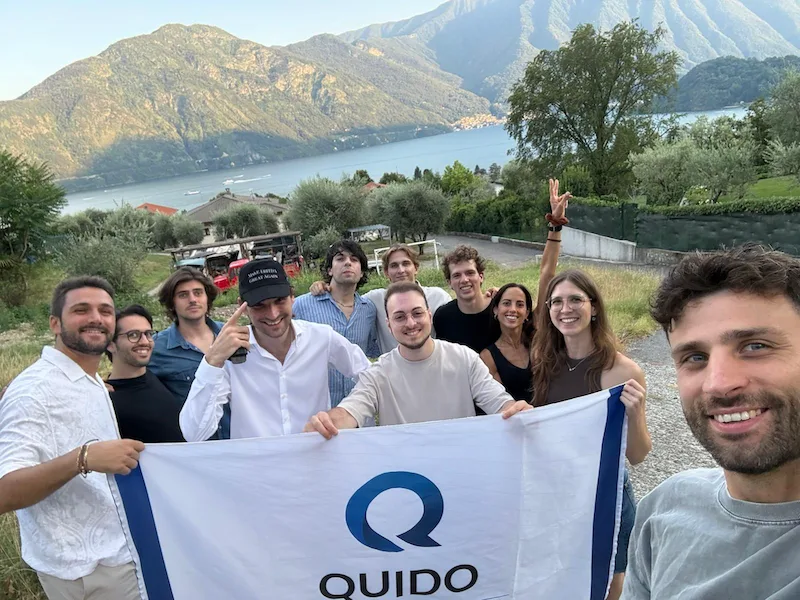
To test Bergadano's thesis, conversations took place with three individuals who embraced this path at Quido AI: Gianluca Maiorino, founding engineer, who joined in March 2026 after nearly a decade in large corporate environments; Ilaria, founding data scientist, who joined in March 2026 following roles at Cerved and Accenture; and Emilio Crespi, founder engineer, who joined in December 2025 after experience at another startup called Vedrai and his own venture, Curabit. Their backgrounds diverged, yet each abandoned something significant to pursue this opportunity.
Why They Left
Gianluca's decade-long tenure at a major corporation had become suffocating. "What weighed on me wasn't the abstract values," he reflects. "It was the everyday reality — security policies that kept getting more invasive, to the point where they actively hurt productivity instead of protecting anything." Beneath this lay a deeper concern: the prospect of remaining a subordinate contributor. "After years of building up experience, I wanted somewhere I could contribute more, not just execute."
Ilaria's trajectory passed through Cerved and Accenture—"structured, serious places," she characterizes them, "but in organisations that size, you feel the hierarchy everywhere. You've got very little room to manoeuvre." She sought work where her contributions would register as meaningful.
Emilio's journey differed: rather than corporate employment, he had worked at another startup and launched his own venture, Curabit, which concluded operations at the end of 2025. He encountered Bergadano through mutual connections during this transition. "You could say I arrived at Quido straight off the back of that."
The First Week
Emilio captures the initial experience through metaphor: "walking into a restaurant, or a bar, still being built. The people working inside welcome you with open arms, start giving you something to eat and drink straightaway, and while you're there they get you helping — putting up a shelf, assembling a piece of furniture. And then you realise that's actually the thing you want to be doing."
Ilaria's recollection emphasizes disorientation rather than comfort. "At a big company, there's usually a week of onboarding where you don't really do anything yet. Here, I was working within the hour." Gianluca identifies the same sensation—"disorienting — but also fascinating. It wasn't just about getting to know Quido, it was getting to know the whole ecosystem around it."
This disorientation stems primarily from velocity. "The biggest difference from normal work," Ilaria observes, "is how fast decisions get made and acted on. Before, an idea had to go through a manager, then a client, then someone else again just to check the budget — months before anything started. Here: you have an idea, you share it, and within two days it's already being built."
Emilio connects this acceleration to organizational scale: "Being few in number means big decisions get made without too many people weighing in. When you're a small group and everyone's in sync, sometimes you don't even need to say anything out loud — a gesture, a line of code, is enough."
Growth and Capability
Several months into their tenure, both Gianluca and Ilaria describe substantial progress. "I had to relearn a lot from scratch," Gianluca recounts, "constantly wondering if I was up to it. At first it felt a bit like swimming and struggling to catch your breath. Now I've got more command of things — I can actually focus on the goal rather than just staying afloat."
Ilaria quantifies her development: "four months in, it feels like a year. Before, I never made the final call on anything — everything had to be escalated. Now I speak directly to data suppliers, make strategic decisions on my own patch, almost from day one."
Leadership Observed
When asked about Bergadano's leadership from proximity, Emilio—self-described as a realist or pessimist—highlights his consistent ability to identify positive dimensions even in setbacks, generating sustained team energy. Ilaria notes something complementary: months into the venture, Bergadano and co-founder Francesco maintain the humility they exhibited initially, despite the company's expansion from two to nearly fifteen people. "They could easily have let it go to their heads," she observes. "Instead they're still very down to earth, always open to being challenged."
When pressed to characterize leadership style, the three resort to imagery. Ilaria sees "a team captain, one who knows he can't do everything alone. He leads by example — he shows you how things could be done, not how they should be done." Gianluca ventures further: "I'd say a CrossFit coach — a bit biased, I admit. He adapts the exercise to whoever's doing it, and stays switched on through the whole workout, because he knows that if you get it wrong, you could get hurt."
What Binds Early Employees
For Emilio, the connective tissue is shared experience—"getting things wrong together, deciding together, celebrating or suffering together, as a small group. You can't build the same bond with a hundred people that you can with five."
Ilaria frames it around product ownership: "You're the one shaping it, starting from zero, with only a handful of people. Once a company becomes a properly structured organisation, the big strategic calls tend to stay with senior management — whoever arrives early gets to make them from the start instead."
Gianluca distills it more simply: a collective pursuit of agency tempered by humility, rooted in belief in something worthy of personal investment.
Advice for Day One
When asked what they would tell themselves on their first day, Emilio and Ilaria converge from different angles. "Give yourself one more minute — or a few more days — before making the big calls," Emilio suggests, "rather than getting swept up by enthusiasm, or its opposite, into a rushed decision."
Ilaria's counsel parallels this: "Take it slowly, one problem at a time. At the start I felt overwhelmed by the responsibility — even though I was never really deciding alone, Lorenzo and Francesco were always there behind me."
For Prospective Early Employees
Emilio insists on balanced representation: "Too many articles only show the upside, because it needs to sell. The good: enormous energy, being surrounded by people with that same energy, big decisions to make from early on. The bad: frequent changes of direction, strategies that aren't always well defined." His diagnostic is straightforward—if you demand precision and consistency, this environment may disappoint; if you thrive on dynamism and can tolerate uncertainty, it might align perfectly.
Ilaria's message carries personal weight: "It isn't true that you learn more at a big company than at a startup. I wish I'd known that sooner." She recalls initial skepticism from her social circle—most people around her had pursued conventional corporate paths, and her decision prompted confusion rather than encouragement. "In the end, everyone was happy for me," she says, "because they could see I was happier. But at the start, there was definitely a bit of a shock."
Gianluca concludes with a personal principle: resist settling into comfort, particularly when something excites you—not despite the excitement, but because of it. Embrace mistakes as the most potent learning instruments available, rather than viewing them as failures to be avoided.
Source: Startup Reporter