Dastan Tomanbaev received an acceptance letter to STATION F's Landing Zone in Paris. The cost of showing up—airfare, lodging, and often an IELTS certificate requiring its own travel and exam fees—totalled roughly €5,000. He had none of it. The invitation, one that thousands of founders would consider a stroke of extraordinary luck, simply expired.
Across Europe's accelerators, hackathons and investment funds, the rhetoric is consistent: talent matters, background doesn't. Yet Tomanbaev's experience—declined opportunities despite genuine ability, blocked by the need for a passport that grants visa-free travel, thousands in savings, English certificates, and a registered company—suggests the gap between stated values and lived reality runs deep. At 18, he is a self-taught founder building Solifon AI, a browser-based gesture-control tool called Air Canvas, working alone from a village in Kazakhstan. He was also invited to ETHGlobal's Tokyo hackathon. He turned that down too, for the same reason.
Learning to code on a 4GB phone
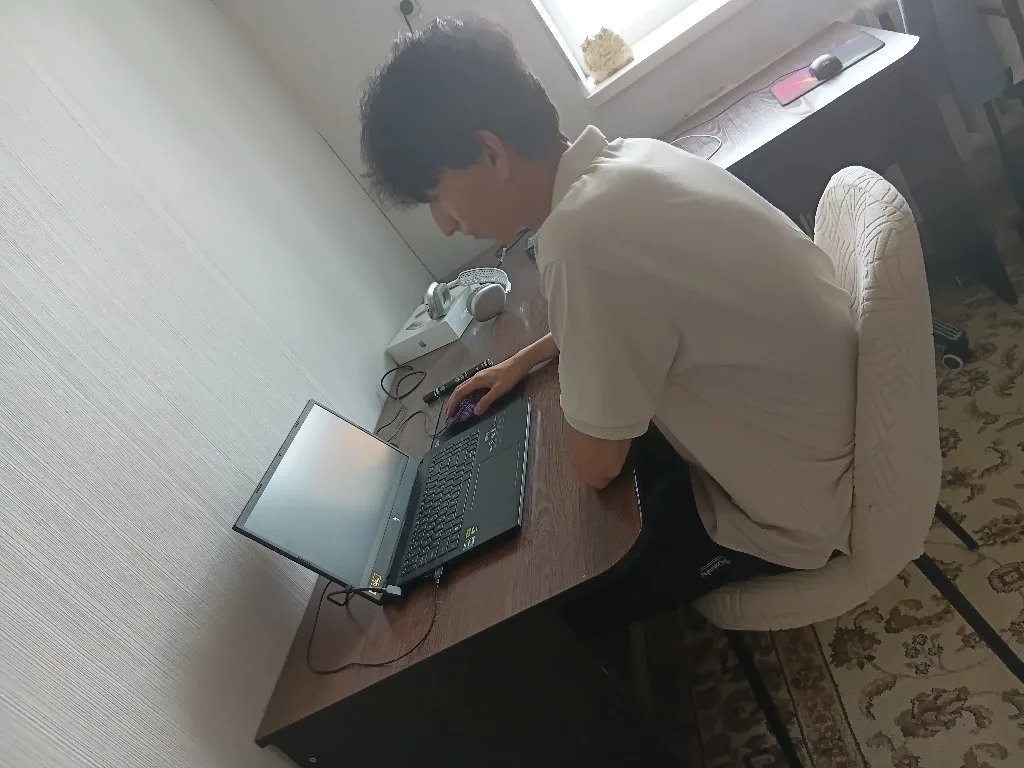
Tomanbaev's technical journey began in secondary school when he started learning JavaScript, which would later become the backbone of Air Canvas. But his first real machine-learning experiments happened on a smartphone with 4GB of RAM, before he owned a computer at all.
My path started in Year 9. I'd just begun learning to code — JavaScript first, which later became the foundation for my gesture-control system, Air Canvas. But before I ever had a computer, my first real attempts at machine learning happened on an ordinary smartphone with 4GB of RAM. I'd got it into my head that I didn't just want to use AI — I wanted to train my own model, right there on the phone. Reality hit fast. Processes kept crashing from lack of memory; I had neither the processing power nor the storage. I couldn't get far. But that hardware ceiling is exactly what pushed me to look for alternatives and go deep into web technologies and browser-control solutions — the kind that can run anywhere, regardless of how powerful the device is.
Dastan Tomanbaev
The Plus One foundation eventually provided him with his first laptop. The moment marked a turning point in his understanding of what was possible.
It was pure, uncomplicated joy. It wasn't just a gift to me — it was the first laptop I'd ever owned. Before that, all my potential had been locked inside the tiny screen of an underpowered phone. When I opened that laptop, I felt like a door into the real world of technology had genuinely opened in front of me. That day I understood something important: I had no more excuses left. I now had the tool. Everything from that point depended only on how much effort I was willing to put into the code.
Dastan Tomanbaev
Self-taught through Google Colab and Kaggle, Tomanbaev encountered his first major technical obstacle when learning how cloud infrastructure and memory management actually functioned. He built his first dataset by hand, creating 4,000 rows of training examples and uploading them to Google Colab. After the training completed, he discovered he had forgotten to write the script that would save the model's weights to disk. When the Colab session reset, all that work vanished.
The Colab session reset, and all that work simply vanished. It was a bitter but genuinely important lesson. I had to start again and write proper save architecture this time. But the moment the retrained model finally generated a response, and correctly stated its own name and the name of its creator — that made up for every one of those lost hours.
Dastan Tomanbaev
Building for a problem he lived through
Tomanbaev's second major project emerged from personal experience. As a child, he experienced a speech delay. This motivated him to build Ananyn Zhuregi—"Mother's Heart"—an AI-powered tool designed to support children with similar challenges.
I went through this myself as a child, so the problem was very personal to me, and I genuinely wanted to help children in the same position. But once I got into the machine-learning architecture, I ran straight into the harsh economics of AI. To train a neural network to understand specific defects in children's speech, you need datasets of millions of audio samples, enormous computing power, and budgets in the millions of dollars.
Dastan Tomanbaev
The first version of Mother's Heart was not a functioning AI system but rather a clickable prototype—a UI concept without complex analysis underneath. Tomanbaev eventually recognized that building a medical-grade neural network for speech analysis was a task for a national healthcare system, not for a solo teenage developer in a village. He abandoned the project.
To be completely honest, the first version wasn't a working AI product at all — it was a UI concept, a clickable prototype. There was no complex analysis under the hood, just a button to visualise the interface. I built the concept to show my vision. But building a full medical-grade neural network is a task for a national healthcare system to solve, not for an 18-year-old solo developer from a village. Once I understood those limits, I changed direction completely.
Dastan Tomanbaev
The concept had been designed as offline-first technology for families in villages without reliable internet access or nearby specialists. Tomanbaev understood that running heavy audio analysis on a low-power smartphone in such environments was not technically feasible with available hardware. The product never attempted to make medical diagnoses—a line he was unwilling to cross ethically. Its theoretical function would have been limited to basic support until an internet connection became available.
The mathematics of exclusion
When Tomanbaev received the acceptance to STATION F's Landing Zone and the invitation to ETHGlobal's Tokyo hackathon, he faced a moment that crystallized the gap between opportunity and access. The cost of attending either event was prohibitive.
It was frustrating, of course. You get the email that thousands of startup founders dream of, and then you realise your path is closed simply because you don't physically have the money for a plane ticket. But I didn't spiral into it, and I don't regret it. I reasoned it through: life goes on — maybe neither I nor my product were actually ready for the global stage yet. I just closed the invitation tab, opened my code editor, and kept working. If I can't get to them in person, my code will still reach their screens.
Dastan Tomanbaev
The financial barrier extended beyond travel costs. A plane ticket and accommodation represented a minimum of €5,000—an astronomical figure for his family. But the obstacles multiplied beyond money. Unlike citizens of the United States or European nations, Tomanbaev faced a complicated visa bureaucracy. Many programmes and funds additionally required official certificates such as IELTS 6.0 or higher, which meant paying for an exam in a distant city.
The problem isn't just plane tickets and accommodation — that's a minimum of €5,000, an astronomical sum for my family. The problem is also the passport and the requirements. Unlike Americans or Europeans, we don't just get a visa — it's a complicated bureaucratic process. On top of that, a lot of programmes and funds require official certificates like IELTS 6.0 or higher. I have the knowledge, but I don't have spare money or time to travel to a city and sit a paid exam for a piece of paper. The gap isn't measured only in money — it's measured in passports, too.
Dastan Tomanbaev
Beyond the financial and bureaucratic hurdles, Tomanbaev encountered a different form of gatekeeping: age and geography. Institutions and programmes expected to see adult professionals with established credentials, not teenagers from villages.
It happens constantly, especially with state programmes or when looking for work. I show them real, working projects with neural networks that I built myself. And they look at my age and my registered address and ask: 'Where's your official work experience? Do you have a diploma or a certificate?' The system isn't looking at what you can actually do — it's checking whether you fit their standard template of an 'adult employee.' If you don't have the paperwork, your real skill doesn't exist to them.
Dastan Tomanbaev
Programmes like Astana Hub and Alem AI presented additional barriers. They demanded that applicants arrive with registered companies, starting capital, and teams already based in cities. The system, as Tomanbaev saw it, was built for impressive reports rather than supporting innovation at its earliest stages.
What's most frustrating is that this ecosystem is often built for impressive reports, not for supporting real innovation at the very start. These incubators expect a ready-made businessman to walk in with a registered legal entity, starting capital and a city-based team already in place. It's like a closed club 'for insiders.' Innovation is often born in garages and villages, but the system demands you become a corporation on paper before it will give you a chance. It kills the spirit of building a startup and turns everything into endless bureaucracy.
Dastan Tomanbaev
Pivoting toward what's buildable
Solifon AI has taken multiple forms over time. It began as a multi-model chat assistant with science simulations, then became Mother's Heart focused on speech development, and now centers on Air Canvas and a broader AI workspace. Each shift reflected Tomanbaev's evolving understanding of what a real business actually requires.
The projects kept changing because my understanding of what a real business actually is kept changing. I started out running on enthusiasm, but I quickly realised that bolting an API onto a website isn't innovation. I kept searching for a niche where my code would have genuine value, until I arrived at the current model — subscriptions and more sophisticated interfaces like Air Canvas.
Dastan Tomanbaev
A few months ago, Tomanbaev posted about exploring a full buyout of Solifon AI for $30,000, including the brand, code, dataset and press coverage. That offer no longer stands. At that time, the project was essentially a website without a unique domain, connected to a third-party language model's API—something like Claude. Anyone with a subscription and basic technical knowledge could have replicated it. There was no proprietary technology, no protected feature. He wanted to sell because he needed resources. He has since stopped trying to sell what he describes as thin air and has focused instead on building something genuinely complex.
Mother's Heart has been shut down completely. The first version was only a UI button with no real foundation beneath it. Tomanbaev recognized there was no point building something that no one could actually use in practice due to smartphone hardware constraints.
I've shut it down completely. As I said, the first version was just a UI button. I realised there was no point building something with no real foundation underneath it — something no one could actually use in practice because of smartphone hardware limits. I killed the project because in business, you can't hold on to dead ideas.
Dastan Tomanbaev
Air Canvas, the current focus, is technologically complete. The gesture-control system works through a webcam. Yet the product has achieved zero active users in the real world. The technology exists, the code is written, but without a budget for advertising and marketing, the product remains invisible.
I'll say the least popular thing a startup founder can say: right now I have zero real active users. The technology is fully built, the code is written, gesture control through the webcam works well. But in the real world, if you don't have money for advertising and marketing, nobody sees your product. I've built a great engine, but I don't have fuel — a traffic budget — to make it move. That's the harsh reality of being a solo founder.
Dastan Tomanbaev
What comes next
Tomanbaev applied to the Hero Training accelerator. He was rejected. The rejection, he believes, confirms the pattern he has observed throughout his journey: European accelerators prioritize applicants with money, valid visas, and IELTS certificates. They seek safe, standard cases. He does not fit their template.
I applied — and I've already been turned down. And that rejection proves, once again, exactly what we've been talking about: they want people with money, with visas, with IELTS certificates. European accelerators look for safe, standard cases. I don't fit their template right now.
Dastan Tomanbaev
When asked what single resource would move things forward most concretely, Tomanbaev's answer was direct and specific.
I don't need abstract advice or mentorship. If I could get one thing tomorrow, it would be a micro-grant — seed funding — specifically for marketing and server capacity. I can write any code and build any interface myself. I just need a starting budget to put Air Canvas in front of the first thousand real people and get actual metrics back.
Dastan Tomanbaev
For other young builders in small towns with ideas but assumptions that they must relocate to a city, Tomanbaev offers no Silicon Valley platitudes about belief and determination. Instead, he offers a map of the actual choices available where he comes from.
I'm not going to give him Silicon Valley motivational fairy tales about 'believe in yourself and it'll all work out.' I'll tell him the truth: where I'm from, you have three standard doors. The first is finding a stable, boring job as a manager. The second is going to college or university for a diploma. The third is going to a construction site to carry bricks — which is genuinely how a lot of people around here survive. A startup is the secret fourth door, and it's the cruellest one. You'll have nothing. No proof it'll work, no one using your product at the start, and nobody will care. Only go into startups if you literally cannot live without writing code. If you can live without it — go carry bricks instead. At least that pays reliably.
Dastan Tomanbaev
Solifon AI is available at solifonai.online.
Source: Startup Reporter