In just four months, investors increased their valuation of Cambridge Aerospace by 2.6 times. Yet two critical figures that would allow outsiders to assess whether that valuation makes sense have never been disclosed: the unit cost of the Skyhammer interceptor and the monetary value of the UK Ministry of Defence contract.
The company announced on August 10 that it had closed a Series C round of $300 million, valuing the business at $3.4 billion. The funding was led by DFJ Growth and included participation from Lux, Accel, Lakestar, Never Lift, Ora Global and Elad Gil & Co. This represented a dramatic leap from the Series B round, which closed four months earlier at $200 million and a $1.3 billion valuation.
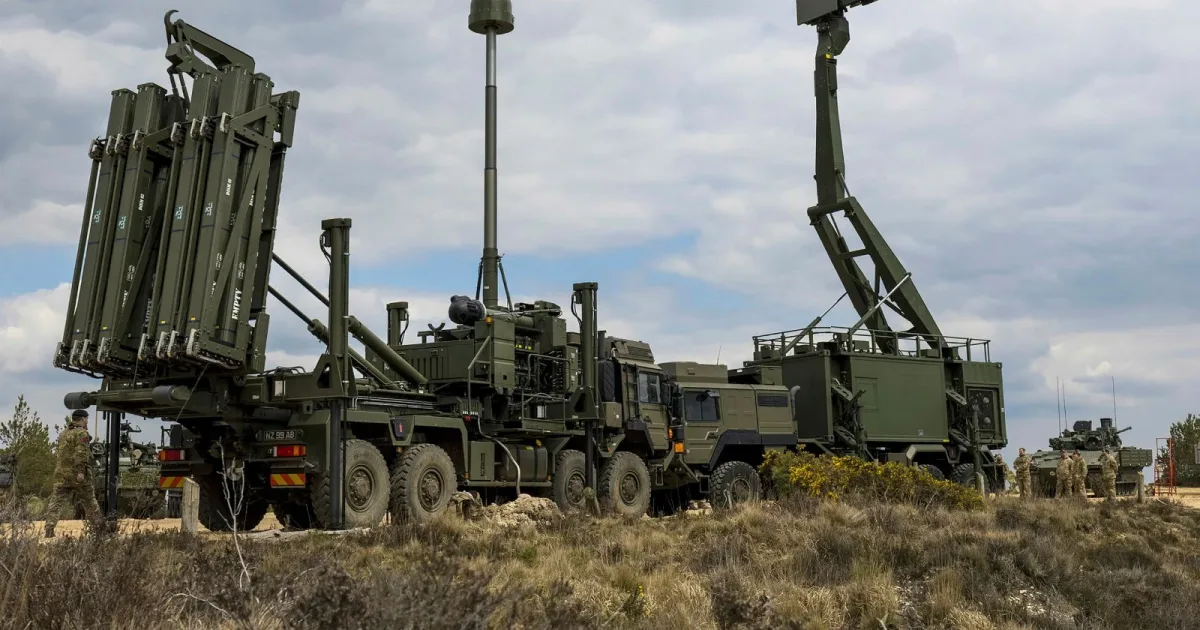
Cambridge Aerospace, established in 2024, manufactures Skyhammer, a modular low-cost interceptor designed to neutralize Shahed-style attack drones. The system has a 30km range and maximum speed of 700km/h. The company's product portfolio also includes Starhammer, a weapon aimed at faster and higher-value targets not expected to reach market until 2027, a multistatic radar system called Looking Glass, and a solid rocket motor programme named Nightstar. Skyhammer is the only product with an actual customer.
The existence of that customer is precisely what makes the valuation debatable rather than implausible. It is also what prevents independent verification of the company's worth.
What the public record actually contains
The Ministry of Defence has released five documents touching on Cambridge Aerospace, and the sequence in which they appeared matters significantly.
On March 18, the department listed Cambridge Aerospace among thirteen UK defence firms whose representatives attended a London roundtable with Gulf ambassadors and defence attachés to discuss industry support for regional partners.
On April 10, then Defence Secretary John Healey opened the London Defence Conference by announcing that the MoD intended to purchase Skyhammer missiles and launchers for the UK Armed Forces and Gulf partners. The announcement came with careful language: the initial tranche was conditional on contract completion, and the deal was described only as "multi-million pound," encompassing integration, technical support and end user training. Cambridge Aerospace chief executive Steven Barrett stated that Skyhammer had been engineered to deliver "affordable mass."
On May 1, the MoD confirmed that the contract had been signed less than two weeks prior. The announcement also noted that Skyhammer had undergone testing in Jordan under demanding desert conditions at one of Deep Element's defence development facilities, with Minister for Defence Readiness and Industry Luke Pollard present. Again, the contract was described as "multi-million-pound" with no specific figure attached.
On May 17, in a release primarily addressing a different weapon system, the department referenced the deal once more as a signed multi-million-pound contract. This marked the second confirmation of signature, and again without any numerical value.
On July 13, the MoD awarded £3.16 million to three suppliers—Frankenburg Technologies, Greenjets and Cambridge Aerospace—to develop low-cost interceptors under the Low-Cost Air Defence Effectors programme, part of a five-nation European initiative involving Poland, France, Italy and Germany. The announcement did not specify how the funding was distributed among the three companies.
The sole pound figure the MoD has attached to Cambridge Aerospace is £3.16 million, shared with two other organisations. The contract that fundamentally matters to the company's business has been announced, signed and referenced multiple times, yet never quantified.
One additional document addresses the company, though it concerns a different matter entirely. On May 19, Sir Laurie Magnus, the Independent Adviser on Ministerial Standards, published his correspondence with Sir Grant Shapps, who co-founded Cambridge Aerospace alongside Barrett and served as chairman from November 2024 until April 30 this year. Shapps had been Defence Secretary until July 2024, and his appointment had been approved on the basis that the company was civilian, with the condition that he "must not work in, or advise on, defence matters." Magnus determined that Shapps had "allowed a perception of impropriety to develop," had failed to seek updated guidance as circumstances changed, and had "failed to uphold the standards expected in the Rules." Shapps has maintained that he had no involvement whatsoever in the Ministry of Defence contract, that despite holding the chairman title he was not a company director and possessed no voting rights, and has apologised for not obtaining updated advice sooner.
Shapps's statement also reveals the procurement route. He describes being "only abstractly aware that an Urgent Operational Requirement process was nearing completion," the government's mechanism for accelerated purchasing. A search of Contracts Finder, the government's public register of award notices, yields no results for Skyhammer, the Low-Cost Air Defence Effectors programme, or any of the three suppliers. The contract value was never entered into the system where such figures are normally recorded.
Why "cheap" is the most valuable word in air defence right now
Cambridge Aerospace operates in a market born from a mathematical problem that its customers cannot solve through conventional means.
The July announcement highlighted the scale starkly: in March 2026, Russia deployed the equivalent of over 200 drones daily against Ukraine. Countering that volume with traditional interceptors creates costs that escalate rapidly. A February 2025 CSIS analysis of Russian long-range strikes estimated each Shahed at $35,000, though the authors acknowledged that estimates vary widely. The same study valued a Patriot PAC-3 interceptor at "over 3 million dollars" and a NASAMS round, an AIM-9X variant, at "slightly over 1 million dollars."
Deploying the latter against the former represents an exchange no defence ministry wishes to repeat nightly. This cost disparity forms the entire commercial argument, and every investor in the August funding round is betting on where Skyhammer fits within that gap.
Cambridge Aerospace has refrained from publishing a specific price, though it has indicated a range. At DSEI in 2025, Barrett placed Skyhammer's cost in the tens of thousands of dollars, and reporting of the April order cited him equating it to a Shahed drone at £20,000 to £30,000. Barrett has characterised the interceptors as "not only cost-effective but also highly capable." The company's public messaging, echoed in industry coverage, frames unit pricing at one to two percent of conventional interceptor costs. None of these statements constitute an actual price. When The Aviationist covered the April order, it noted that no exact unit cost for Skyhammer has been made public, and no specific figure appears in any company statement, any Ministry of Defence release or any parliamentary response.
Where this could be wrong
A private valuation represents a price that two sets of lawyers agreed upon, not an objective measurement. DFJ Growth's Randy Glein stated that the firm "surveyed the global landscape and identified Cambridge as having the best team and technology to build the most advanced and modern air defense infrastructure for Europe and its allies," a statement reflecting conviction from someone who has just taken an equity stake. This reveals something about the investor's perspective.
The government record is also more complicated than the timeline suggests. The July award release states that Cambridge Aerospace "has only recently been identified to the Ministry of Defence, demonstrating the value of widening access to new market entrants." Yet the same department had named the company in a press release four months prior and had a Defence Secretary announcing procurement intentions from a conference podium three months earlier. The most plausible explanation is that a production purchase and a development competition proceeded through different sections of a large bureaucracy and were documented separately. This represents an inconsistency in the public narrative rather than a definitive contradiction, and none of the available documents resolves it.
The CSIS figures warrant their publication date as well. They appeared in February 2025, and the paper itself acknowledges that the underlying data "was not specific enough for cost-exchange calculations," which is precisely the type of calculation that underpins a low-cost interceptor pitch. They provide useful orders of magnitude but nothing more granular.
What can be confirmed is substantial. The contract has been signed, the interceptor was tested in Jordan with ministerial oversight, deliveries were scheduled to commence in May, and the company reported more than 250 employees in August, with two-thirds working in technical and engineering capacities, distributed across the UK, Germany, Poland, Norway, Ukraine and Australia. The April announcement had stated the deal would generate over 50 new jobs and support 125 existing positions, a different metric from total headcount, so these two figures do not form a simple before-and-after comparison.
Defence Secretary Wes Streeting described the valuation as "a great vote of confidence in Britain" and connected it to a government initiative designed to develop defence startups into billion-pound enterprises. By his own logic, the scheme is succeeding, though Cambridge Aerospace does not appear among the thirteen firms that actually hold contracts under the unicorn fund. Whether the interceptor proves cheap enough to fundamentally alter the cost-exchange equation that made it fundable remains an open question, and the answer rests with the company and its customer, neither of which has disclosed a figure.
Source: Silicon Canals