Gravis Robotics claims its retrofit kits deliver "up to a 30% boost" against peak manual operation. When speaking to Inc., however, the company described the machines as having delivered "about 30 percent on multiple projects" against human-operated equipment. A researcher contacted by Inc. expressed interest in understanding what exactly was being measured.
On 17 August, Zurich-based Gravis Robotics—which attaches autonomous systems to excavators manufactured by other companies—announced that SoftBank would invest $200 million in its Series A round. SoftBank was the sole investor identified in the announcement. Inc. reported the investment valued the company at $1 billion on a post-money basis, though Gravis's own statement contained no valuation figure and avoided the term unicorn.
The investment essentially purchases a productivity claim, yet that claim emerged in two distinct formulations on the same day.
One figure, two wordings
The written announcement hedges the claim twice over. Gravis stated its understanding of its machines had "allowed us to squeeze productivity from these systems—delivering up to a 30% boost in jobsite productivity compared to peak manual operation." This phrasing sets an upper limit rather than a typical outcome, and measures against peak manual operation—a term left undefined in the release. The baseline could refer to the best performance a skilled operator achieves, or a machine's maximum throughput under manual control. These represent different benchmarks, and the release never clarifies which applies.
The version provided to a journalist was less constrained on both fronts. According to Inc., Gravis stated its machines "have delivered productivity improvements of about 30 percent on multiple projects compared with human-operated equipment." The language shifted from up to to approximately, from a reachable ceiling to achieved results across multiple projects, and from peak operation to any human-operated equipment.
Earlier versions exist from Gravis itself, phrased differently again. A November 2025 announcement described the technology as "boosting output 30%, reducing rework, and improving safety"—no ceiling, no comparison point, no defined benchmark. The March 2026 US-expansion announcement mentioned partners benefiting "by up to a 30% increase in operator productivity," introducing a third subject for the same figure, alongside "97% bucket fill rates" and "estimated annual net savings of up to $74,000+ per machine." When this publication covered the 2025 round in November, it reported the figure in the same flat manner—increases output by 30 per cent, with no ceiling or comparator—because that is how the company presented it. The underlying issue is not dishonesty. Rather, a single number has circulated for nearly a year, attached variously to output, operator productivity and jobsite productivity, yet no formulation has ever included a methodology.
What a specialist would want beside it
Vineet Kamat, a University of Michigan professor studying construction automation, told Inc. he would need additional context before assessing the figure's significance. A credible comparison, he explained, requires similarly sized machines, experienced operators, comparable site and soil conditions, and the complete workflow rather than just machine cycle time. It should also factor in "setup, supervision, rework, downtime, fuel use, maintenance, and safety performance," ideally across multiple sites and operating conditions.
Gravis has released additional numbers rather than a method. Across the company's announcements from November 2025, March 2026 and August 2026, plus the news coverage they generated, there is no baseline definition, no project count, no measurement duration and no identified measurer. No customer or third party has placed its own figure on record. Morgan Sindall Construction, cited in the 2025 announcement, described the robotic excavator as "as productive as a skilled machine driver – and in some instances, enhanced team efficiency," which expresses an impression rather than a measurement. The closest to independent verification comes from an investor: Archie Muirhead of IQ Capital, which participated in the 2025 round, told EU-Startups that Gravis's technology is "already delivering measurable productivity gains on live projects across four continents"—measurable, but without the measurement itself.
Kamat's assessment of the technology itself is not negative. He told Inc. that excavation presents a harder robotics challenge than moving goods through a controlled warehouse, since it occurs in "an unstructured, constantly changing environment" where soil, weather, slopes, buried utilities, workers and other machines shift rapidly enough to demand safety-critical decisions in real time.
Chief executive Ryan Luke Johns is clear that removing the operator from the cab is not the company's proposition. "It's not about taking operators out of the machine," he told Inc. "It's about getting machines to be 30 percent more productive, to get an operator to drive multiple highly productive machines." One person managing a fleet remains a labor story, but a different one from full automation.
What Gravis sells
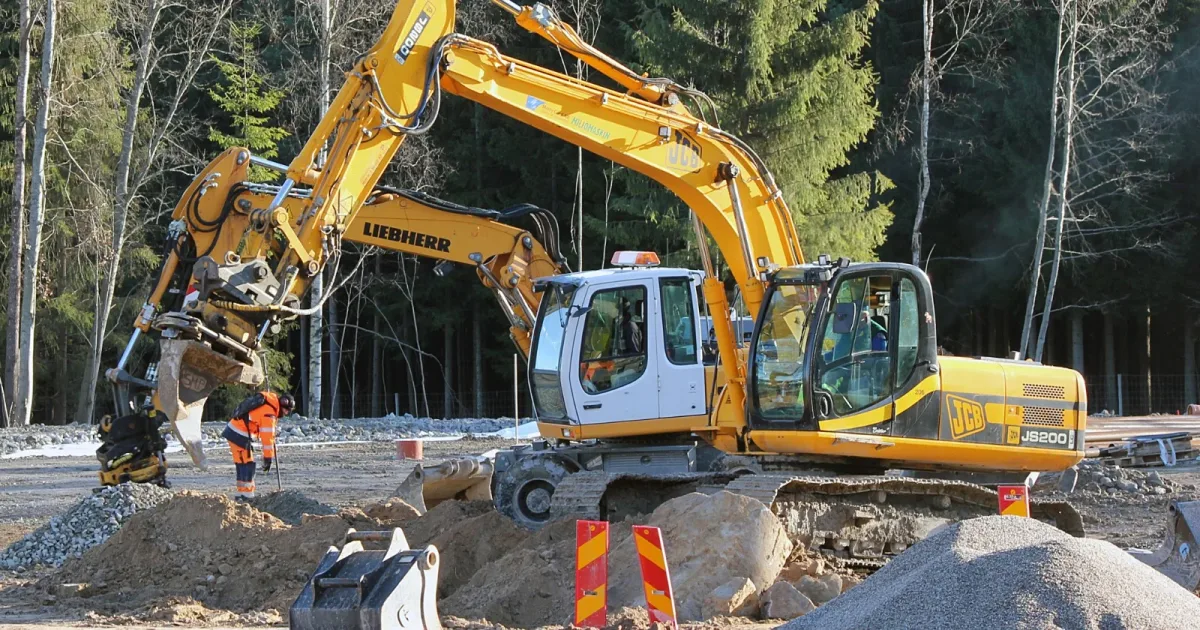
The Gravis Rack is a package of sensors, computing hardware and software that attaches to machines contractors already own. The announcement lists nine manufacturers whose equipment has carried it—Caterpillar, Case, Develon, John Deere, JCB, Hitachi, Sumitomo, Yanmar and Volvo—plus "and more." Johns told Inc. the Rack has been adapted across more than a dozen brands, makes and models. The company's rationale for retrofitting rather than manufacturing combines commercial and philosophical reasoning: the announcement notes that roughly two thirds of global demand for heavy equipment lies outside the top three makers, and contends that contractors "shouldn't be forced into a closed, single-brand ecosystem."
Gravis emerged from ETH Zurich in 2022. Johns serves as chief executive and co-founder, Dominic Jud as chief technology officer and co-founder, and Marco Hutter, a robotics professor at ETH, as co-founder and board member. Inc. estimates the company at roughly 75 people with systems on four continents, and quotes Johns saying digging represents about 70 percent of what the machines perform. Inc. also reports Gravis expecting to be live in seven countries by November. Both details originate from the company: its November 2025 announcement stated it was "live in seven countries across the UK, EU, US, LATAM and Asia," and its March 2026 announcement said machines were "already deployed across infrastructure and materials projects in seven countries." Seven has been Gravis's stated position since November 2025, matching what Inc. reports as its target for November 2026.
The Gravis Copilot mode keeps the operator in the cab with live 3D guidance and hazard detection. Full autonomy mode removes the operator entirely. Johns cited a recent example from Texas where machines worked "from the start of the day until the lunch break without any intervention at all."
In July, SoftBank was weighing an acquisition
Twenty-four days before the announcement, on 24 July, Bloomberg reported that SoftBank was evaluating an acquisition of Gravis in a deal that "could ultimately value" the company at more than $500 million. According to sources familiar with the discussions, no final decisions had been reached on deal size or structure. Both Sifted and Inc. covered the acquisition report; Sifted alone included the detail about no decisions being finalized. The Bloomberg original is behind a paywall and has not been reviewed.
What was announced instead was a minority investment at a reported $1 billion post-money valuation. The natural reading is that the valuation doubled in three and a half weeks, but the arithmetic requires care. "More than $500 million" establishes a floor rather than a specific figure, and describes what a deal "could ultimately" reach, not a price anyone agreed to. The $1 billion post-money figure includes SoftBank's own $200 million investment. Neither number originated from Gravis, and no straightforward multiple can be calculated from them.
The record it broke was 34 days old
Gravis characterizes this as the largest Series A in construction robotics history. Superlatives in press releases are easily surpassed, so it merits checking what the record actually shows: nothing that contradicts the claim. The largest prior Series A found in the sector is TerraFirma's $100 million led by Kleiner Perkins, announced on 14 July 2026 as part of a roughly $115 million total—some outlets treat the entire $115 million as the Series A, which does not change the record but does shift the sector total. Bedrock Robotics emerged from stealth in July 2025 with $80 million across seed and Series A combined. Built Robotics has raised $112 million. Teleo's Series A in 2022 was $12 million. The claim holds, and it displaced a record set just 34 days earlier.
The category definition does significant work, however. Bedrock Robotics, founded by former Waymo employees and building a retrofit kit to convert standard excavators into autonomous machines, raised $270 million in February 2026 at a $1.75 billion valuation, co-led by CapitalG and the Valor Atreides AI Fund. More capital, a higher valuation, six months earlier, for a nearly identical product description. Round numbers reflect accounting conventions, not actual size, and the record is drawn narrowly enough to exclude the best-capitalized company pursuing the same objective. Looking at headline rounds only, these three companies have raised roughly $570 million between February and August, or $585 million if TerraFirma's full $115 million is included—a deliberately round sum either way, since cumulative totals would involve double-counting. Caterpillar, whose machines Gravis retrofits, has separately unveiled autonomous excavators, loaders, dozers, haul trucks and compactors.
The underlying demand is not contested. Global construction generated about $13 trillion of output in 2023 according to McKinsey, while construction productivity rose roughly 10 percent between 2000 and 2022 against about 90 percent in manufacturing. Labor shortages present another constraint: Associated Builders and Contractors estimates the US industry needs 349,000 additional workers in 2026. Johns says Gravis now has "quite a few" machines on data-center projects, alongside highways, utilities, oil and gas work and quarries. Kamat anticipates autonomy will first spread through repetitive, clearly defined operations before reaching complicated mixed-fleet sites, which roughly matches that sequence.
What is checkable here, and what is only announced
Some elements are more solid than coverage suggests. The kit exists and is fitted to machines from named manufacturers. Customers and partners are identified by name. And a public funder backs a trial: Flannery Plant Hire, one of Britain's largest heavy-equipment rental companies, and Gravis received funding under the UK government's first CAM Pathfinder: Enable competition, for a project testing the system across six excavators on trenching, bulk excavation and truck loading. Gravis values the project at $8 million and says it leads it; the programme's own announcement on 10 August provides no figure and describes the project as led by Flannery and Gravis Robotics. Either way it represents money for demonstration rather than purchase, and it is separate from the commercial arrangement the two companies also operate, under which contractors can rent excavators already equipped with the Rack.
Three matters are less certain. Whether the round has actually closed: the release's headline says Gravis "Raises" $200 million while its body states SoftBank "is investing" it, Inc. says Gravis "is raising" the money, and Engineering News-Record headlined the round as being set for the company though its own text says Gravis "has secured" it. Announced, signed and funded represent three distinct states and no source on record distinguishes between them.
The valuation: the $1 billion comes from press reporting, not company disclosure, and the EUR 862 million figure in European coverage is a currency conversion of it—a number that clears a billion in dollars and does not in euros. Gravis links to the Inc. article from its own announcement page, so it is not rejecting the figure. It has not published it either.
And the productivity figure, which is where this began. It is company-reported, it appeared in two wordings on one day, it has a third and simpler life in earlier coverage including our own, and the only specialist on record has outlined what a credible version would require. An obvious source exists to supply an independent number and it is compromised: Holcim, named among Gravis's customers and partners, is also an investor. Taylor Woodrow and HD Hyundai do not appear on any Gravis investor list we could locate, and either could report what the Rack accomplished on a schedule. Until one of them does, or the UK trial publishes results, the 30 percent remains a figure with three versions and no supporting calculation behind any of them.
Source: Silicon Canals