Open Cosmos, a European space infrastructure company headquartered in Harwell, Oxfordshire, has closed a €300M funding round to accelerate satellite mass manufacturing and build out connectivity and data services layered on top of its own constellations. Lightrock led the investment, with participation from ETF Partners, Institut Català de Finances, Entrepreneurs First, two international pension funds, Convex Group, the UK's National Security Strategic Investment Fund, Phoenix Court and Claret Capital Partners.
Founded in 2015, Open Cosmos designs, builds and operates complete satellite missions. Its product suite—OpenOrbit, ConnectedCosmos, OpenConstellation and DataCosmos—delivers secure communications, Earth observation and real-time intelligence to governments, institutions and businesses. The €300M raise represents roughly six times the $50mn the company secured in its previous round. Open Cosmos reports five consecutive years of profitable growth and has signed more than $370mn in contracts over three and a half years.
The company claims manufacturing capacity of one satellite per day across its four factories and maintains a 100% mission success rate. Its next-generation OpenConstellation satellites have reduced Earth observation intelligence delivery from up to 48 hours to as little as 30 minutes by using onboard AI processing and satellite-to-satellite links, eliminating the need to wait for ground station passes.
Open Cosmos designed, built and launched its first ConnectedCosmos satellites within two and a half months of securing Ka-band spectrum filings—a pace that stands out as notably rapid for European space ventures. The company's architecture comprises four components: OpenOrbit handles spacecraft design, construction and operations; OpenConstellation enables governments to share infrastructure rather than each funding independent systems; ConnectedCosmos supplies sovereign broadband and IoT connectivity; DataCosmos converts imagery into actionable intelligence.
The company illustrates its capabilities with a practical scenario: a satellite detects a temperature anomaly over a forest, classifies it onboard as a probable fire, and transmits the alert directly to firefighters in areas where terrestrial networks are absent. This operational dimension underscores the sovereignty argument beyond theoretical discussion. Europe's recent policy debates on sovereign infrastructure have centred largely on American suppliers offering local deployment of their systems. A shared constellation built and operated within Europe, with backing from a UK national security fund, presents a distinct model.
Market conditions favour the company's expansion. Global venture investment in space reached $11.3bn in the first half of 2026, surpassing the $10.1bn recorded across the entirety of 2025. European governments have shifted from viewing satellites as scientific endeavours to treating them as essential infrastructure. Shared-constellation economics appeal to smaller nations because building independent sovereign capability remains prohibitively expensive—a distinctly European proposition that differs fundamentally from Starlink's approach.
Space infrastructure is becoming as critical as energy, digital networks and transport. Governments and enterprises increasingly require secure communications and operational data delivered through resilient systems. But infrastructure alone isn't enough. The real value comes from the intelligence that relays what's happening on Earth in real time and the global connectivity to deliver it.
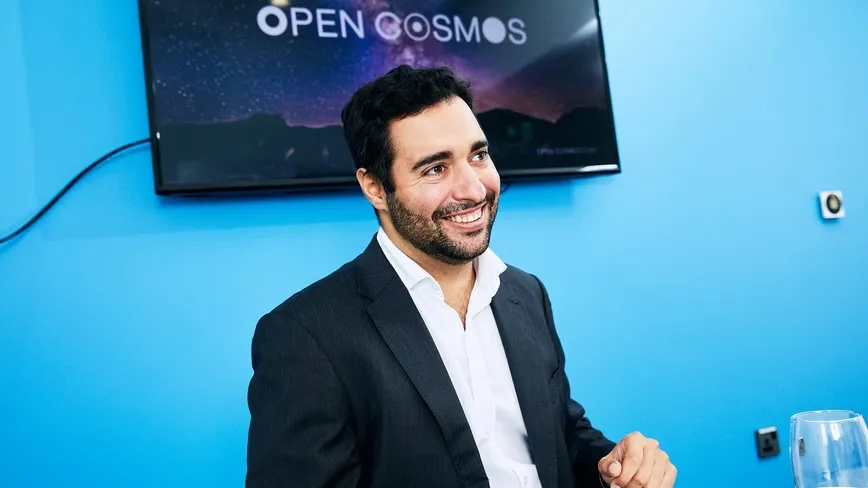
Rafel Jorda Siquier, Founder and CEO of Open Cosmos
Saul Klein of Phoenix Court characterised the achievement more directly, emphasising that European founders equipped with adequate time and capital can compete with the world's leading companies. While such statements are standard at European funding announcements, Open Cosmos's financial performance lends credibility to the claim.
Rafel and the team have spent a decade turning world-class science and engineering into real industrial capability, building a profitable space company that can manufacture satellites at scale and deliver critical sovereign infrastructure. When we give ambitious founders the time and capital to build, Europe can challenge the best in the world, and the proof is right here in Open Cosmos.
Saul Klein, co-founder and executive chairman of Phoenix Court
Source: The Next Web