Georgia's startup landscape remains largely invisible to outsiders. Search for information about the country's leading companies, its investor base, or the strength of its venture ecosystem, and you'll find surprisingly little. Yet beneath this low profile lies a different reality entirely. StartupBlink data shows Georgia hosts 131 startups, with the ecosystem expanding by 78% in the past year—a growth trajectory that ranks among the region's fastest.
Over the past decade, Georgia has systematically constructed its innovation infrastructure. The Georgia Innovation and Technology Agency (GITA), operational since 2014, has channeled more than $14 million into approximately 240 startups while establishing a network of ten technology parks across the country. These parks function as gathering spaces for entrepreneurs, researchers and capital providers. The country has also streamlined business registration to under thirty minutes and introduced the Virtual Zone Person status, which grants substantial tax advantages to qualifying technology exporters.
This deliberate positioning has begun attracting international venture players seeking regional footholds. Among the most significant arrivals is 500 Eurasia, the regional division of Silicon Valley-based 500 Global, which has made Tbilisi a nexus for founders and investors spanning Central Europe, the Caucasus and Central Asia.
Building a regional startup network
Through 500 Eurasia, the venture firm has deepened its regional engagement, partnering with startups and public institutions to strengthen the local innovation ecosystem. The firm's first regional investment occurred more than a decade ago. Its current iteration, operating through 500 Global (Eurasia), collaborates with GITA and Bank of Georgia to connect entrepreneurs from the Baltics, the Balkans, the Caucasus and Central Asia.
Eurasian founders inherently build for fragmented markets from day one. Unlike Silicon Valley/US founders who scale domestically first, these entrepreneurs develop cross-cultural product adaptation as a core competency — essential for global expansion.
Pedro Santos Vieira, Partner at 500 Global
The accelerator's value extends beyond its twelve-week mentorship cycle. Participants gain introductions to global investors, invitations to major conferences including Web Summit and SLUSH, and access to one of Silicon Valley's most extensive founder networks. For entrepreneurs from this region, these connections have historically represented a critical missing piece: a tangible pathway to international markets.
Building beyond domestic markets
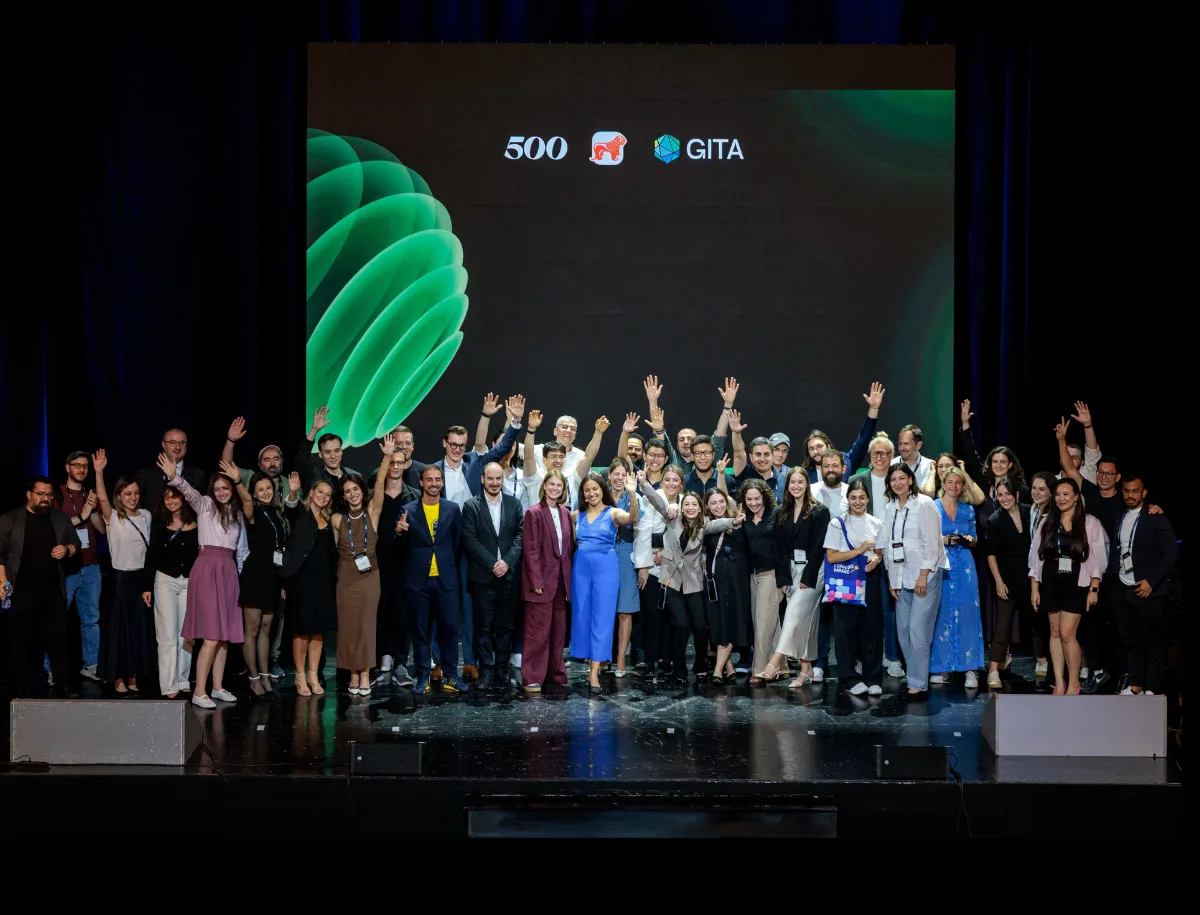
In June, Tbilisi's historic Rustaveli National Theatre transformed into a startup stage as 500 Global Eurasia held its Batch 10 Demo Day. The venue drew startup founders, venture capitalists, operators and ecosystem builders from nearly 30 countries across Central Europe, the Caucasus and Central Asia. The nine presenting companies spanned automated penetration testing, AI-powered debt collection, customer intelligence, restaurant workforce management, clinical trial recruitment and financial compliance—a landscape where artificial intelligence featured in most offerings.
A notable pattern emerged: the founders were not primarily seeking capital. Instead, they showcased traction, expansion strategies and acquisitions of other companies. Many had spent years inside the industries they now sought to transform—managing restaurant chains, scaling bootstrapped operations through conflict and economic instability, collaborating with medical professionals, leading digital transformation initiatives or developing enterprise software long before generative AI became mainstream. For most, technology was rarely the starting point.
Vadym Bortnyk, co-founder of MaiCall, exemplifies this pattern. His path began not with a tech insight but with family legacy. He grew FreshLine into a restaurant chain spanning more than 50 locations across Ukraine, Belarus and Kazakhstan, selling over 15 million sandwiches. After leaving hospitality, he led the Directorate of Regional Digitalisation at Ukraine's Ministry of Digital Transformation, coordinating reforms across more than a thousand municipalities. He then moved into fintech, managing online lending operations in Sri Lanka and Mexico, overseeing roughly 30,000 loans monthly and supervising a team of 170 debt collectors.
My mom is a mathematician, my dad is an entrepreneur, and they ran a sewing factory and a restaurant. From the age of five, I grew up inside their businesses.
Vadym Bortnyk, co-founder of MaiCall
Within that lending environment, Bortnyk observed something most would overlook: machine learning recovers debt more effectively than human collectors. This observation became MaiCall, an AI-powered collections platform reimagining debt recovery. Initially, the company struggled to articulate its differentiation. During the accelerator, mentors pushed the team to focus on what customers genuinely valued: recovering money. As Bortnyk reflects, "We came in selling software. We walked out delivering money."
Experience before disruption
The startup mythology celebrates garage origins. Several Tbilisi founders would likely challenge that narrative. None described a sudden eureka moment or late-night brainstorming revelation about AI's transformative potential. Instead, their companies emerged from years spent observing industries so entrenched in inefficiency that few questioned the status quo.
Mariam Kharazishvili, co-founder of Clinova, arrived at healthcare through an unexpected route. Her previous venture created augmented reality environments for brands. One client operated clinical trials, an assignment that exposed her to a world rarely visible outside pharmaceutical research.
Hospitals spend at least half a year manually reading thousands of handwritten records just to start a trial. And eighty percent never finish recruitment in time.
Mariam Kharazishvili, co-founder of Clinova
The timing proved significant. McKinsey data reveals that trial sites in emerging markets increased from 49% during 2005–2014 to 65% between 2015 and 2024. Pharmaceutical developers were expanding beyond traditional markets, drawn by lower costs and more diverse patient populations. The demand for efficient recruitment and data infrastructure intensified accordingly. "The market exploded," Kharazishvili observes. "The infrastructure didn't."
When Clinova entered the accelerator, the company was primarily focused on CIS countries. By Demo Day, the strategic conversation had shifted toward Saudi Arabia and the broader Middle East, where governments have designated healthcare digitisation and biotechnology as national priorities. Mentors repeatedly challenged the team's enterprise sales approach, questioning whether founder-led selling could scale within an industry characterized by multiple decision-makers, lengthy procurement cycles and risk-averse institutions.
500 kicked exactly where it hurt most. And that's what good mentorship does.
Mariam Kharazishvili
Rather than defending their original strategy, the team rebuilt it entirely. They emerged with a refined ideal customer profile, a structured sales process, and an approach that substantially shortened their sales cycles. "The market found us before we found it," Kharazishvili says. "Our focus over the next six months is deploying Clinova across a minimum of five hospitals in Saudi Arabia, alongside expanding market coverage in Georgia. That's the only milestone that matters."
Rethinking the growth strategy
Alina Golubieva arrived at the accelerator with substantial entrepreneurial credentials already established. Before launching Karpatia Benefits, she had spent more than a decade building businesses. One scaled from three employees to one hundred and twenty, generating $15 million in revenue without external funding—growth that accelerated during Covid-19 and persisted through Russia's full-scale invasion of Ukraine.
Karpatia Benefits itself originated from a straightforward observation: companies genuinely wanted to support employee wellbeing, yet the systems delivering those benefits remained trapped in spreadsheets, email chains and manual processes. HR teams invested countless hours managing workflows that employees scarcely noticed.
What I enjoy most is taking something painful and bureaucratic and making it feel simple.
Alina Golubieva, CEO & Co-founder at Karpatia Benefits
This philosophy contrasts sharply with venture capital's typical hyperbole. It also reflected a consistent theme among several cohort founders, many of whom prioritized solving specific problems over disrupting entire industries. Yet even for someone with years of entrepreneurial experience, the accelerator introduced unfamiliar thinking patterns. "Before 500 Global," Golubieva explains, "I built businesses on classic bootstrap logic. Grow within your cash flow. Keep operations tight. Protect what you're building."
Venture-backed companies, she discovered, operate according to different principles. "The program was my first deep exposure to what building for hyper-growth actually looks like. It's a different way of thinking about market pull, focus and speed." However, she resists the notion that founders should discard everything learned before venture capital. Her perspective reflects how startup financing itself has evolved.
My takeaway isn't 'grow at any cost.' It grows fast, but keep enough ground under your feet to navigate what's happening around you.
Alina Golubieva
Nurdias Aitbayev, co-founder of MyBots.pro, experienced similar recalibration. His company initially positioned itself as a chatbot platform. During the program, mentors encouraged the team to expand beyond individual AI tools and instead construct an AI workforce platform serving SMBs and enterprise teams.
We fundamentally changed our approach to sales and marketing, and the results speak for themselves: 12 weeks of work in the program led to 2x revenue growth.
Nurdias Aitbayev, CEO & Co-founder of MyBots.pro
"Perhaps the biggest difference is that we started thinking globally," he adds.
Learning to think bigger
Umid Akhmedov returned to Demo Day as a 500 Eurasia alumnus, having completed the accelerator previously. For him, the program's most difficult lesson arrived as unfiltered criticism. After more than fifteen years in corporate roles at Saxo Bank, Ørsted, Microsoft and Danske Commodities, he encountered feedback delivered with unusual directness.
My six-year-old would be able to make a better slide than you.
Umid Akhmedov, CEO & Co-founder of Tezbor
In the corporate world, feedback arrives wrapped in three layers of diplomacy. In the startup environment, it arrives raw and direct.
Umid Akhmedov
The critique didn't alter his strategy or product. Instead, it produced something more fundamental: it removed the corporate veneer. Since presenting at Demo Day eighteen months prior, Tezbor has substantially transformed. The company pivoted from coordinating individual couriers to developing software for logistics companies, expanded operations in Kazakhstan, and secured its first paying European customers.
Momentum accelerated with the acquisition of Fargo, one of Uzbekistan's most prominent logistics companies. This deal doubled the startup's monthly recurring revenue while expanding its delivery network. Tezbor has also secured investor commitments from SQB Ventures, Orbit Ventures and a Danish angel investor as part of an ongoing $1 million seed round.
"Operationally, we're targeting roughly a doubling of monthly revenue and active clients, and a tenfold expansion of our parcel shop presence in Uzbekistan (around 1,400 shops) with the utilization discipline baked in from day one this time," Akhmedov explains.
Building companies before they build startups
Whether any Tbilisi presenter becomes the region's next unicorn remains uncertain. What appears increasingly clear is the caliber of founders Georgia is assembling. A new generation arrives with expertise accumulated long before launching startups—from running established businesses, directing digital transformation initiatives, or working within the industries they now aim to improve.
If Georgia continues attracting these founders, its impact may transcend producing a single unicorn. It could cultivate a regional network of entrepreneurs already building across borders.
The 500 Global Accelerator Program in Eurasia combines in-person and remote phases emphasizing growth, fundraising and product-market fit. Participating founders receive mentorship, access to a regional founder community, and the opportunity to secure up to $100,000 in funding. The program accepts applications on a rolling basis, with its 11th cohort beginning in September 2026.
Source: The Recursive — Events tag