The trajectory of Cursor's revenue expansion presents a narrative that strains credulity. Yet the underlying accounting remains opaque, leaving fundamental questions about profitability and long-term viability unresolved.
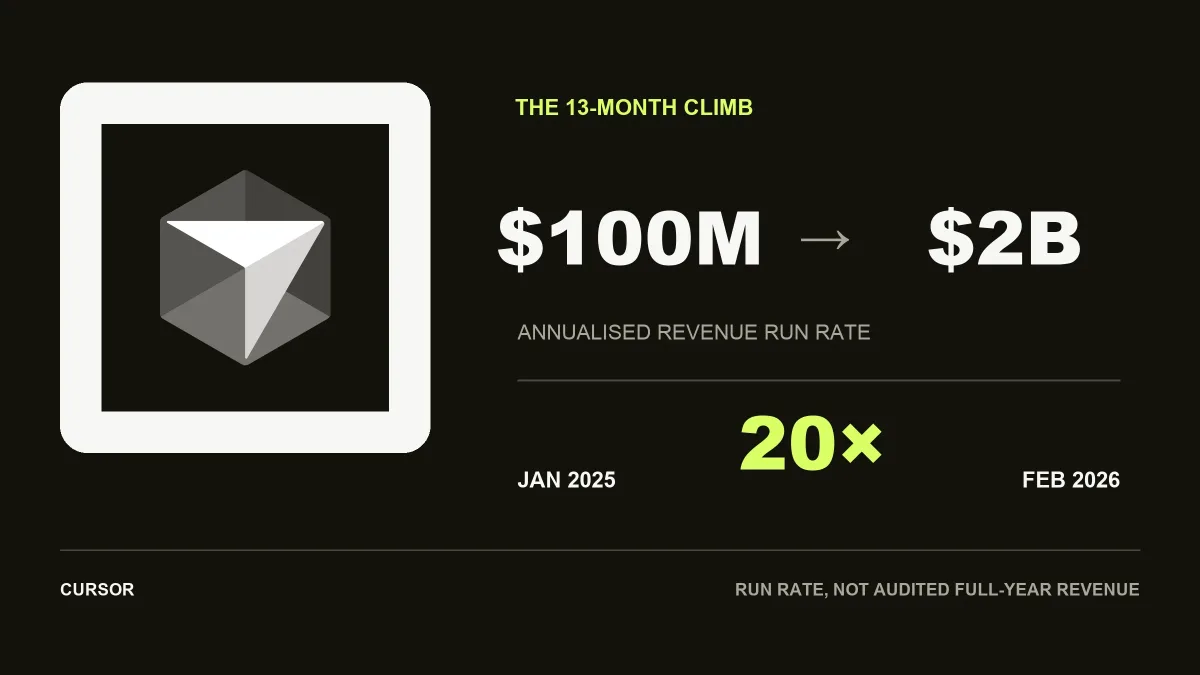
During January 2025, the AI-powered code editor reached $100 million in annual recurring revenue. Within thirteen months, Bloomberg reported its annualised revenue run rate had climbed to $2 billion. The multiplication is straightforward: a twentyfold expansion.
The accounting picture, however, proves considerably more intricate. Neither figure represents cash actually collected over a 12-month span, and the $2 billion claim arrived without audited financial statements. Instead, it originated as a private-company run-rate projection attributed to someone with knowledge of the business.
This distinction does not diminish the expansion's significance. Even accounting for these qualifications, transitioning from nine-figure revenue velocity to a $2 billion pace across 13 months represents exceptional momentum in the software sector. The growth trajectory substantially exceeded the early expansion rates publicly documented for both Slack and Zoom.
The $2 billion milestone, however, has already become historical. A subsequent report indicated Cursor had reached a $4 billion annualised run rate by June 2026. The $2 billion figure functions best as a single waypoint along a striking growth curve, rather than as a current assessment or a completed fiscal-year outcome.
The 13-month climb
Sacra documented in February 2025 that Cursor had achieved $100 million ARR in January. The outlet's assessment suggested the company had generated approximately $1 million ARR merely 12 months prior, though that earlier figure also represented an estimate rather than a verified public disclosure.
By June 2025, industry reports positioned Cursor at $500 million. The company itself then furnished the subsequent concrete measurement. Upon announcing a $2.3 billion Series D on 13 November 2025, Cursor disclosed it had surpassed $1 billion in annualised revenue.
On 2 March 2026, TechCrunch relayed Bloomberg's account that the figure had doubled to beyond $2 billion during the preceding three months. Cursor declined to provide an immediate response to TechCrunch's inquiry for verification.
Collectively, these markers trace a curve whose steepness intensified as values climbed: $100 million in January 2025, roughly $500 million in June, exceeding $1 billion in November, and surpassing $2 billion by February 2026.
A twentyfold expansion across 13 months translates mathematically to approximately 26 per cent compounded expansion each month. This represents a mathematical characterisation, not a projection. No reasonable interpretation should presume a company can sustain such compounding indefinitely.
What "annualised revenue" actually means
Run rate projects a current period forward to estimate a hypothetical complete year. Should a company generate revenue at a monthly pace of roughly $167 million, multiplying that velocity by 12 yields approximately $2 billion.
This metric proves valuable when expansion outpaces the relevance of the most recent finished year in capturing present business scale. It also presents an advantageous perspective for organisations whose latest month substantially surpasses prior months.
Run rate diverges from revenue acknowledged under standard accounting principles across a finished 12-month window. It does not illuminate seasonal patterns, likelihood of customer renewal, potential usage decline, or what portion of existing velocity derives from transitory promotions.
Cursor and reporting surrounding it have employed "annualised revenue" and ARR somewhat synonymously. Within subscription enterprises, ARR typically denotes recurring contract value. An annualised revenue run rate can encompass broader categories, particularly when usage-based charges fluctuate. Without access to underlying financial records, the precise breakdown remains undisclosed.
The most straightforward characterisation is consequently the least sensational: by February 2026, Cursor was reportedly producing revenue at a velocity that would approximate more than $2 billion annually if that pace persisted.
Slack and Zoom took longer, but the comparison has limits
Slack and Zoom function as logical reference points because each transformed a straightforward workplace application into a substantial software enterprise via organic user adoption. Their public filings, nonetheless, disclose finished fiscal-year revenue rather than private run-rate projections.
Slack's 2019 S-1 filing documented revenue of $105.2 million, $220.5 million and $400.6 million across fiscal years concluding in January 2017, 2018 and 2019. Over two years, the company advanced from approximately Cursor's initial scale to roughly quadruple that magnitude.
Cursor's reported run rate expanded from $100 million to five times that level in roughly five months, then to twenty times it within 13 months. Based on the disclosed figures alone, the acceleration demonstrated substantially greater velocity.
Zoom's annual report covering the year ended January 2021 illustrates a distinct pattern. Revenue climbed from $151.5 million to $330.5 million and subsequently $622.7 million across three fiscal years preceding the pandemic-accelerated period when it reached $2.65 billion.
Zoom therefore progressed from the low hundreds of millions to exceeding $2 billion in annual revenue across approximately three fiscal years, with substantial assistance from an extraordinary worldwide circumstance. Cursor's reported run rate traversed a comparable range in approximately 13 months.
This observation substantiates the specific assertion that Cursor expanded with greater speed. It does not render the figures equivalent. Slack and Zoom were submitting recognised revenue conforming to public-company accounting standards. Cursor was disclosing or being reported through annualised private-company projections. The comparison concerns velocity, not accounting comparability.
Why a coding tool could grow this quickly
Cursor operates within a task developers perform repeatedly during each working day. An effective coding assistant does not require weekly activation. It can integrate into code composition, navigation, problem diagnosis and assessment, generating numerous occasions to demonstrate utility.
The offering additionally possessed a streamlined pathway into organisations. Individual programmers could embrace it without substantial institutional friction. As adoption expanded, Cursor could then commercialise administrative, protective and collaborative capabilities to the sponsoring company.
This grassroots strategy eventually intersected with institutional purchasing power. Per Bloomberg's reporting as summarised by TechCrunch, large enterprise purchasers represented approximately 60 per cent of Cursor's revenue upon reaching the $2 billion run rate.
Enterprise-level revenue can accelerate expansion dramatically because a single transaction may encompass hundreds or thousands of seats. Institutional clients additionally demonstrate reduced inclination to abandon established tools over minor pricing variations once integration, compliance procedures and operational processes are embedded.
Timing played a consequential role. Cursor emerged as enterprises were distributing fresh capital toward generative AI, and as capable general-purpose models became accessible through application programming interfaces. The company could construct a product layer atop those models without absorbing the complete expense of training every foundational model independently.
None of these circumstances ensures permanence. They illuminate why revenue could accumulate with unusual rapidity throughout a window of concentrated purchasing appetite.
The revenue figure leaves out the expensive part
Conventional software accommodates each supplementary customer at negligible incremental expense. AI-driven coding products operate differently because each query, model-generated response and autonomous operation consumes computational model processing.
Cursor may procure that processing from model suppliers, operate certain models internally, or employ a hybrid approach. The disclosed run-rate figures do not specify the composition. They equally withhold gross margin information, the magnitude of subsidised intensive usage, or how computational expenses evolve as customers request increasingly sophisticated functionality.
This renders revenue composition significant. A dollar of subscription income carrying elevated and predictable gross margin does not represent the identical economic value as a dollar requiring substantial, fluctuating expenditure on third-party model services.
The disclosed metrics additionally communicate little regarding customer persistence, revenue concentration or negotiated reductions. A substantial enterprise proportion can reinforce revenue stability, yet it can simultaneously create vulnerability to a smaller quantity of significant contract renewals.
Competitive forces emerge from Anthropic's Claude Code, OpenAI's Codex, GitHub Copilot and additional coding applications. Programmers can shift preferences with relative ease, whereas enterprises proceed with deliberation. Cursor's movement toward corporate relationships may function simultaneously as a growth mechanism and protection against unpredictability in the individual developer market.
These observations do not suggest revenue weakness. They represent the inquiries a run-rate headline cannot adequately address.
The $2 billion milestone was already out of date
By the moment the $2 billion figure had become embedded in industry discourse, Cursor was reportedly advancing further. Forbes disclosed on 8 June 2026 that annualised revenue had climbed to $4 billion, ascending from $3 billion in late April and $2 billion in February.
That subsequent report similarly represented a run-rate assertion, not an audited complete-year outcome. It warrants examination with equivalent scrutiny. It does, nonetheless, establish that the 13-month progression from $100 million to $2 billion constituted merely one phase of the acceleration.
Capital raising followed a parallel trajectory. Cursor's November 2025 funding round assigned the company a $29.3 billion valuation. Subsequent fundraising discussions connected progressively greater valuations to it. A valuation expresses what investors consented to disburse for an ownership percentage under specified circumstances. It does not constitute a determination regarding eventual profitability or enduring competitive position.
Revenue expansion and capital accessibility can strengthen one another. Increased sales justify a higher valuation; additional funding finances model processing, enterprise business development, product innovation and computational infrastructure; those investments can catalyse additional sales. This cycle persists until expansion, profitability or investor confidence shifts.
What the 13 months really show
Cursor's progression ranks among the swiftest software revenue expansions on record because the documented waypoints are unusually concentrated. Even permitting for run-rate accounting, private reporting and an artificial intelligence spending surge, relatively few software enterprises have transitioned from $100 million to a multibillion-dollar velocity in marginally beyond a year.
The reference to Slack and Zoom carries value precisely because those organisations once appeared exceptionally rapid. Their filings illustrate the typical duration required for a celebrated workplace solution to convert initial user enthusiasm into hundreds of millions in yearly sales.
Cursor compressed that progression by embedding itself into a routine technical activity, leveraging individual programmers as an entry mechanism, penetrating large enterprises and arriving when purchasers possessed fresh allocations for artificial intelligence.
What the figures have not yet demonstrated proves equally consequential. They do not substantiate a complete year of $2 billion transactions, let alone $4 billion. They do not communicate profitability levels, renewal dependability or the continuing expense of supporting progressively capable coding agents.
The unvarnished account remains noteworthy nonetheless. Cursor did not simply expand with velocity. It attained a reported revenue velocity in 13 months that preceding software titans required years, and in Zoom's situation a once-per-century demand phenomenon, to approximate. The outstanding inquiry concerns whether the operational economics supporting the curve can prove as resilient as the curve itself is dramatic.
Source: Silicon Canals