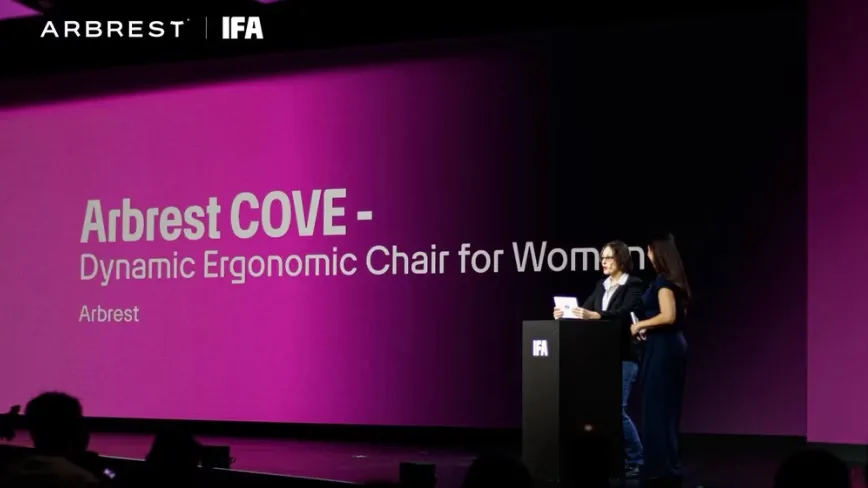
The stage at IFA Berlin 2026 became a place to test what most office chairs treat as aberrations. ARBREST unveiled COVE, its inaugural offering, by putting it through a sequence of everyday movements: leaning into work, rotating the torso, shifting weight, tilting backward. The chair earned an IFA Best of Design award for the effort. Displayed at Hall 2.2, Stand 141, the demonstration carried a message that extended beyond the product itself: the human body does not hold a single shape during work, yet support typically vanishes the moment posture changes.
COVE represents ARBREST's entry into the ergonomic chair market, though the company frames itself more broadly as a smart lifestyle technology brand. The founding principle is to address genuine gaps in how work and daily life are supported—gaps that existing furniture has largely ignored. Rather than layering technology visibly onto products, ARBREST aims to let it operate quietly in the background. The chair is positioned as the company's opening statement, not its entire vision.
Rethinking the Reference Body
The impetus for designing COVE stems directly from how conventional office furniture is engineered. Most chairs begin with a standardized body model, then attempt to accommodate variation through adjustment mechanisms. This hierarchy creates predictable casualties: users with smaller frames find themselves compensating for seats cut too deep, lumbar supports positioned out of reach, armrests spaced too far apart, or feet dangling above the floor. Women's bodies vary as much as any population, yet the category has historically treated their dimensions as optional refinements rather than design priorities. ARBREST inverted that sequence, making smaller frames—and specifically women's proportions—a starting point rather than an afterthought.
The 7-Point Fit Calibration anchors COVE's approach. Rather than adjusting individual components in isolation, the system considers seat height, width, depth, lumbar support, armrests, headrest and footrest as an integrated whole. The chair accommodates users between 150 and 175 centimetres tall, with seat heights ranging from 46 to 54 centimetres and seat depths from 43 to 49 centimetres. The goal is to establish proper proportions from the outset, reducing reliance on post-purchase tweaking to correct fundamental mismatches.
Details Built Around Actual Bodies
The seat itself follows a deliberate structure. A reinforced sit-bone region creates a stable foundation. The pelvic area contours to match the body's natural shape, while a tapered front edge aims to minimize pressure concentration on the thighs. A dual-tier active footrest bridges the distance between leg length and seat height—solving a chronic problem where unstable positioning in the legs, pelvis and lower back forces users into constant micro-adjustments seeking equilibrium.
Peripheral details reveal the same user-centered thinking. The 3D Winged Headrest provides space for ponytails and textured hairstyles when reclining. Touch controls feature wide surfaces suited to longer fingernails. The 5D armrests track elbow movement as the user types, reads, browses or turns to speak—following the arm rather than forcing it into a fixed angle. None of these elements revolutionizes the category independently. Collectively, they signal that the chair was conceived around how people actually work, not around an idealized diagram of posture.
Movement as a Design Feature
The mechanical systems make movement central to the design logic. COVE's multi-axis forward-tilt chassis tilts to 16 degrees, enabling users to shift closer to the desk without perching precariously on the seat edge. The footrest continues its support throughout the motion. The point is not to showcase maximum range but to maintain contact and stability as the body leans, sits upright, rotates or reclines.
The 12-Zone Micro-Motion Backrest distributes support across twelve separate units mounted along a flexible spine plate. A minor shoulder rotation, a weight shift or a lower-back adjustment triggers response from different zones. This inverts the conventional ergonomic directive to "sit correctly." Instead of forcing stillness, the chair adapts as the body moves.
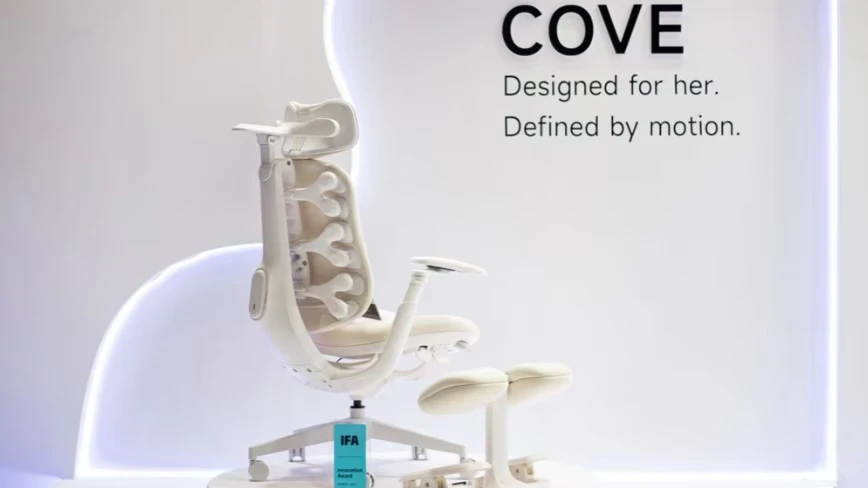
These elements connect through a 5-Point Synchronized Support system linking the headrest, armrests, backrest, seat and footrest as coordinated contact zones. When fatigue sets in, a single touch activates motorized lumbar support. As the backrest reclines, the lumbar support extends forward and the footrest continues to cradle the legs, creating a brief seated stretch without requiring the user to stand.
Beyond the Chair
COVE's significance does not rest on claims that it solves every challenge tied to desk work. Rather, it translates an emerging conversation about inclusive design into something tangible and measurable. Designing for women in this context goes beyond shrinking dimensions. It means examining where the pelvis naturally settles, how feet connect to the floor, how hair and nails interact with daily use, and how a person transitions between focused work and rest.
Following its IFA presentation, ARBREST plans to move COVE toward an initial launch or crowdfunding campaign sometime in 2026, with specifics to follow. The deeper implication of the project challenges a foundational assumption: the user is not a fixed form, and furniture should not demand that she behave as one. COVE marks the brand's first product and its opening move toward additional smart lifestyle offerings designed around genuine user requirements.
Source: The Next Web