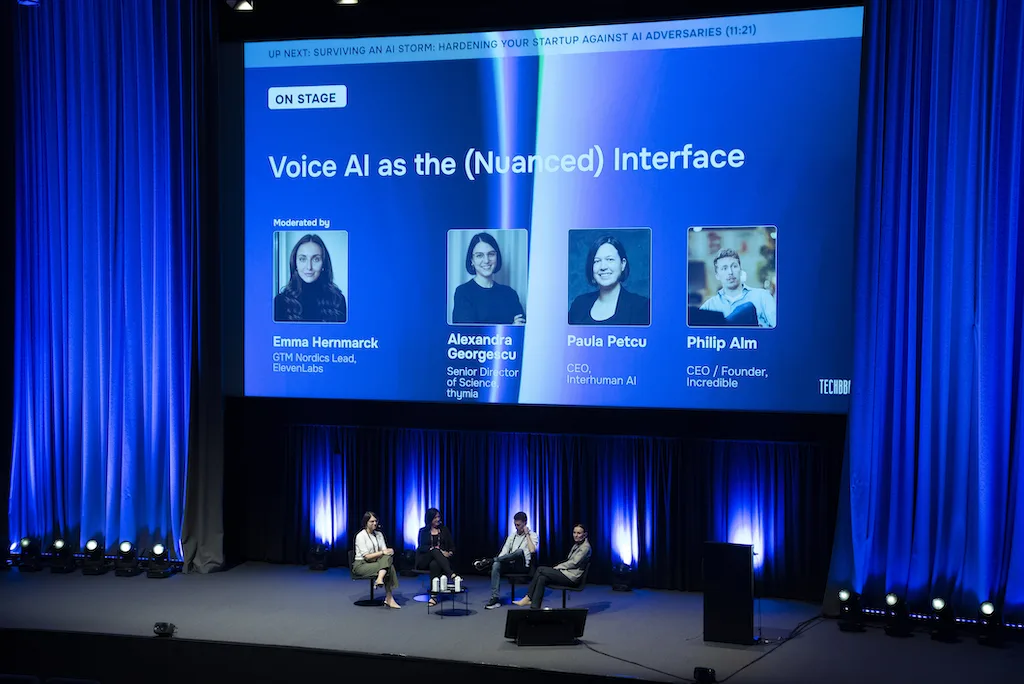
Paula Petcu sat down during TechBBQ 2026 in Copenhagen to discuss her journey from pharmaceutical executive to founder of Interhuman AI, the startup she co-founded in 2023 to build what she describes as a "social intelligence layer" for artificial intelligence. The company's models analyse hesitation, confusion, stress and confidence in audio and video, going beyond the words themselves to understand what is actually being communicated.
Interhuman AI recently unveiled its first product, Inter-1, and closed a €2 million pre-seed funding round led by PSV Tech, with participation from EIFO, Yope, Antler and a group of angels from Ada Ventures. Before launching her own venture, Petcu spent seven years in digital health at pharmaceutical firm Lundbeck, followed by two years as CTO at Brain+, where she developed a digital therapeutic application for dementia patients.
Teaching machines to understand humans
Petcu frames her company's mission simply: "In one line, we're teaching machines to understand humans. We're a bunch of AI engineers and behavioural scientists trying to understand human communication and put that into models that, based on audio and video input, can understand what's actually happening – is someone confused, are they displaying confidence, hesitation, and so on."
The platform functions as a horizontal layer that other developers can integrate into their own applications across training, sales, digital health, personal companions and numerous other domains. The company's origins lay in mental health, drawing on Petcu's background in brain health at Lundbeck. She recognised that understanding how patients communicate—not just what they say—matters significantly for those dealing with depression, schizophrenia and other conditions in clinical trials.
The initial concept centred on an AI coach capable of providing emotional support through conversation, sight and hearing, responding appropriately to users. However, the vision expanded considerably as the team became more ambitious about serving multiple markets beyond mental health.
The ChatGPT moment
The decision to leave her established career path crystallised around 2022, when Petcu was still serving as CTO at Brain+. The arrival of ChatGPT marked a turning point. "I'd played with the early GPT models and built some applications on top, but when it launched to the world, it was a completely new interface – not just for the nerds, but for everyone," she recalls. "I'd built chatbots before; I'm an engineer, but this was completely different."
Petcu recognised an opportunity to combine this breakthrough with the facial expression and sentiment analysis research she had explored at Lundbeck. "There's something here, I thought. And the question is: who does it?" Beyond the technical possibility, she had accumulated experience across startups, consulting, corporate environments and executive roles at startup level, observing CEOs navigate fundraising and company leadership. The prospect of building something entirely her own, rather than contributing to someone else's vision, appealed to her.
Why "hesitation" is harder to define than to code
The real challenge, Petcu emphasises, lies not in engineering but in definition. Before writing any code, the team must precisely articulate what each signal represents. This process involves collaboration between behavioural scientists and AI engineers. Alberto, Interhuman's head of behavioural science based in Milan, works alongside psychologists and other behavioural researchers to review literature on human communication and construct a framework showing how social signals manifest in facial expressions, body language, hands and voice.
These signals can take the form of vocal markers, filler words, extended pauses or changes in tonality. While some patterns appear universal across cultures, the timing and acceptability of displaying them vary. The team began with twelve signals relevant to their target verticals, though countless more exist if one catalogues every possible behaviour.
The engineers then assess feasibility, often discovering significant overlap between signals—confusion and hesitation, for instance—that makes training models to distinguish them difficult. The complexity increases further because multiple signals frequently occur simultaneously; someone might display both confusion and agreement at once. This necessitates constant iteration: engineers test implementations, identify where signals fail to represent accurately, and return to refine definitions. "It's always back and forth to get better accuracy," Petcu explains.
The cost of an AI that only listens
The ability to read a room—to sense unspoken emotions and reactions—remains a rare skill in humans. By embedding this capability into AI tools, Interhuman aims to democratise something previously available only to the perceptive few. Yet convincing customers they need this technology presents a challenge.
Petcu argues that artificial intelligence has excelled at generating text, writing code and reasoning, yet "still fails to understand us as humans. Fails to respond appropriately to what you're actually saying." She points to problematic scenarios in sales and healthcare where an AI system remains perpetually cheerful and agreeable, making users feel brilliant even when they are sad—an inappropriate response that misses the actual emotional context.
As voice-based AI agents proliferate across industries, the stakes rise. "If a system fails to register hesitation or confusion – things that will impact a company's revenue – I think we'll see, on a societal level, an opportunity lost." Safety and business performance intersect here. Beyond voice interactions, the technology applies to broader agent deployments and eventually to robotics. "If we have AI taking care of our elderly, or in our own homes, we want it to understand, even when we don't say something and react accordingly."
What building robots and hosting a podcast taught her about people
Petcu's work with robots offered insights into human nature itself. "Working with robots was definitely very interesting, because it's exploring humans, in a way. I feel like we as humans don't necessarily understand ourselves that well — we don't go deep enough, and we have our own biases and assumptions."
Her podcast on founders' mental health served a dual purpose—exploring what it means to be a founder while providing therapeutic value for herself and her guests. She observed how people reacted emotionally when OpenAI modified a model they had grown attached to, comparing it to the film Her. "I think humans have a need to be heard and understood. A lot of people don't have someone to talk to, especially elderly people, so having a companion you can talk to is really interesting."
While acknowledging risks of over-reliance on AI companions, Petcu sees genuine opportunity. Among current use cases for robots interacting with humans, care stands out as particularly promising. Loneliness increases with age as social support networks shrink, making conversation partners valuable. However, the interaction must feel natural. "It shouldn't be the person who needs to learn how to talk. It should be the robot that understands and adapts."
Meeting her co-founders
Petcu's first co-founder, Line Clemmensen, is a professor in AI whom she met at a webinar where both were invited to speak about artificial intelligence in healthcare. Clemmensen had conducted research with therapists and patients, using cameras to study behavioural coding—whether stress, confusion or therapeutic closeness could be detected visually. "She kept referring back to my presentation too, so afterwards we said, let's talk," Petcu recalls. Clemmensen was working at the Technical University of Denmark and shared Petcu's values and vision. They launched a small research project to test their ideas' feasibility.
Months later, someone from Antler, the venture capital firm, invited Petcu to a networking event. There she met Frederik Sally, the third co-founder, who brought marketing and commercial expertise along with a background in design and storytelling. The team recognised they were too technical and needed stronger commercial perspective. After roughly four weeks collaborating during Antler-facilitated hackathons, the fit felt right. Frederik had independently considered using AI in mental health, signalling alignment on values and purpose.
Petcu's advice for aspiring founders seeking co-founders centres on network building. "I was invited to that webinar because I knew someone, someone I met through someone else, who I met through someone else again; it's a network effect you build over years. You give something, you get something back, but you can't plan for it. You just need to trust in it."
Building as a foreigner in Denmark
Petcu moved from Romania to Denmark seventeen years ago, requiring her to rebuild her professional network from scratch. While this presented challenges—lacking the support systems available at home—it forced rapid skill development. "It makes you develop skills fast, and in some ways I think you become better at it than locals, because you have to rebuild from nothing."
The Danish reputation for social insularity proved partially accurate. "It's said that Danish people can be a bit difficult to make friends with; they have their own social networks, and at 3 pm they're off picking up their kids." However, Petcu found a subset of people oriented toward startups and entrepreneurship, and built connections within that community.
The Danish startup ecosystem has transformed dramatically since Petcu's arrival. When she launched her first startup in 2011 from her master's thesis, ecosystem support for entrepreneurs was minimal. Today, universities operate lighthouse programmes and innovation labs to help researchers and students commercialise ideas. "The ecosystem has changed a lot over the past fifteen years, and it's had a real impact on the number of companies being created — students already have the idea of building something, and they go and do it."
The view from day two of TechBBQ
TechBBQ represents a cornerstone of Denmark's growing entrepreneurial infrastructure, connecting founders and facilitating relationships. Beyond the main conference, side events offer intimate settings for networking around specific interests. "I'd say it's the event of the year in Denmark — I always book it in my calendar a year in advance," Petcu says. She notes that some investors and participants are choosing TechBBQ over Slush, positioning it among Europe's premier conferences.
Regarding conversation topics in the hallways, Petcu expressed hope that social intelligence would emerge as a significant theme. "I'm probably a bit biased, but I do hope so!" She observed that conversational AI and AI agents dominated discussions, reflecting the conference's theme of "Emerging from Agency." Voice AI particularly interests her, noting that even software developers now use voice interfaces to code, whispering commands to their computers using tools like Whisper Flow. "I do think this is the future, which means what we do becomes even more urgent, because if it's deployed without real intelligence behind it, people will end up disappointed and frustrated."
What she wants people to take away
Petcu emphasises that Interhuman AI represents a different category of artificial intelligence company. While many focus on productivity and efficiency—doing business tasks faster—her company pursues humanisation of AI. "I don't think many companies are doing that, certainly not in Europe, if you look at who else is doing social intelligence as a research and product company, I think we might be the only one here."
This positioning creates both opportunity and challenge. The company essentially opens a market that competitors will eventually enter, making customer education more difficult. Yet Petcu finds motivation in the passion of her team. "I see the passion in everyone working here, and that carries us."
Interhuman AI operates from Copenhagen headquarters and has secured €2 million in pre-seed funding. Inter-1, the company's debut product, identifies twelve behavioural signals—hesitation, confusion, engagement and stress among them—across audio, video and text inputs. Additional information is available at interhuman.ai.
Source: Startup Reporter