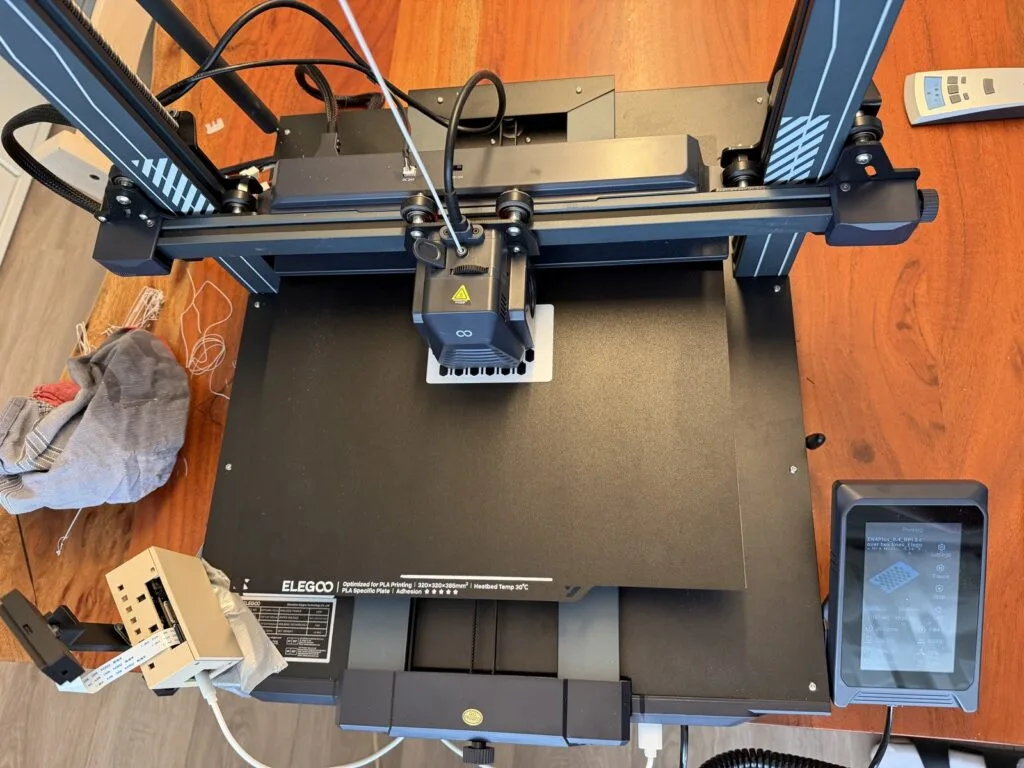
Modern 3D printers often ship with built-in sensor networks and imaging systems designed to catch mid-print disasters like spaghetti failure, saving material and machine wear. Yet many users either lack access to such equipment or prefer to keep their printing operations offline. Philipp Schweizer has published instructions for converting an Arduino UNO Q into a standalone print monitor that runs entirely on the local network.
Rather than training the system to recognize specific failure modes, Schweizer's method teaches it what a healthy print looks like. The watchdog flags anything that deviates from normal operation, which sidesteps the need for extensive training datasets and catches unforeseen problems automatically. This approach proves far more practical than attempting to anticipate every possible malfunction.
Hardware and setup
The build requires an UNO Q with 4GB of memory, an Arduino UNO Media Carrier, a V2-style IMX219 camera module, and a 3D-printed bracket with mounting hardware. The bracket positions the lens toward the nozzle and print bed, though users will likely need to adapt it to their specific printer geometry.
How the detection works
The system leverages Edge Impulse's FOMO-AD anomaly detection model, integrated through Arduino App Lab. Schweizer demonstrates how to gather training images passively during normal print runs. Keeping resolution at 632×480 pixels keeps computational demands low while maintaining detection accuracy.
To avoid false alarms, the software only triggers an automatic pause when three of the last four frames show anomalous behavior. When activated, it halts the job via the Moonraker API, which works with Klipper-based printer controllers. Users running Octoprint or other software can adapt the watchdog to their setup. The system also broadcasts MQTT messages compatible with Home Assistant and displays status on a local webpage.
Privacy and cost benefits
The entire operation stays within the local network, making it ideal for users concerned about data privacy and security. Beyond privacy considerations, this approach offers an economical alternative to proprietary monitoring solutions, requiring no subscription fees and working across multiple printer models rather than locking users into a single brand.
Source: Arduino Blog