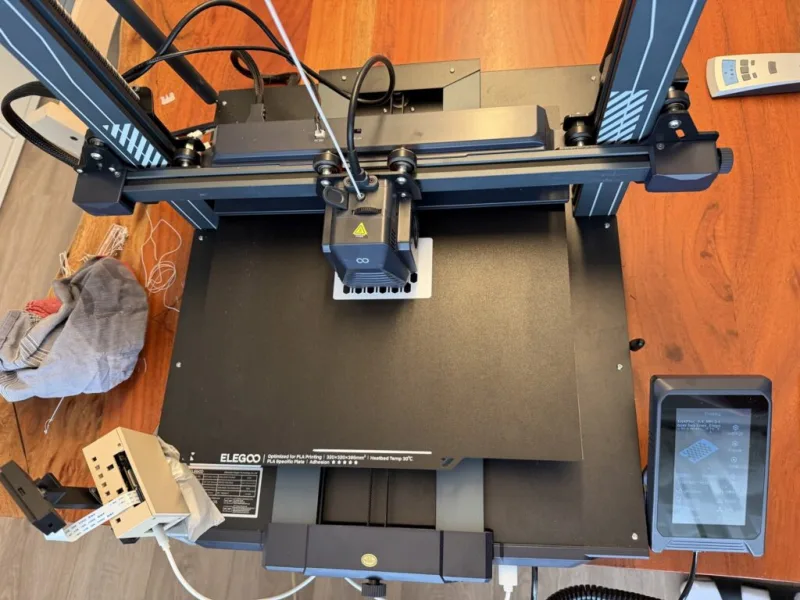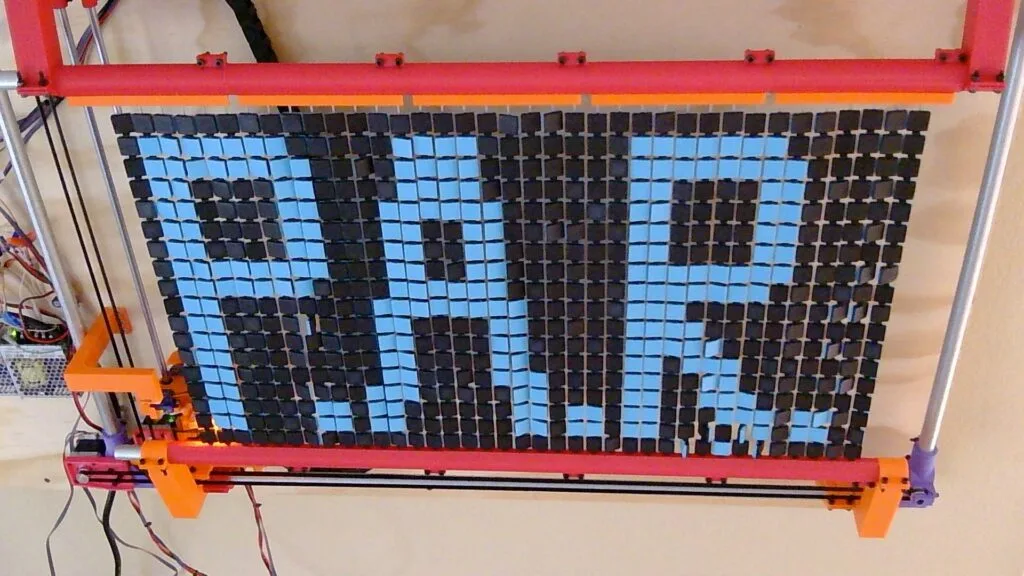
Flip-disc displays were ubiquitous before LEDs, LCDs and OLEDs became affordable, but their electromechanical complexity and moving parts have made them costly and scarce today. Yet their distinctive appeal persists—enough so that Zimm decided to build something new inspired by their charm: P.A.R., short for Pixel Art Robot, a flip-squisk display that accepts artwork submissions from the public.
At the heart of P.A.R. are "squisks"—square discs with a light-colored face on one side and a dark face on the other. Zimm manufactured these by 3D printing interlocking channels into both halves, allowing them to snap together as a single unit. The display arranges 37 × 18 of these squisks in a grid. By flipping each squisk between its two sides, the system can generate low-resolution monochrome images.
While the concept resembles a traditional flip-disc display with square elements instead of circular ones, P.A.R.'s underlying mechanism differs fundamentally. The "robot" in its name hints at this distinction.
Conventional flip-disc displays rely on solenoids to manipulate permanent magnets attached to each disc's axle, toggling them between states. This approach demands a dedicated solenoid and control circuit for every single disc, driving up both material costs and complexity significantly.
Zimm's design sidesteps this entirely. Instead of solenoids or magnets, a robotic arm positioned behind the display physically reaches out and flips each squisk by hand. The mechanism resembles a pen plotter oriented vertically, equipped with a servo-driven pin that manipulates the squisks. An Arduino Nano ESP32 board governs the robot's movements and incorporates a color sensor that reads the current state of each squisk as it approaches.
This architecture brings a major advantage: eliminating solenoids makes scaling straightforward. Zimm can expand the display's size and resolution simply by lengthening the axes and adding more squisks. The trade-off is speed—the system operates considerably slower than a traditional flip-disc display.
Because P.A.R. runs on a Nano ESP32, it connects to the internet. Zimm created a website where visitors can upload artwork, which P.A.R. then physically renders onto the display for all to witness. The site also maintains a gallery showcasing all previously drawn images, and invites users to contribute their own designs.
Source: Arduino Blog