The journey that took Nintendo from a Kyoto card business to dominance in American living rooms unfolded through trial and error rather than grand strategy. When the company introduced the Nintendo Entertainment System in 1985, it did not attempt a nationwide push but instead began with a cautious market test in New York.
The company's oldest and most influential American product share roots in the same corporate story, yet that story was far from linear. Founded in Kyoto in 1889 to manufacture hanafuda cards, the business that would eventually create the NES did not spend nearly a century simply waiting for its moment. Instead, it shifted identities, explored different markets, developed toys, recruited unconventional talent and took risks that did not always succeed.
Understanding this distinction reshapes how we see Nintendo's rise. The celebrated progression from cards to gaming machines is better understood not as a story of foresight but as one of continuously discovering fresh approaches to interactive entertainment. While Gunpei Yokoi's contributions proved vital to this shift, the engineers, designers and business operators who transformed a thriving Japanese console into a viable American retail product were equally important.
The card company came first
Fusajiro Yamauchi established his hanafuda manufacturing and sales operation in Shimogyo-ku, Kyoto in September 1889. Nintendo's formal history documents an incremental growth pattern rather than a dramatic pivot: the introduction of Western-style playing cards in 1902, mass-produced plastic cards in 1953 and cards featuring Disney characters in 1959.
Hanafuda represent a traditional Japanese card format, featuring floral imagery and seasonal motifs on their compact surfaces. Although these products contained no electronics, the business model surrounding them cultivated capabilities that would prove enduring: standardised manufacturing processes, clear rule communication, efficient distribution of entertainment goods and the ability to encourage families to return repeatedly.
In 1963, the company renamed itself from Nintendo Playing Card Co., Ltd. to Nintendo Co., Ltd. While this name change alone did not immediately establish a new business direction, it created conceptual space for one to emerge. With Japan's card market facing natural constraints, president Hiroshi Yamauchi began investigating what other products and services the organisation might pursue.
Diversification was a search, not a straight line
The company's exploratory ventures included Daiya, a taxi service based in Kyoto and connected to Yamauchi. A photograph from 1971 and research compiled by early-Nintendo historian Erik Voskuil document this unusual chapter, as Nintendo Life has reported. Beyond taxis, Nintendo manufactured novelty items and gradually moved into toy production.
Popular accounts sometimes present these initiatives as a humorous catalogue of missteps preceding the inevitable emergence of Mario. This interpretation grants hindsight excessive influence. During that period, Nintendo functioned as a modest producer testing where its manufacturing capabilities, existing distribution channels and knowledge of entertainment products might expand.
These experiments also generated valuable institutional knowledge. The card business had taught Nintendo about game mechanics, family entertainment, licensed intellectual property and consistent production methods. The toy sector introduced moving parts, faster design cycles and the challenge of capturing consumer attention instantly. Rather than identifying a single new market, the company was assembling a toolkit for making play tangible, accessible and immediately understandable.
Gunpei Yokoi found a route from maintenance to toys
In 1965, Gunpei Yokoi joined Nintendo as an electrical engineer responsible for maintaining the card-manufacturing machinery. During his downtime, he constructed a mechanical extending grabber purely for personal enjoyment. When Yamauchi observed the device during a factory tour, he requested a commercial version. Introduced in 1966 under the name Ultra Hand, this creation became an early commercial success.
This account endures partly because it reads like a corporate legend. Yet the engineering dimension deserves equal attention. Yokoi was not an untrained technician who stumbled into product design. He possessed formal training in electrical engineering, grasped mechanical principles and possessed the skill to make inexpensive components perform in ways that were instantly recognisable and gratifying. The Video Game History Foundation's conversation with historian Matt Alt offers particularly valuable perspective on this distinction.
Yokoi subsequently developed the Ultra Machine, the Love Tester and light-gun based games. His trajectory moved gradually from purely mechanical systems toward electronic components, but remained centred on how the player physically interacted with the device. Whether pulling, aiming, testing or pressing controls, the outcome had to be clear and rewarding.
Yokoi's creations did not single-handedly revolutionise Nintendo. The company already possessed leadership committed to expansion and personnel skilled in manufacturing and distributing new products. However, the commercial performance of Yokoi's early creations demonstrated that an engineer with an intuitive sense of play could establish an entirely new market segment. In 1980, his Game & Watch line merged portable gaming with liquid-crystal display technology into a consumer product.
Electronic entertainment arrived in stages
Nintendo's official record documents the Laser Clay Shooting System in 1973, the Color TV-Game 6 and 15 in 1977, arcade game development beginning in 1978, Game & Watch in 1980 and Donkey Kong in 1981. Mechanical toys, optoelectronic games, portable handheld devices and arcade software formed a progression. The company did not leap directly from paper cards to a home console.
The console narrative should not be attributed to Yokoi alone. Masayuki Uemura directed the hardware engineering team responsible for the Family Computer, known as the Famicom. Shigeru Miyamoto and numerous other designers and engineers created the software that gave Nintendo's hardware its distinctive appeal. This represented a collaborative network of complementary abilities rather than one person's continuous stream of innovations.
Nintendo released the distinctive red-and-white Famicom in Japan during July 1983. Manufacturing defects in the initial units necessitated a recall and repair programme, demonstrating that Nintendo's expansion was not without obstacles. Following these corrections, the system gained significant domestic popularity and provided Nintendo with a foundation for considering international expansion.
A Nintendo annual report from that era straightforwardly documents the subsequent development: the American adaptation of the Famicom, rebranded as the Nintendo Entertainment System, entered the United States market in 1985. This marked 96 years following the company's establishment. While the numbers align neatly, the actual market entry proved considerably more modest than typical descriptions indicate.
The 1983 crash was real, but it was not global
The American market presented an unappealing landscape for Nintendo's entry. The North American home-console sector had suffered from an oversupply of hardware and cartridges, inconsistent game quality, retailer financial losses and competition from personal computers. According to the Smithsonian's NES collection documentation, retailers faced a marketplace flooded with competing consoles and hastily developed games.
Describing this period as a "video game crash" can suggest the damage was universal. However, arcade gaming, computer games and Japan's console market followed distinct trajectories. The Famicom was thriving in Japan while American retailers remained hesitant about investing in another home console. Nintendo confronted not a collapse of the entire video game industry but rather a loss of confidence in a specific product category and distribution method.
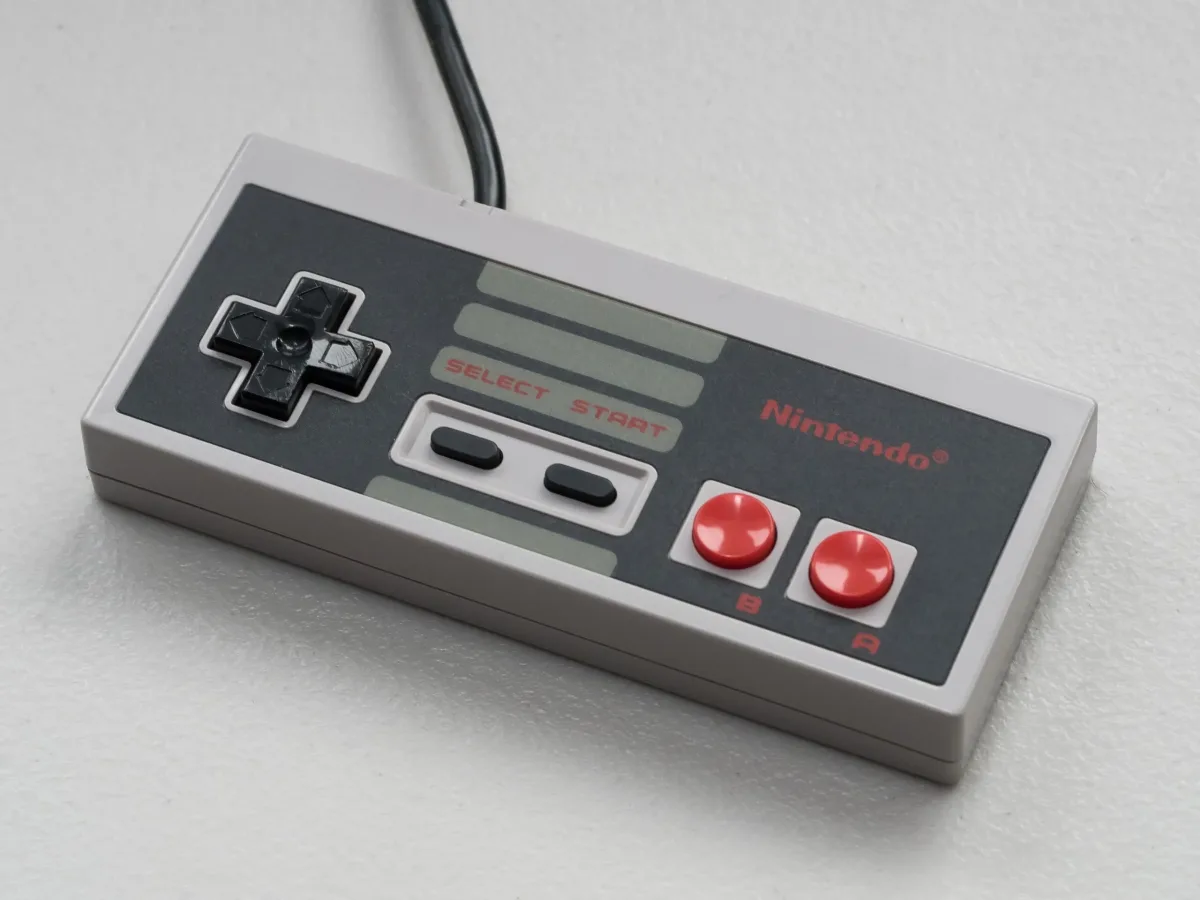
Nintendo's response combined engineering and business strategy. The American system differed visually from the compact Famicom, instead resembling a piece of equipment designed to sit alongside a television and VCR. Marketing positioned it as an entertainment system, cartridges were branded Game Paks and the package could incorporate the Zapper light gun and R.O.B. robot accessory.
These decisions extended beyond surface-level presentation. Nintendo incorporated a lockout chip and implemented a selective licensing system to prevent unauthorised cartridges from functioning on the system. This approach later faced criticism regarding the control it granted the platform manufacturer, but the underlying rationale was pragmatic: Nintendo sought to prevent another wave of incompatible or mediocre software from eroding consumer trust.
The 1985 launch was a test, not a nationwide conquest
The statement that Nintendo "launched in America" requires an essential clarification. According to the Video Game History Foundation's NES Launch Collection, Nintendo introduced and sold the finished NES in October 1985 as a limited test market confined to New York. The Foundation's archived materials encompass launch-event merchandise, trade publications and documentation of how the system was marketed. Los Angeles and additional markets received the system in 1986 before a broader national expansion.
This phased approach makes the turnaround narrative more compelling, not less. Nintendo did not place a single massive bet on a supposedly exhausted market. Instead, it modified the Famicom, presented it as a distinct product, validated the concept in one challenging metropolitan area and expanded methodically as results justified the investment.
Super Mario Bros. provided a powerful illustration of the hardware's capabilities. The controller design was straightforward, gameplay mechanics taught players through experience and the game world possessed greater coherence than the majority of cartridges released before the market downturn. Simultaneously, Nintendo's licensing restrictions, retail partnerships and distinctive packaging design gave retailers and consumers confidence in software bearing the Nintendo brand.
The NES was not solely responsible for revitalising the North American home-console market. Sega and Atari released competing systems, personal computers maintained relevance and the recovery cannot be attributed to a single device. Nevertheless, the NES emerged as the dominant platform in that resurgence, playing a central role in establishing the home console as a sustainable mainstream product rather than a discredited early-1980s phenomenon.
Company histories frequently reshape experimentation into inevitability. A more instructive interpretation, particularly valuable for contemporary innovators examining how organisations sustain growth, recognises that Nintendo repeatedly adapted an established competency into novel applications. The underlying thread was not cards, taxis or computer chips individually. It was the thoughtful design and careful distribution of interactive entertainment.
The former card manufacturer penetrated American households by learning from successful products, discontinuing unsuccessful ventures and treating a troubled market as a design problem to solve. The 96-year arc carries significance precisely because no one in 1889 possessed the ability to foresee it.
Source: Silicon Canals