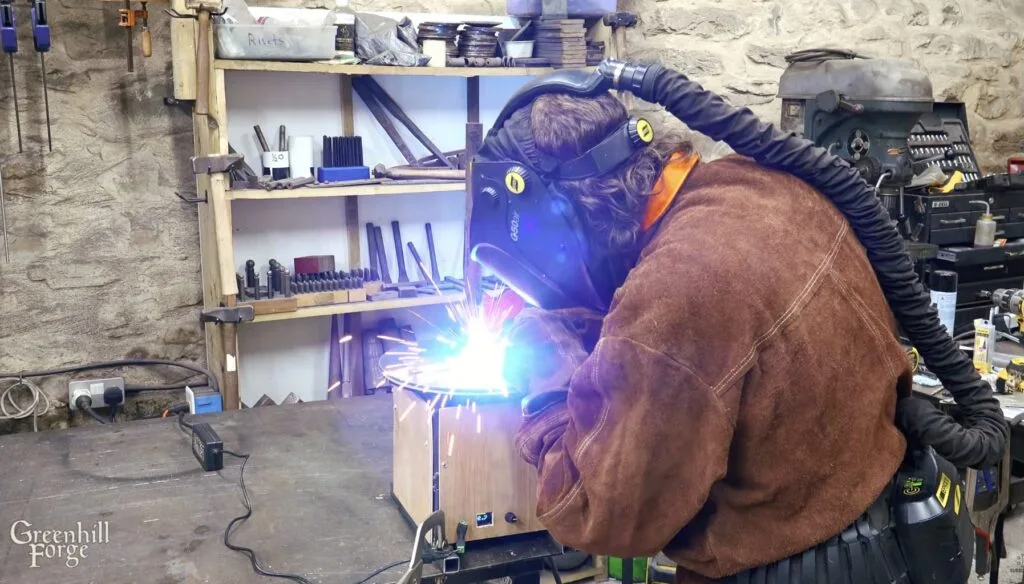
MIG welding becomes significantly more challenging when the workpiece sits at an awkward angle or requires work along an extended seam. In these scenarios, the resulting welds often appear amateurish. The solution lies in maintaining a stable welding position throughout the entire process. For cylindrical objects, Greenhill Forge developed an Arduino-controlled rotary welding platform that addresses this problem.
The fundamental purpose of such a table is straightforward: rotating the workpiece beneath the welding gun allows the operator to maintain an optimal, stable angle as the work progresses. While conceptually simple, the implementation involves several technical considerations that Greenhill Forge carefully engineered into their design.
The physical construction relies on a mild steel frame, a heavy-duty lazy Susan bearing, and a circular mild steel work surface. This combination represents relatively basic fabrication that an experienced welder could assemble in a single afternoon, provided they have access to steel-cutting equipment—particularly for the circular tabletop.
The critical design challenges emerge from the welding process itself. The rotating surface must maintain consistent speed, and operators need the ability to adjust that speed. Equally important is establishing a reliable electrical path for current flow from the ground clamp to the welding wire.
Greenhill Forge implemented rotation control using an Arduino UNO Rev3 paired with a stepper motor equipped with a gear reducer. A spider coupler connects this assembly to a shaft affixed beneath the tabletop. A rotary encoder enables users to adjust rotation speed, while a compact OLED display shows the current speed setting, allowing operators to replicate the same speed in future sessions.
For the electrical ground path, Greenhill Forge positioned a ground strap around the shaft above the spider coupler. This arrangement creates a complete current circuit: ground clamp to ground strap to motor shaft to table to workpiece to wire. This configuration allows the tabletop to rotate freely without cable entanglement while protecting the electronic components from electrical current.
Source: Arduino Blog