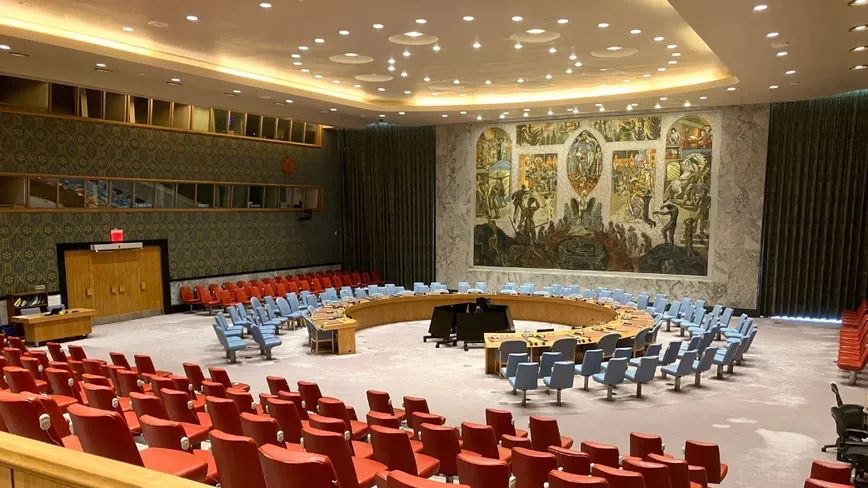
During a UN Security Council meeting in New York, the United States made clear its opposition to any coordinated international approach to regulating advanced artificial intelligence. Michael Kratsios, who heads the White House Office of Science and Technology Policy, delivered remarks emphasizing that nations must handle AI governance independently rather than through multilateral structures.
Kratsios framed rapid progress in AI development as something to embrace rather than slow down. He stated: "The frontier of intelligence is advancing rapidly. That is not a reason to pause its further development or to constrain it with new global governance structures." Throughout his remarks, he referred to cutting-edge AI systems as superintelligence.
The director highlighted America's position as the leading force in the field, noting that Washington has collaborated with frontier research labs to evaluate emerging models and established cybersecurity coordination mechanisms to address potential vulnerabilities. While expressing openness to international dialogue on new technologies, Kratsios stressed that such conversations must not evolve into binding global regulatory frameworks.
Kratsios invoked President Trump's recent address to the General Assembly, saying: "As President Trump said before the General Assembly yesterday, the United States totally rejects any attempt to construct a global scheme of control of superintelligence." He pointed to the Carolina Principles, endorsed by G20 innovation ministers at a gathering in Chapel Hill, North Carolina this month, as the preferred model for international cooperation on emerging technologies.
The American position centers on preserving each country's authority to determine its own regulatory path. Kratsios told the Council: "The American people's representatives will legislate and regulate on the American people's behalf. You should do the same for your people." Rather than creating supranational oversight bodies, he argued that nations should prioritize building domestic expertise and infrastructure.
The US strategy includes offering American technology and expertise to other nations. Through its exports program, American firms would assist partner countries in developing secure systems and building their own AI capabilities. Kratsios emphasized: "If you take the risks and benefits of superintelligence seriously, the most important thing you can do is to develop your country's ability to understand and use it."
According to Kratsios, international bodies should focus on exchanging practical knowledge to strengthen national capacity rather than establishing centralized regulatory authority. He concluded: "A prosperous future will not be secured by a global regulator."
The American stance contrasts sharply with positions taken by major figures in the AI industry. Sam Altman of OpenAI, Dario Amodei of Anthropic, and Clément Delangue of Hugging Face each advocated for international standards or mandatory disclosure requirements during the same meeting. Yoshua Bengio went further, calling for licensing requirements for frontier AI systems.
Source: The Next Web