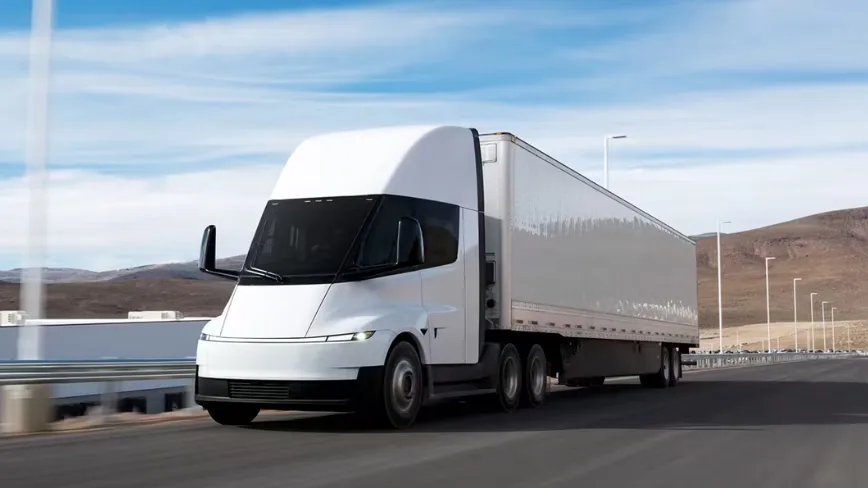
Volume production of Tesla's Semi has commenced at Gigafactory Nevada, with the first customer deliveries occurring this week. The Class 8 truck, initially unveiled in 2017, now enters the market with specifications that Tesla has detailed comprehensively. The vehicle achieves up to 500 miles of range on its Long Range variant and 325 miles on the Standard Range configuration, supported by charging capability reaching 1.2 megawatts.
Range and charging specifications
Tesla's range figures come with specific operational parameters. The Long Range model reaches 500 miles while the Standard Range achieves 325 miles, both calculated at 1.7 kWh per mile consumption. These measurements assume a gross weight of 82,000 pounds, travel at 55 miles per hour, ambient temperature of 20 degrees Celsius, level terrain, and use of a tandem axle aero kit paired with a compliant dry van trailer. The truck draws power from three motors capable of delivering up to 800 kW combined.
At maximum charging rates, Tesla states that 60% of the vehicle's range can be restored within 30 minutes. Both the truck and its charging infrastructure employ the MCS 3.2 connector standard.
European infrastructure ahead of market entry
Tesla has already constructed more than 100 megawatt-capable charging stalls distributed across 21 European locations spanning Germany, France, Britain, Sweden and the Benelux region. This infrastructure deployment precedes the truck's European availability by several years, with market entry scheduled for 2027.
European regulations mandate charging points with minimum 350 kW capacity at 60-kilometer intervals along the core heavy goods vehicle network. The megawatt-level charging infrastructure that Tesla has installed exceeds these mandatory requirements and represents a commercial investment rather than a regulatory obligation.
Battery capacity and cell sourcing
Battery specifications for the Semi emerged through a California Air Resources Board filing rather than direct Tesla disclosure. The Long Range variant contains 822 kWh of usable capacity while the Standard Range holds 548 kWh. The vehicle utilizes Tesla's proprietary 4680 cells manufactured at Gigafactory Texas, cells that have demonstrated performance below that of supplier alternatives in the company's passenger vehicle lineup.
Early orders and market momentum
Swedish logistics company Einride placed the largest order announced to date, committing to 500 Semi trucks for freight operations across California, Texas, New Jersey, Illinois and Georgia. This represents the most substantial deployment commitment from any buyer globally. Amazon maintains warrant positions representing approximately 12% ownership in Einride.
A coalition of shipping companies placed an order for 2,500 Semi trucks this week, a volume that would approximately double the existing American electric truck fleet. Tesla targets annual production of 50,000 units once Gigafactory Nevada reaches full operational capacity.
Market conditions favoring electrification
Diesel fuel prices in the United States currently average above $6.50 per gallon, representing record levels driven by geopolitical tensions including conflicts in Ukraine and Iran. These elevated fuel costs create economic incentives for fleet operators to transition toward electric alternatives, supporting demand for vehicles like the Semi.
Source: The Next Web