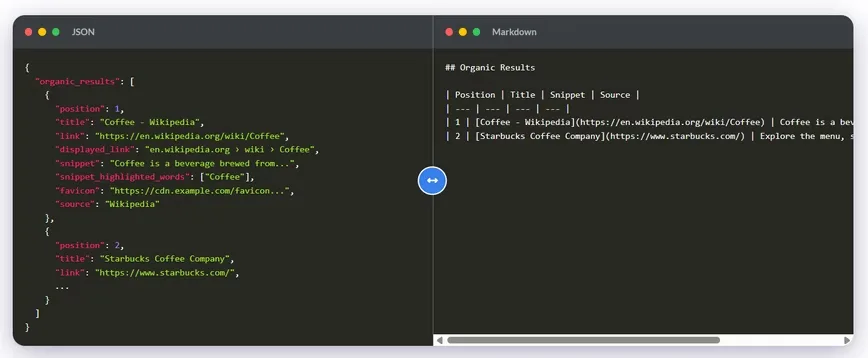
Throughout the stack supporting artificial intelligence applications, Markdown is establishing itself as a preferred standard. An increasing number of service providers are adopting it as their primary output format for content that models must process, moving away from JavaScript Object Notation (JSON), which has long served as the universal interchange format.
This transition mirrors the actual mechanics of how large language models function: their training regimen, the way conversational interfaces present responses, and how engineers approach building systems that balance tokens, context windows, and operational expenses. The momentum behind this change is grounded in practical advantages.
Markdown aligns with model behavior
The foundation for this shift lies in the training data itself. Enormous volumes of Markdown have been fed into large language models—spanning documentation pages, README files, technical writing, discussion forums, and reference materials. This saturation means models have internalized Markdown's structure; they naturally parse headers, lists, tables, and code blocks as meaningful signals rather than formatting noise.
On the output side, chat applications already know how to render Markdown without additional processing. When a model generates Markdown, the user interface displays it directly. When a model receives Markdown as input, it encounters information formatted in a way that matches both its training distribution and its expected output style. This creates a smoother cycle than working with dense, hierarchical JSON structures that require mental decoding before use.
From a token economy perspective, Markdown offers another advantage: it eliminates structural overhead while preserving informational content. For AI systems working within constrained context windows, this efficiency gain means more substantive data per request and reduced cost per inference operation.
The shift is already visible
This movement toward Markdown is not theoretical. Major model providers have already embedded it into their official guidance. OpenAI's documentation on prompt engineering explicitly recommends organizing developer prompts using Markdown headers, bullet points, and tables where appropriate. The guidance specifies using '##' for primary sections, inline backticks for code references, and clear hierarchical structure to enhance model performance and clarity.
Independent prompting resources follow the same pattern, employing Markdown headings for logical divisions, lists for itemization, and tables for side-by-side comparisons. Multiple studies have documented that Markdown consumes fewer tokens and aligns more naturally with how models trained on technical documentation understand information, making it the preferred choice for sophisticated prompts, particularly with the newer GPT-5 series models.
API platforms are adopting the standard
Data and API providers have embraced this direction. JSON's reign as the universal data exchange format is giving way to Markdown variants specifically tuned for LLM processing. The motivation remains consistent: reduce token consumption, streamline parsing for autonomous agents, and harmonize with how models receive instructions and generate output.
SerpApi, a nine-year-old search data platform serving developers, researchers, and large enterprises with structured information from Google, Bing, YouTube, and similar sources, recently rolled out Markdown output across its entire suite of more than 100 APIs at no additional charge. The capability allows developers to request search results in a token-efficient Markdown format instead of JSON, specifically designed for AI agents and LLM applications. The implementation requires no new endpoints; developers simply add a query parameter, use a route extension, or include a header on their existing calls.
SerpApi's own testing demonstrates the impact. A single Google search query for "coffee" generates 24,723 tokens when returned as JSON but only 6,435 tokens as Markdown—a 74% reduction. When combined with field selection, the same response shrinks to 1,298 tokens. Across its API portfolio, SerpApi reports typical token savings around 50%, with certain endpoints achieving reductions exceeding 90%.
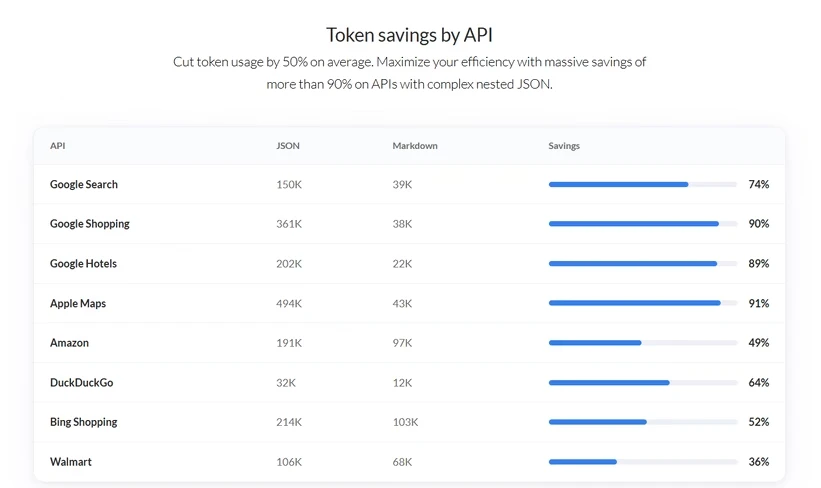
These figures matter because search results represent some of the most complex, heavily nested payloads that AI agents process. JSON responses include redirect URLs, icon references, tracking codes, and deeply embedded metadata that models do not require for reasoning. Markdown output preserves essential elements—headlines, excerpts, URLs, costs, and review scores—in clean tables and lists while automatically removing much of the internal tracking infrastructure and redundant information.
To access the Markdown format, developers can append 'output=md' to their query string, call the '/search.md' endpoint, or set an 'Accept: text/markdown' header. Responses include YAML frontmatter for metadata, organized Markdown tables for result collections, and standard inline hyperlinks, all formatted to integrate seamlessly into prompts or agent memory systems.
What comes next
As autonomous agents consume an expanding share of web content, the infrastructure supporting them will increasingly prioritize machine readability over human-centric formatting. JSON will retain its importance for data transformation and schema validation, but for the phase where AI systems absorb external context, Markdown is becoming the new standard.
Expect additional data providers to introduce Markdown versions of their responses in the coming period, particularly those serving search, retail, location, and content delivery use cases where token efficiency directly affects performance and cost. Prompt design patterns and agent frameworks should converge on Markdown sections, tables, and lists as the standard approach for presenting retrieved information to models. Supporting tools will likely evolve to track and optimize token usage, with Markdown as a key optimization lever.
For teams working with LLMs in production, the direction is clear. When integrating external data sources into models, formats that echo the models' training patterns and output conventions should take priority. Markdown has transcended its role as a documentation format. It is becoming the shared vocabulary connecting search infrastructure and artificial intelligence systems.
Source: The Next Web