Since its founding in 1979, Ars Electronica has positioned itself as a bridge between artistic disciplines and technological innovation, fostering dialogue about humanity's future through collaborative projects that challenge established norms. The organization maintains what it describes as the world's largest archive of digital art and media works. In a new series, members of the Ars Electronica team are revisiting landmark projects from this collection, selecting works that have shaped their thinking and remain relevant to contemporary challenges.
Nicole Grüneis, Head of Content & Education Development at the Ars Electronica Center, chose to spotlight "Chijikinkutsu," a sound installation by Japanese artist Nelo Akamatsu. The work captured the Golden Nica award in 2015 within the "Digital Music & Sound Art" category and was exhibited at that year's Ars Electronica Festival. Grüneis later encountered the project again when curating an Ars Electronica Export exhibition for the VW Forum in Berlin two years later, where she oversaw its reinstallation in a new context.
Merging Science and Tradition
The installation fuses a geophysical phenomenon with a centuries-old Japanese acoustic practice. "Chijiki" refers to geomagnetism—an ever-present planetary property that shapes our environment yet remains imperceptible to human senses. "Suikinkutsu," the second component of the title, names a traditional Japanese water sound installation where droplets falling into a concealed vessel generate subtle acoustic effects.
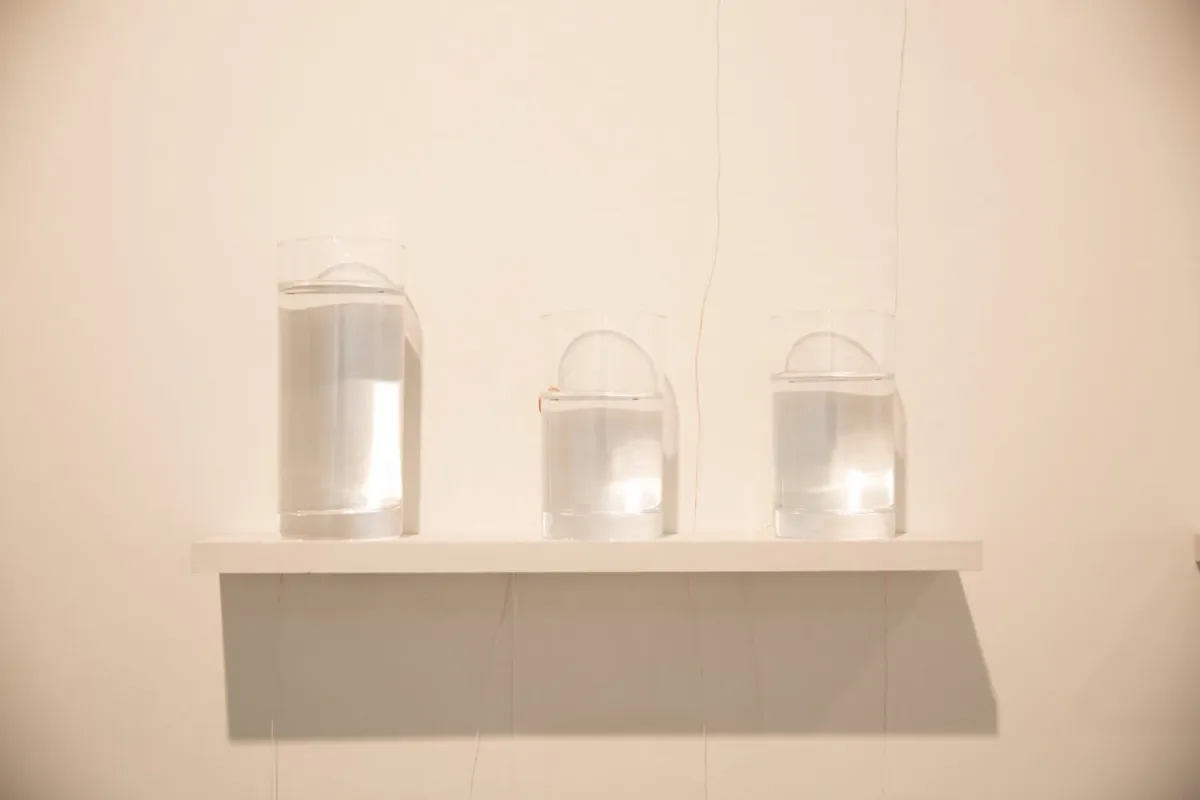
Akamatsu's physical setup comprises water-filled glasses, magnetized needles, and copper coils arranged on a shelf-like framework that creates an enclosed space within the larger room. The needles float atop the water and naturally orient themselves along the Earth's magnetic field lines, pointing north and south. Controlled electrical pulses generate temporary magnetic fields that shift the needles' positions. When they contact the glass surfaces, they emit barely audible, delicate tones.
Rather than forming a dense acoustic environment, these sounds exist as dispersed, fragile vibrations scattered throughout the space. They occur unpredictably and demand active, intentional listening to perceive. Visitors often find themselves attempting to capture and mentally preserve these ephemeral tones, constructing imagined melodic sequences from them. The installation cultivates a state of focused awareness in which an undetectable natural force becomes knowable through patient auditory attention—a moment simultaneously mysterious and revelatory.
Minimalism as Conceptual Strength
What distinguishes "Chijikinkutsu" in Grüneis's assessment is its deliberate restraint. While contemporary media art frequently emphasizes technological sophistication, visual spectacle, and immersive environments, Akamatsu pursues the inverse: limited resources, quiet sounds, and understated visual language. The work avoids flashy displays and refrains from explaining its underlying scientific principles through educational means. Instead, it generates poetic resonance—a narrative that simultaneously addresses geological phenomena, cultural heritage, and technological systems while facilitating an encounter that engages both intellect and sensation.
Relevance in an Age of Hidden Systems
Grüneis emphasizes the work's contemporary significance by pointing to the invisible technological infrastructures that structure modern existence. Algorithmic systems and electromagnetic networks—essential to daily life—operate beyond direct observation and immediate awareness. "Chijikinkutsu" renders such concealed forces tangible without oversimplifying, amplifying, or attempting to control them.
The installation simultaneously proposes a counterpoint to dominant technological logic. Rather than emphasizing velocity, visibility, and productivity, it privileges deceleration, quietude, and attentiveness. It invites recalibration of perception and engagement with subtlety and emptiness—dimensions that are architectural, acoustic, and philosophical in nature. The work also speaks to ecological and social preoccupations by presenting nature and technology not as opposing forces but as interdependent systems requiring relational understanding. Humanity's role emerges not as controlling agent but as responsive, receptive participant.
Finally, the installation recuperates a vital cultural capacity: the practice of listening while stepping away from self-centeredness. Amid perpetual sensory bombardment and individualistic orientation, "Chijikinkutsu" establishes a space where perception decelerates and intensifies—where immediate surroundings become experientially available, and awareness emerges that certain phenomena, though invisible, persistently exist.
About Nicole Grüneis
Grüneis has served as Head of Content & Education Development at the Ars Electronica Center since joining the organization in 2008. Her responsibilities encompass developing exhibition frameworks and narratives for diverse audiences, designing educational programming, and preparing cultural mediators and information specialists. During her initial years at Ars Electronica, she worked directly in art and cultural education within the museum context. Her academic background reflects a transdisciplinary commitment: she designed her own curriculum combining psychology and art, emphasizing how cultural production can encourage unconventional thinking and critical reflection.
Source: Ars Electronica