Ars Electronica 2026 generated substantial enthusiasm when it returned to downtown Linz in September. The festival's relocation to the city center proved popular with the public, drawing visitors who spent more time exploring its offerings. Gerfried Stocker, Artistic Director of Ars Electronica, noted that "125,000 visits across 40 venues show that our return to the city center was very well received by the public."
The 30th anniversary of the Ars Electronica Center contributed to increased local participation. Veronika Liebl, Managing Director of the Ars Electronica Festival, highlighted the appeal of the new FESTIVAL WALK in the city center: "It encourages us to bring our artistic and scientific exploration to the places where people spend their daily lives—where they meet, learn, play, shop, pray, and discuss."
Educational programming drew significant participation. The WE GUIDE YOU initiative, which offered thematic guided tours throughout the festival, attracted over 2,500 participants across 227 tours covering 22 different topics, according to Christl Baur, Head of the Ars Electronica Festival & Program Director. The Ars Electronica Center's 30th anniversary celebration on the eve of the festival brought approximately 1,000 attendees.
International participation and scale
The festival assembled a global creative community. More than 1,200 artists, scientists, developers, and activists from 77 countries participated in the 2026 edition, which encompassed exhibitions, conferences, concerts, performances, and screenings.
Opening celebrations and performances
The festival launched with a birthday party for the Ars Electronica Center and Ars Electronica Futurelab. Around 1,000 guests attended the evening, which featured new exhibitions from Ars Electronica Futurelab and Ars Electronica Solutions. Robots mingled with attendees, while Dennis Russell Davies, Maki Namekawa, and Cori O'Lan performed a special edition of Pianographique in Deep Space 8K. Moritz Simon Geist delivered a techno-robotic performance in the Sky Loft.
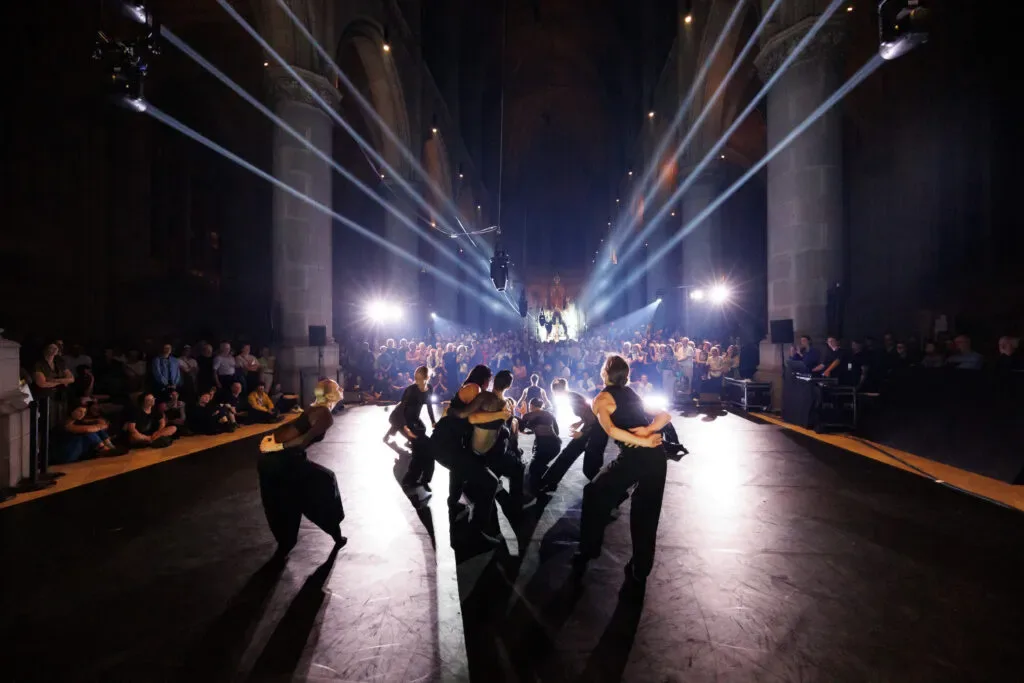
The official opening took place at St Mary's Cathedral in Linz, where approximately 2,500 people gathered for a musical and performative exploration spanning five centuries. The program examined what defines humanity through compositions by Richard Wagner, Olivier Messiaen, and György Ligeti's Lontano, performed by Markus Poschner and the Bruckner Orchestra Linz. Tanz Linz presented WORSHIP, while Johannes Hiemetsberger's Company of Music offered polyphonic singing from various locations within the cathedral.
The Great Concert Night at Posthof Linz, held for the first time at this venue, filled all three halls simultaneously. Daniel Haas presented his sound installation PULS in the Small Hall. Maki Namekawa performed Philip Glass's Polaris in arrangements by Glass and Michael Riesman, accompanied by visuals by Cori O'Lan, in the Medium Hall. Brigitta Muntendorf presented ORBIT – A War Series, exploring violence and contempt for humanity, in the Main Hall. The Nightline continued in the Middle Hall. A total of 1,700 people attended the event.
Exhibition venues and programming
The festival showcased award-winning projects from the Prix Ars Electronica and the STARTS Prize, alongside works from students at the University of Art and Design Linz and 42 other universities worldwide. Installations from global Ars Electronica network partners, exhibitions from the Linz Institute of Technology at Johannes Kepler University, and the new Ars Electronica Futurelab exhibition "Hello Worlds!" anchored the programming. The Lentos Art Museum and the Ars Electronica Center drew particularly strong attendance.
The FESTIVAL WALK presented the festival's theme across eight locations throughout the city, allowing visitors to explore 42 artworks while walking through church interiors, a school, a hospital, a museum, and green courtyards. According to Christl Baur, the initiative "combined art with the urban experience—and all in perfect fall weather."
The create your world program, held for the first time on the grounds of the JKU MED Campus, emphasized cross-generational experimentation, play, and debate. Film City, developed in partnership with the Academy of Austrian Film, enabled numerous visitors to engage in filming, editing, storytelling, and acting. Artist Joseph Herscher, known for his Rube Goldberg machines, performed an elaborate demonstration of getting dressed and eating breakfast.
Expanded conference and academic participation
The Expanded conference on Animation and Interactive Art 2026, organized by FH OÖ and Ars Electronica, achieved record participation. The event received 243 submissions—approximately 150 percent more than the previous year—and operated as an ACM In-Cooperation Event. The three-day program featured more than 50 academic and artistic presentations and curated panels. The Expanded Play Gallery at Atelierhaus Salzamt, featuring 13 interactive media installations, was fully integrated into the conference as its own track for the first time. The Ars Electronica Animation Screenings at the MED Campus presented selections from the Prix Ars Electronica New Animation Art category across 11 programs.
The University of Arts Linz presented approximately 200 contributions from more than a dozen degree programs and 21 international guest universities at locations including Hauptplatz 6 and 8 and Domgasse 1. The project "Flood the Zone with Courage" on Linz's Hauptplatz created space for free expression and activist contributions, including five projects from Interface Cultures students. The exhibition "Codes [ ] Rituals" in the Audimax and the Sound Campus drew steady international visitor traffic throughout the festival.
Institutional partnerships and support
The festival operated with support from 340 cooperation partners and sponsors from the region and worldwide. Gerfried Stocker emphasized that "a festival on this scale is only possible thanks to the countless cooperation partners and sponsors from the region and from all over the world."
Looking ahead
Ars Electronica 2027 is scheduled for September 8 to 12, 2027, and will again occupy Linz's city center. Veronika Liebl announced plans to "open up one or two hidden corners of the city center and repurpose them for our artistic and scientific exploration."
Statements from city and cultural leaders
125,000 festival visits in just five days is remarkable. I am delighted that so many people took the time to attend a festival that engaged with questions as difficult as they are urgent. That is exactly what we need as a democratic society.
Dietmar Prammer, Mayor of the City of Linz and Owner Representative of Ars Electronica
With 125,000 visits, Ars Electronica has once again confirmed something to us: questions about the future such as artificial intelligence and robotics move culture and business just as much as the broader public. For all technological development, people remain at the center. We all help shape our future. The new festival hub in the city center brought these questions about the future into the middle of our city. My personal highlight was the opening at Mariendom — an impressive encounter between tradition and the future. The good collaboration between city and province shows what we can achieve together. The interplay of Ars Electronica, Klangwolke and Brucknerfest gives Linz and Upper Austria a unique profile as a cultural location. We want to continue building on this cultural autumn together and strengthen its appeal beyond the region. What is at stake here is art and culture, our future, and a modern Austria that shapes that future with confidence.
Doris Lang-Mayerhofer, City Councilor for Culture and Chairwoman of the Advisory Board of Ars Electronica
Expanded – Conference on Animation and Interactive Art 2026, organized by FH OÖ and Ars Electronica, was a great success and was able to further strengthen its international standing. Since 2024 the conference has been held as an ACM In-Cooperation Event. With a total of 243 submissions — around 150 percent more than the previous year — Expanded 2026 set a new record. The three-day program comprised more than 50 academic and artistic presentations as well as curated panels, and offered a diverse international discourse at the intersection of animation, interactive art, technology and research. A particular highlight was the Expanded Play Gallery at Atelierhaus Salzamt, which, with 13 interactive media installations, was for the first time fully integrated into the conference as a track of its own. The program was complemented by the Ars Electronica Animation Screenings at the MED Campus, which presented a selection from the Prix Ars Electronica category New Animation Art, international guest screenings and Meet the Artist screenings across a total of 11 programs.
Juergen Hagler, Professor at the Hagenberg Campus of the University of Applied Sciences Upper Austria
As part of the Ars Electronica Festival, the Kunstuni Campus presented around 200 bold and critically probing contributions from more than a dozen degree programs and 21 international guest universities, turning the locations at Hauptplatz 6 and 8 and at Domgasse 1 into a lively stage for exhibitions, installations, performances, screenings and workshops. Among the things that will make 2026 memorable is the project 'Flood the Zone with Courage' on Linz's Hauptplatz, which created an open space for free expression and activist contributions and within which Interface Cultures students also presented five projects. The exhibition 'Codes [ ] Rituals' in the Audimax and the Sound Campus likewise drew a steady stream of international visitors throughout the festival.
Brigitte Hütter, Rector of the University of Arts Linz
The Ars Electronica Festival 2026 impressively demonstrated how science and art can jointly open up new perspectives on the challenges of our time. I was particularly pleased that this year the JKU MED Campus, as one of the three festival hubs in the middle of Linz, became a resonating space for this interplay and thereby made the breadth of the JKU visible. From medicine and technology to artificial intelligence and the societal questions bound up with it, numerous projects showed how research can be made tangible and extended through artistic approaches. Especially in the year of our 60th anniversary, we want to act as pioneers of open discourse, because it connects our academic work with society. Discourse also creates a space in which we can think together about the future and about humanity in an increasingly technologized world.
Stefan Koch, Rector of Johannes Kepler University Linz
We are very pleased to be a cooperation partner of Ars Electronica for the eleventh time as Bruckner Uni. Inspired by Future Begins and Negotiating Humanity, Sonic Saturday explored the question of how the future is already taking shape in sound-art and digital practices. 101 artists from 30 countries presented electroacoustic and spatial music, live performances and audiovisual sound and light installations. With the Tangible Music Lab we were also able to establish collaborations with universities in Brno, Corfu, Wrocław and Mexico City. This international cooperation underscores once again the appeal of our location and our commitment to artistic exchange, cultural participation and the exploration of possible futures.
Martin Rummel, Rector of the Anton Bruckner University
We are delighted by the strong interest in Ars Electronica at the Lentos. These successful figures show how well the interplay between the two institutions works. The award-winning works of the Prix Ars Electronica and the S+T+ARTS Prize presented at the Lentos impressively demonstrate how artists take up current developments and critically reflect on their social, political and ecological consequences. I am particularly pleased that in doing so we also reach many people who discover our museum anew during the festival.
Hemma Schmutz, Director of the Lentos Kunstmuseum
The once again impressive figures of the Ars Electronica Festival strengthen our cultural location. We are grateful to be part of the project, and we see how impulses radiate out from here that are more than mere markers of the times — they are an enrichment. Art and technology are not a contradiction but an expression of human volition, at the center of which, however, must always stand the pertinent question of the conditions of being human in a time of radical change. This year's theme made that abundantly clear.
Hermann Schneider, Artistic Director of Landestheater Linz
Ars Electronica and the Brucknerhaus are blood relatives. All the more wonderful, then, that this fundamental closeness becomes livelier and more palpable year after year: whether in our collaboration during Klangwolke week, at the Sound Park, or at Posthof, which hosted the Big Concert Night for the first time. We are in this together — and that will remain the case in the future!
Norbert Trawöger, Artistic Director, Brucknerhaus / LIVA
From the perspective of OÖ Landes-Kultur GmbH, this year's Ars Electronica impressively demonstrated the fruits of the collaboration we have intensified over recent years. It was particularly gratifying that this cooperation is long since no longer merely organizational but increasingly takes place at the level of content and programming as well. The exhibitions and programs at OK Linz and at the Francisco Carolinum fitted almost self-evidently into the overall program of Ars Electronica and were perceived by numerous visitors as a great enrichment. The strong concentration on Linz city center proved especially successful. OK-Platz developed into a lively hub of the festival, while the Kulturquartier in the Ursulinenhof and the voestalpine Open Space provided an ideal setting for international guests, encounters, discussions and presentations. The short distances between institutions, the high quality of the public space and the immediate connection between art, technology and urban life created a very special atmosphere.
Alfred Weidinger, Scientific Managing Director, OÖ Landes-Kultur GmbH
Source: Ars Electronica