Quantum computing discussions typically center on Germany, France, and established Western technology hubs. Yet the actual machines tell a different story. Three Central and Eastern European nations now operate quantum systems, marking a shift in where the continent's computational future is being built.
IBM will deploy a Quantum System Two at the FreeYa Mind Campus in Iași, Romania this October—the region's first privately owned quantum computer, supported by over €100 million in backing. Poland launched PIAST-Q, a 20-qubit trapped-ion system built by Innsbruck's AQT, at the Poznań Supercomputing and Networking Center in June 2025 as part of the EuroHPC initiative. Czechia introduced its own EuroHPC quantum machine, VLQ, in Ostrava that September. Within eighteen months, three CEE countries established sovereign or EU-supported quantum infrastructure.
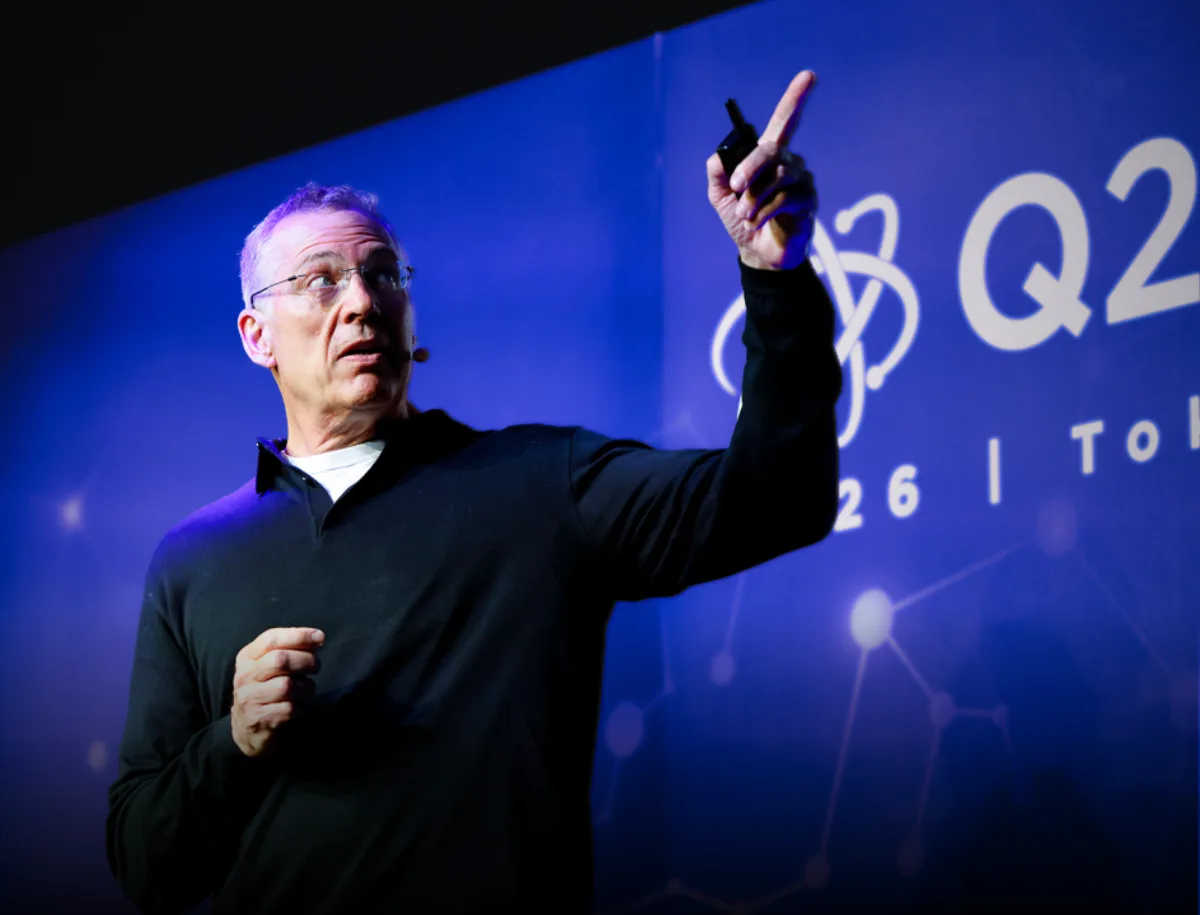
What the region lacked was a gathering place to bridge this hardware development with investors, industry leaders, and commercial partnerships. Q2B Copenhagen, scheduled for September 9-10, fills that gap. Organized by QC Ware, the conference series represents the quantum industry's leading business event globally and will be held in the Nordic region for the first time. We spoke with QC Ware CEO Matt Johnson about the quantum sector's actual state, where commercial opportunity emerges, and his belief that this edition could become continental Europe's largest quantum business gathering.
The reality behind the quantum narrative
Johnson speaks plainly about the industry's current position. "No enterprise is running production problems on quantum hardware today," he stated. The fundamental challenge remains economic rather than purely technical: quantum systems must outperform classical alternatives, including NVIDIA GPUs, to justify business adoption.
There are over 90 quantum hardware companies racing to be first to provide enterprises with something useful, and none of them have actually produced a machine with production value yet.
Matt Johnson, QC Ware CEO
Instead, enterprises conduct research-phase trials, testing smaller versions of real problems to understand quantum integration into existing systems. Yet Johnson sees momentum accelerating. Hardware vendors competing for investment and credibility drive rapid progress. "If they say they're going to have 100 logical qubits by a certain point, a competitor says, well, we might get to 200," he explained.
We've seen more advances in the past 12 to 18 months than in the previous five years.
Matt Johnson, QC Ware CEO
Where genuine commercial opportunity emerges
Johnson identifies cryptography as an early application area but downplays its significance. Shor's algorithm can theoretically break encryption at scale, which concerns security and cryptocurrency sectors, yet enterprise value concentrates elsewhere. Chemistry and materials science—drug discovery, catalyst development, molecular and crystal structure analysis—represent the first genuine commercial frontier. "Those industries will be the first to see true value," Johnson said. Financial services follow, particularly quantitative applications like derivatives pricing and portfolio optimization, with supply chain and manufacturing optimization further down the timeline.
Rather than highlighting single breakthrough projects, Johnson points to sustained, incremental work across IBM, hardware vendors, national laboratories, universities, and startups modeling physical systems. This unglamorous accumulation of evidence moves the industry toward commercial viability more reliably than headline announcements, though it advances the acceleration he describes.
Why CEE's infrastructure development reshapes the conversation
Johnson's observations about Europe's structural advantages extend beyond Denmark, the conference host and co-organizer alongside the Ministry of Foreign Affairs, Novo Nordisk Foundation, Novo Holdings, and 55 North. "European states tend to be more concentrated, not as spread out, and that lends itself to industry and government collaboration more readily," he noted, citing Denmark's integrated government-industry-academia approach as exemplary. This pattern isn't isolated: most EU member states pursue comparable strategies with governments directly supporting national hardware champions. Romania's Iași initiative, Poland's PIAST-Q, and Czechia's VLQ exemplify this coordinated approach.
CEE possesses the infrastructure and government-backed sovereignty framework Johnson identifies as distinctly European. The region's constraint is specialized talent. A 2024 European Physical Society workforce study counted fewer than 3,500 people across the EU with advanced quantum expertise against projected demand exceeding 20,000 specialists by 2030.
Bridging this gap requires exactly what Q2B provides: a single venue assembling hardware manufacturers, software engineers, venture investors, academic researchers, and government officials rather than scattered national forums.
Conference programming and participants
The opening session features an ambassadors panel on international quantum cooperation, moderated by Louise Lund Henneberg, Acting Director of the Department for Techplomacy at the Danish Ministry of Foreign Affairs. Keynotes, business seminars, and technical workshops follow, addressing optimization, chemistry simulation, pharmaceutical and materials discovery, error correction, and machine learning. Speakers include Microsoft Quantum's Lauri Sainiemi, Dr. Nathan Baker, NQCP and Quantum Foundry Copenhagen CEO Peter Krogstrup, and Novo Nordisk Foundation CSO Lene Oddershede.
Day two programming includes a venture capital panel hosted by Needham & Company's Steven Camp featuring investors from 55 North, Deep33, Quantonation, Firgun Ventures, and Qbeat Ventures, alongside a startup competition organized by BioInnovation Institute and sessions from AstraZeneca, Boehringer Ingelheim, Merck, and NTT Data Group. The VC panelists represent no CEE-focused funds, positioning the region's opportunity less as direct funding access and more as exposure: CEE teams gain visibility before global quantum capital that typically overlooks Eastern Europe.
For first-time attendees uncertain about quantum's relevance, Johnson recommends treating the conference as an efficient method to encounter the entire ecosystem simultaneously rather than seeking a single transformative application. "The whole purpose is to help amplify application discovery," he said.
You get the hardware vendors and their supply chain, the software developers, the VC community, the academic researchers, and the government agencies all in one place. You'd otherwise need months to meet that many relevant people.
Matt Johnson, QC Ware CEO
What lies ahead
Johnson anticipates utility-scale quantum computers entering operation within 24 months, characterizing the current phase as a hundred elite competitors launching simultaneously in an already-underway race. His stated objective for this edition, considering sponsorship and participation levels, is establishing it as continental Europe's largest quantum industry event. Regardless of whether it achieves that distinction, this represents the first instance of hardware vendors, capital sources, corporate buyers, and government representatives gathering in a space accessible to CEE companies and researchers without requiring travel to Silicon Valley or Munich.
For a region now possessing tangible infrastructure, this represents the moment worth attending.
Q2B Copenhagen runs September 9-10, 2026, in Copenhagen, Denmark. Register with code TR-20-CP for 20% off.
Source: The Recursive — Events tag