Linz hosted the presentation of the State of the ART(ist) Award 2026 on July 28, marking the fifth year that Ars Electronica and Austria's Federal Ministry European and International Affairs have recognized artists creating work amid war, political repression, censorship, environmental collapse and structural violence. The initiative celebrates projects that merge artistic practice with activism and human rights advocacy, illuminating social realities while creating spaces for new forms of dialogue.
The competition drew record participation this year. Submissions totaled 561 projects spanning 86 countries, underscoring art's role as a vehicle for expression, reflection and civic engagement during periods of political upheaval. The festival's overarching theme, NEGOTIATING HUMANITY, resonates with this year's award focus. The jury—comprising Irene Agrivina (ID), Christl Baur (DE), Simon Mraz (AT), Maritta Muukkonen (FI), Ivor Stodolsky (FR/US) and Tau Tavengwa (ZW/GB)—observed that "we live in a time when creating art has become an act of courage — an act of defending democratic values and artistic freedom."
Grand Prize: Paolo Almario's Marmelade
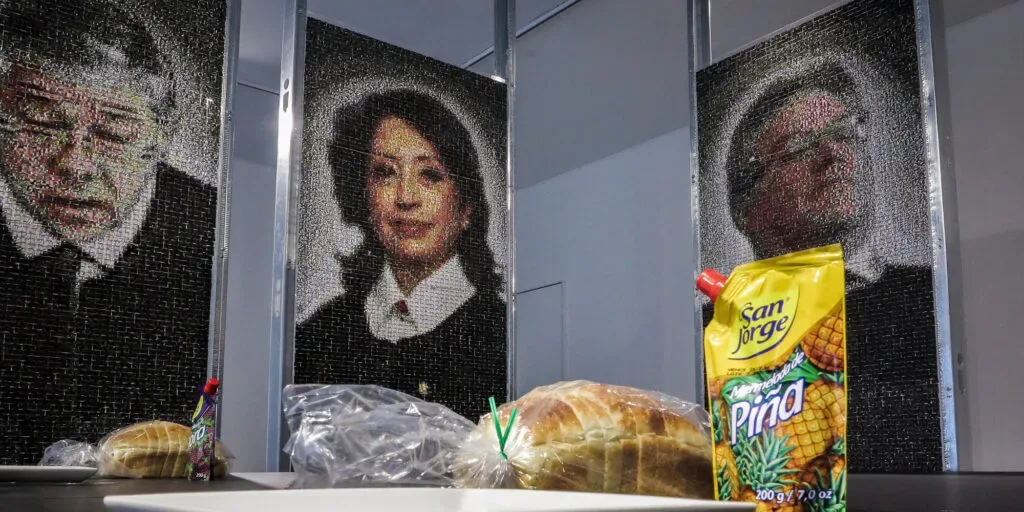
Colombian artist Paolo Almario receives the 6,000-euro grand prize for Marmelade, an installation that merges personal narrative with political inquiry into authority, graft and remembrance. The work centers on likenesses of figures from Colombia's judicial and governmental apparatus, constructed from approximately 4,800 hand-cut jam labels mounted onto Plexiglas and set into custom cavities. From distance, these become recognizable faces; up close, they fragment into thousands of individual labels.
During display, seven robotic arms will progressively disassemble the mosaic sections. The pieces descend onto a table and ground, mingling with breadcrumbs and jam residue deposited by visitors, who are invited to consume Colombian jam spread on bread. The title invokes "mermelada," a Colombian colloquialism for the patronage-based allocation of political authority. The gradual erasure of the portraits embodies redistribution: what once signified state power passes symbolically to the public through consumption.
Almario's work draws from decades of political persecution within his own family. The depicted individuals connect to legal actions pursued against his father. Marmelade situates this family history within a wider examination of institutional constraints, constructing a participatory poetics of redistribution—a creative mode of resistance born when official systems break down.
Award of Distinction: Sara Azadkhani's Canvas
Iranian artist Sara Azadkhani receives the Award of Distinction and 4,000 euros for Canvas, a photographic series investigating how juridical and communal hierarchies embed themselves in women's bodies and existence. The project originates in Azadkhani's own two-year divorce process in Iran, during which she witnessed a legal apparatus granting men unilateral divorce authority while forcing women to surrender assets, property or parental custody to dissolve their marriages.
The psychological toll of this ordeal inscribed itself upon Azadkhani's body as injuries and marks—a wordless record of her suffering. In Canvas, she photographs her skin and translates these marks into visual material that binds private suffering to broader social and political frameworks. The series exposes how legal codes and male-centered cultural norms penetrate even the most private dimensions of human life.
Festival Presentation
Both prize-winning works will feature in the thematic exhibition "NEGOTIATING HUMANITY" during the Ars Electronica Festival 2026, running September 9–13. Marmelade and Canvas anchor the FESTIVAL WALK, a curatorial path originating at OK Platz that connects multiple exhibition spaces through shared conceptual concerns. Almario and Azadkhani will attend the festival to present their projects directly to audiences.
About State of the ART(ist)
State of the ART(ist) launched in 2022 as a partnership between Ars Electronica and Austria's Federal Ministry European and International Affairs, responding to Russia's invasion of Ukraine. The program has since championed artists whose practice faces threats from political suppression, armed conflict, social disparity, ecological catastrophe or technological surveillance. The 2026 edition emphasizes the convergence of artistic practice, activism and resistance, alongside art's capacity to foster international cooperation and diplomatic cultural exchange.
Source: Ars Electronica