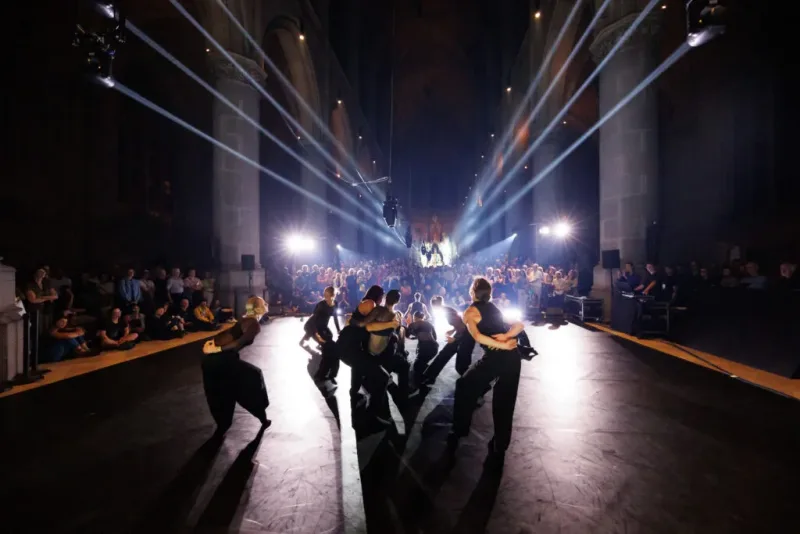
How should we think about shaping tomorrow when the present feels so unstable? This question sits at the heart of the Ars Electronica Festival 2026, where a shared campus will materialize in Linz drawing 45 universities and their competing worldviews into conversation.
The university as an institution has long been imagined as a sanctuary for difficult inquiry—a place where established truths get questioned, where uncertainty becomes fuel for discovery rather than failure. Yet this ideal faces mounting pressure. Between July 2024 and June 2025, Scholars at Risk documented 395 attacks on scholars, students, and universities across 49 nations. The Academic Freedom Index 2026 reveals a troubling pattern: 36 of 179 countries surveyed have seen conditions worsen since 2024, with only eight showing improvement. Even in democracies once considered secure, the picture darkens. Institutional autonomy at American universities has dropped 50 percent since 2015. Scholars at Risk warns that assaults on universities strike at "the foundations of a free society."
Against this backdrop, Ars Electronica and the University of Art and Design Linz are assembling an unprecedented gathering. The 45 participating institutions operate under radically different circumstances—some where dissent flows freely, others where it faces increasing restriction. For five days, these divergent realities will occupy the same physical and intellectual space. Rather than seeking consensus, the Campus Exhibition aims to render different positions legible, to sit with disagreement, and to sustain dialogue across fracture lines. The festival's overarching theme, NEGOTIATING HUMANITY, shifts from abstraction into lived experience.
Room for Dissent
What futures are emerging from the studios and workshops of art schools worldwide? Projects across Europe, Asia, and the Americas grapple with this question through speculative works and interactive installations.
Students in Communication Design at HTW Berlin—Berlin University of Applied Sciences—have created "AGE OF MONSTERS," five experimental setups that interrogate how artificial intelligence and neurotechnologies are governed and where their boundaries lie. Visitors do not remain passive observers; they become embedded within the very systems and logics they are meant to examine.
Taiwan's National Tsing Hua University presents "Anthrocenidion," imagining a world after humanity where machines sift through data and ruins searching for traces of organic existence. Drawing its title from ancient Greek words meaning "human," "emptiness," and "relic," the work conjures a speculative realm of "artificial vigilance"—asking what survives of humanity once humans have vanished and only machines retain memory of their creators.
Three Brazilian institutions—PUC-Campinas, Universidade Federal de Goiás, and Instituto Mauá de Tecnologia—center the body in their collaborative work "HumanMapping." The project examines flesh, closeness, and the cadences of responsive systems, insisting that technology always meets us through physical experience, shaped by gender, social position, and fragility.
At the FHNW School of Art and Design in Basel, artists in the Make/Sense PhD program and Transversal Design MA program investigate how digital systems reshape existence. Through installations, videos, and participatory pieces, they trace how algorithms, interfaces, and data architectures mold bodies, identities, feelings, and principles—and what kinds of cohabitation between people and machines might emerge.
Students in the joint Design & Computation master's program at the Technical University of Berlin and Berlin University of the Arts offer "Negative Spaces," examining how knowledge gets made and shared. The works probe which images, datasets, and technological frameworks determine what becomes visible—and therefore significant—and what gets obscured.
The University of Applied Arts Vienna contributes "Playthings of Touch," six pieces exploring tactile sensation as a pathway to understanding. Knowledge here emerges not only through looking but through contact, pressure, and grasp—and equally through touch withheld or absent. Together they ask what touch discloses about bodies, authority, and connection, and what vanishes when it does not occur.
The Ars Electronica Campus Award
For the third consecutive year, the Ars Electronica Campus Award will recognize outstanding work within the exhibition. A three-person panel of media art specialists will select five Honorary Mentions from all submissions and award a Grand Prize of 2,000 euros. The ceremony takes place Saturday, September 12, at OK QUARTER, where winners will be celebrated alongside participants, collaborators, and figures from the media art field.
The future is a matter of negotiation
Within the University of Art and Design Linz, more than 80 student and emerging artist works will explore diverse questions about futurity. "Students grapple with what humanity means during crisis, how this gets discussed, and who claims the authority to define it," explains Manuela Naveau, university professor of Critical Data at the Institute for Interface Cultures. "Yet they also push back against purely human-centered thinking—recognizing that our world interlaces with other species and the planet itself, so humanity cannot be conceived so narrowly." Naveau co-curates this year's Kunstuni Campus alongside South Korean artist and designer Hess Jeon.
The festival's theme, FUTURE BEGINS, deliberately uses present tense. The future is not some distant destination we await; it materializes through choices and shifts we make now. Yet how do students themselves envision what lies ahead? "I am struck—often deeply moved—by the thoughtfulness students bring to questions about tomorrow; by their ability to name what they feel, what frightens them, what compels them. They hold convictions, they voice them, and they insist these conversations belong in the classroom," Naveau reflects.
Beyond Ready-Made Answers
Taking cue from Isaac Asimov's story "The Last Question," where humanity perpetually defers an answer until merging with a machine, the University of Art and Design Linz reframes the inquiry: not what does the future hold, but what does it cost? The Interface Cultures program pursues this through "Codes [] Rituals," treating student works not as finished declarations but as personal systems and zones for experimentation and shared imagination—made in an age of fractured attention and accelerating media flows.
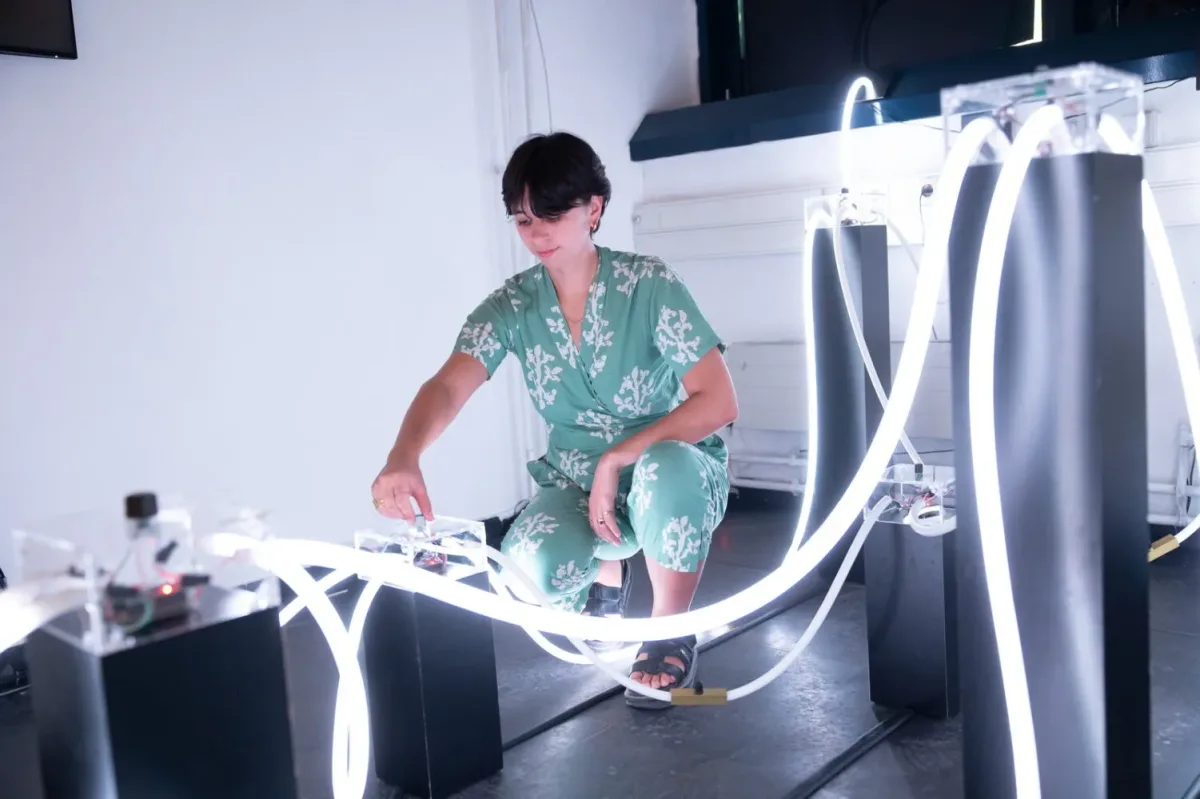
This year marks the first presentation of these works in the University of Art building on Domgasse. Visitors encounter a robotic worm animated by body heat, a limestone record that renders stone audible, and exchanges with an "uninformed" AI anxiety assistant. The Leonardo Laser Talk will also introduce the university's upcoming annual focus: CARE.
The Courage to Disagree
Rather than Asimov's human-machine merger, artists and activists at the University of Art locate the future's potential in human plurality, friction, and messiness. They search for tomorrow not in technological elegance but in the friction between cultural and social voices. This vision crystallizes on Linz's central square under the banner "Flood the Zone with Courage," where feminist positions from FIFTITU% and anti-war activism from ATTAC Austria converge. The project privileges exchange, contradiction, and collective action over algorithmic tidiness.
"Working with ATTAC Austria and the Ars Electronica Center, students and faculty examined arms lobby operations within the European Union and their ripple effects. They drafted artistic concepts and counter-strategies, developed new modes of communication and protest, all meant to deepen public conversation about militarization and peace research. The results appear at the festival on the main square," Naveau notes.
Conflict and Communication
Several Kunstuni Campus works address present-day conflicts and the roles language, media, and technology play. Robin Lütolf's "I am Sorry" comprises eight thermal printers triggered by algorithmic feeds from conflict zones, printing the title's letters. As co-curator Hess Jeon describes it, the installation answers world events "not with analysis, but with expression," while also pointing to an algorithmic and AI-saturated media landscape that lacks emotional comprehension of collective feeling.
"Vocal Duets" by Alireza Khosroabadi and Sara Karimi similarly engages current conflict through language as communicative tool. The video work presents a measured yet forceful performance that makes the proximity between different tongues tangible, contrasting it with impending collision between worlds. In this way, the piece recalls what language binds together across conflict.
The projects described here represent only a fraction of what the 2026 Campus Exhibition will offer. The complete program, listing all universities and works, is available on the festival website.
Manuela Naveau
Manuela Naveau holds a PhD and serves as university professor, independent curator, and art-based researcher. For nearly 18 years she directed Ars Electronica Export, building and leading the department from its launch. Since 2020 she has held the position of university professor for Critical Data at the Interface Cultures Department / Institute of Media at the University of Arts Linz, which she has headed since February 2023 while founding the Critical Data Research Group. Her monograph Crowd and Art – Kunst und Partizipation im Internet was published by transcript Verlag (Germany) in 2015. Her subsequent research and writing have centered on participation, interaction, and collaborative practice in Media and Digital Art, Critical Data, and contemporary art, yielding numerous scholarly publications, essays, and curatorial texts.
Hess Jeon
Hess is an object-oriented artist and designer from South Korea whose practice examines contemporary machines and their cultural and social effects. He combines speculative design with artistic research and playful inquiry. His education includes Industrial Design (BDes) from NCAD Dublin and Interface Culture (MA) from Kunstuniversität Linz, where he is currently pursuing a PhD.
Source: Ars Electronica