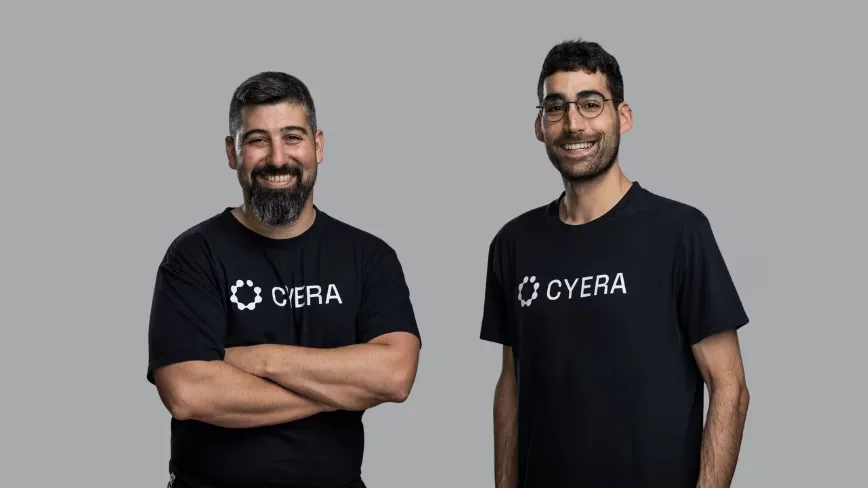
Data security company Cyera has secured $400 million in fresh capital from Growth Equity at Goldman Sachs Alternatives, extending its Series G round that Evolution Equity Partners had led in June. The investment maintains the company's $12 billion valuation, marking the third significant funding round Cyera has closed within the calendar year.
During the announcement on Tuesday, Cyera cofounder and chief executive Yotam Segev highlighted the core challenge driving the investment: "They need to trust what AI agents can see and do before they can scale them." The new capital will support three strategic initiatives: advancing an AI security roadmap, penetrating the federal market, and expanding operations throughout EMEA and APAC regions.
Valuation holds steady at $12 billion
Unlike typical growth-stage funding rounds that push valuations higher, this extension represents a flat round—Cyera gains $400 million without any increase in per-share pricing from the June valuation. The company has now accumulated $1.4 billion in funding across 2024, following a $400 million round in January and the $600 million Series G in June.
Cyera's total funding now exceeds $2 billion since its 2021 founding by Segev and chief technology officer Tamar Bar-Ilan. The company's valuation has grown substantially from $3 billion as recently as 2024. The June round attracted Cyberstarts and Temasek as new backers, while existing investors on the cap table include Accel, AT&T Ventures, Blackstone, Coatue, Georgian, Lightspeed, Sequoia and Spark Capital.
How the product works
Cyera's core offering began with data classification—identifying what sensitive information organizations possess and who can access it. The company has now extended this capability to monitor the software and AI agents operating on that data through two primary products: Agent Guardian and Cyera Endpoint.
These tools track far more than simple prompt-and-response interactions. They record tool calls, database queries, and intermediate actions taken by AI agents across cloud environments and endpoint devices. As local coding agents like Claude Code and Cursor increasingly handle sensitive tasks, Cyera's monitoring extends to these endpoints as well. The company frames its offering as a unified security layer protecting data at rest, in motion, and in use—whether accessed by humans or autonomous agents. Named customers in the announcement include Paramount, Chipotle and Valvoline.
The acquisition that enabled this strategy
In July, Cyera acquired Oasis Security for approximately $1 billion, bringing non-human identity management into its platform. Non-human identity refers to the credentials machines and agents use to authenticate and operate, distinct from human user credentials.
This acquisition fundamentally shaped Cyera's current positioning. While identifying where sensitive data resides represents one security challenge, determining which machine identities can reach that data presents another. Cyera now sells the combination of both capabilities. In a blog post announcing the deal, Segev noted that non-human identities within Fortune 500 companies had grown nearly 500 percent in six months, making them the fastest-growing identity type in enterprise environments. He argued that autonomous agents pose a distinct risk: given valid credentials and a defined objective, an agent can expose data or disrupt processes without requiring an attacker to compromise it. Cyera contends that most enterprise security architectures were designed for people and applications, not for millions of autonomous actors.
A crowded competitive landscape
Irit Kahan, managing director at Growth Equity at Goldman Sachs Alternatives, described securing AI as "one of the defining categories in enterprise technology over the next decade." She identified the specific vulnerability Cyera addresses: as agents proliferate faster than organizations can track, the gap between what agents are authorized to access and what they can actually reach grows dangerously wide.
Multiple competitors have emerged to address this same market opportunity throughout 2024. NewCore raised $66 million in June to provide corporate identity capabilities for AI agents. SailPoint subsequently acquired Entro to integrate non-human identity into its agentic fabric offering. Neo launched from stealth in July with $100 million from a16z and Bessemer to build control layers for agentic software. Comp AI secured $34 million last week for agentic compliance solutions. While none of these competitors command Cyera's financial resources, all are articulating the same fundamental security gap.
Where the capital will be deployed
The federal market expansion represents the most straightforward use of the new funding. Selling security solutions to United States government agencies requires security accreditation, personnel with appropriate clearances, and extended sales cycles—all of which demand significant capital investment long before generating revenue. This is one area where substantial funding directly translates to market access.
The geographic expansion into EMEA and APAC regions addresses another priority. Cyera reports that enterprise demand for agent oversight is accelerating across both regions. The company currently operates across 18 countries with more than 1,500 employees, having already surpassed $2 billion in total funding by June despite this headcount.
Goldman Sachs Alternatives' Growth Equity division has deployed more than $17 billion into companies since 2003, with the broader alternatives business managing over $706 billion and Goldman Sachs supervising approximately $4 trillion in assets as of June's end. This represents Goldman's first investment in Cyera, arriving at the identical valuation that June's investors accepted.
Notably absent from Cyera's disclosures is any revenue figure. The company stated in June that annual recurring revenue had tripled over three consecutive years—a growth rate rather than an absolute number. The $12 billion valuation Cyera has maintained since June rests on financial metrics that remain visible only to investors on the cap table.
Source: The Next Web