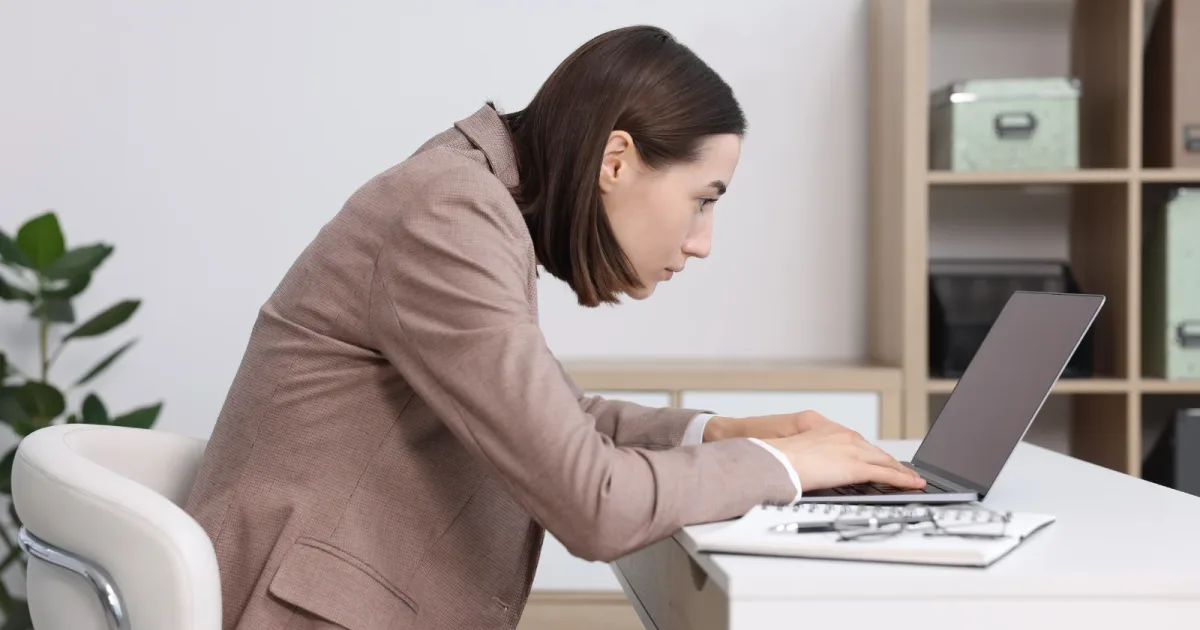
The instinct to make yourself smaller when under pressure is not a character flaw. It is a survival mechanism encoded over millions of years, designed to render you inconspicuous in moments of danger. Telling someone to "sit up straight" misses the point entirely. Such advice treats slouching as a discipline issue, something that nagging can fix. In some cases, that assessment is correct—an uncomfortable chair, a low desk, or a phone held in the lap can all cause forward folding.
Yet there exists another dimension to why adults collapse inward, one that has nothing to do with carelessness. When confronted with stress, particularly the stress of being observed and judged, the body contracts. The shoulders move forward. The chest tightens. The head lowers and the gaze drops. This pattern follows ancient logic: a smaller silhouette presents a smaller target.
What happens when researchers hunch people over on purpose
The earliest research on this topic is also the most straightforward. Four laboratory studies from 1982 by John Riskind and Carolyn Gotay had participants assume either a slumped or upright position before tackling a task. Those who slouched abandoned the puzzles more readily, even when some had no solution. In another experiment within the same paper, people placed in a hunched, defensive posture reported elevated stress levels.
These findings are old and based on small groups, so they should be viewed as preliminary rather than conclusive. However, the pattern emerged again in more rigorous research. A 2015 randomised trial conducted at the University of Auckland secured 74 participants in either a slumped or upright seated position, then subjected them to a standard social stress test featuring a speech and mental arithmetic performed under evaluator observation. The upright participants reported stronger self-esteem, improved mood and reduced fear. The slumped group employed more negative emotion language, more sadness vocabulary, and notably more self-referential statements. A single trial does not constitute definitive proof, yet this study was carefully designed.
Why folding inward can feel safer
This is where standard posture advice becomes complicated. Reducing your physical presence in front of a critical audience may actually serve a purpose.
A 2015 study assigned 85 men to either an expansive, dominant posture or a constrictive, subordinate one while delivering a speech and solving difficult arithmetic problems before two openly critical evaluators. The dominant posture triggered a larger cortisol response. The subordinate group did not experience the stress hormone elevation that this type of protocol typically produces. The researcher interpreted this finding to mean that when circumstances are genuinely beyond your control and the person evaluating you holds all the power, a submissive display can be rational.
Again, this represents a single study with only male participants, and it contradicts most published research. Approach it as a cautionary note rather than established fact. Nevertheless, it illuminates something that posture advocates overlook. Slouching frequently represents a strategy that has worked. At some point—in a classroom, an open-plan office, or a troubled home—occupying less space provided protection.
The trouble starts when the shape stops being temporary
A protective response that arrives temporarily and then departs causes no harm. One that persists becomes self-reinforcing.
Research from VU Amsterdam involved 229 participants who received either a negative or neutral mood induction, then recorded their thoughts while stooped, straight, or in a control posture. Stooping delayed recovery from negative mood, worsened the neutral group's feelings, and increased negative thought patterns overall. The researchers characterized the automatic tendency to stoop during low mood as a self-perpetuating feedback mechanism. The mood draws the body downward, and the body then reinforces the mood.
Ignore anything you have heard about power posing
Before anyone retreats to a bathroom stall to strike a victory pose, some clarification is needed. The widely cited 2010 power posing study claimed that two minutes in an expansive stance elevated testosterone, reduced cortisol and boosted risk tolerance. A substantially larger replication conducted in 2015 found no hormonal or behavioural changes. Participants reported feeling more powerful, and that was the extent of it. The following year, the original study's lead author released a statement disavowing belief in the effect's reality.
What the evidence does support
A 2020 meta-analysis screened nearly 6,000 records and synthesized 73 experiments. It verified genuine differences between expansive and contractive posture, then identified the actual source of those differences. When measured against a neutral posture, contracting demonstrated a moderate effect. Expanding showed almost no effect whatsoever.
The benefits derive from what is eliminated. There is no requirement to manufacture confidence. The meaningful change involves addressing the collapse itself, and the benefit available is limited.
Where to start
Begin by observing the circumstances that trigger slouching before attempting to alter the posture itself: which rooms, which individuals, which moments of the day activate it. Most people discover that the collapse connects to specific spaces and specific people, and recognizing that pattern proves more valuable than any chin adjustment.
Approach change through breathing rather than shoulder mechanics. Pulling the shoulder blades backward creates muscular tension that exhausts within roughly ninety seconds, so it rarely persists independently. Breathing out completely and allowing the sternum to rise on the next inhalation transforms the entire posture without any muscular strain.
Elevate your screens. A laptop positioned on a low desk forces a dropped head for the entire workday, and conscious effort cannot overcome physical setup. Position both feet firmly, center weight over the sit bones, and adjust posture at natural breaks, because scheduled reminders tend to be forgotten by midday.
One final consideration. If the collapse never truly resolves, if it accompanies flat mood and diminished energy, and if it persists even after the stressful situation ends, the posture signals something deeper. This warrants discussion with a medical professional or therapist, and no breathing technique will address it.
Source: Silicon Canals