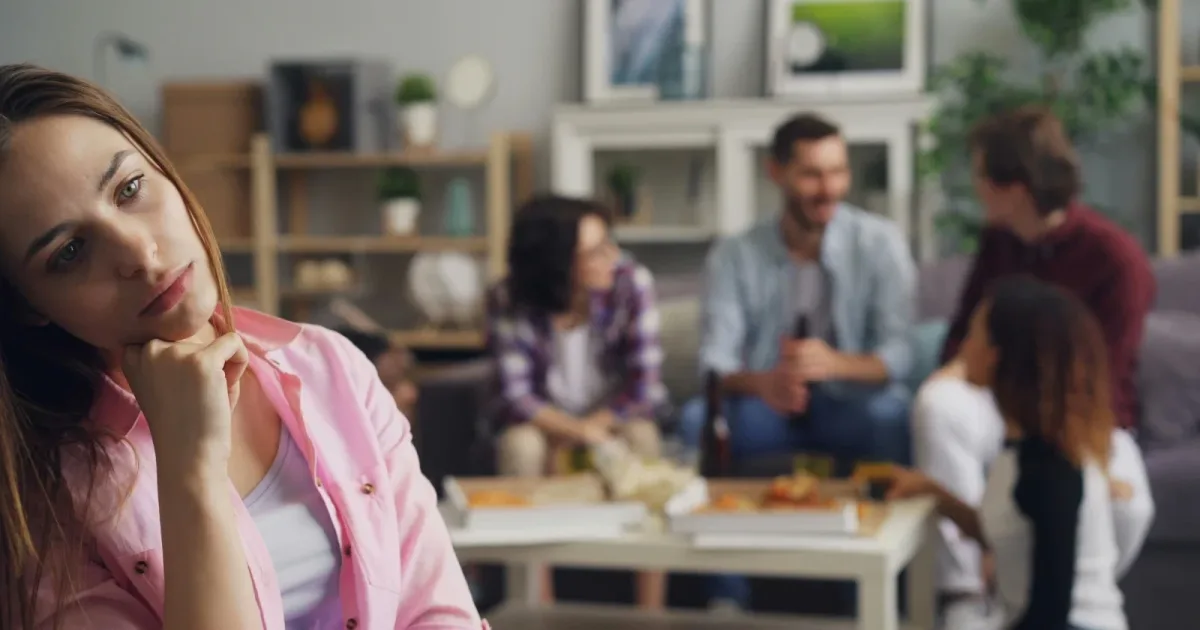
Adaptive strategies learned in childhood often persist into adulthood—our nervous systems retain memories of the behaviours that once kept us safe. A particular kind of silence emerges specifically in family settings, distinct from ordinary shyness or social anxiety.
Consider someone who leads meetings professionally, engages in spirited debate with strangers, and entertains dinner guests with ease. Yet when a certain relative enters the room, this same person becomes noticeably withdrawn. Not withdrawn from boredom or irritation, but diminished—as if physically shrinking. This pattern typically gets misattributed to shyness, moodiness or poor family relations, when in reality it reflects an old survival mechanism still operating under its original programming.
Shyness travels; this response doesn't
Shyness functions as a stable personality trait, manifesting consistently across contexts—at social gatherings, professional interviews, medical appointments, anywhere. The withdrawal described here operates differently. Someone might be talkative in the kitchen yet silent at the dinner table. Comfortable with one sibling but withdrawn around another. The shift can occur within a single hour.
This differs from selective mutism, a diagnosable anxiety disorder typically beginning in childhood where individuals become physically unable to speak in particular settings while speaking freely elsewhere. Ordinary family quietness is less severe and more voluntary. Yet the structural similarity is instructive: the environment itself determines the response.
A fourth survival response that rarely gets mentioned
Most people recognise fight, flight, and freeze as stress responses. Therapist Pete Walker identified a fourth: fawn. Rather than confronting, escaping, or becoming immobilised, the fawn response involves appeasing others. This means rapid agreement, preemptive apologies, constant attunement to the emotional atmosphere, and self-adjustment to match it.
Though not formally classified as a diagnosis in clinical manuals, fawn describes something genuine. Going quiet represents a simplified version of this response. Remaining silent ensures no offence is given and allows one to navigate through the gathering without incident. Children exposed to unpredictable adult emotional states absorb this strategy quickly because it demonstrably works.
Children develop extraordinary skill at reading emotional signals
The mechanism becomes physical and measurable. Research examining children raised in violent households shows they detect anger in facial expressions using minimal information—a barely-formed expression triggers recognition. Studies consistently found this effect strongest for anger specifically rather than emotions broadly.
An important distinction: this research involves maltreated children, a substantially more severe situation than simply living in a tense household. People shouldn't automatically apply these findings to their own family experiences. The underlying principle, however, remains sound: environmental demands shape attention. When household moods carried consequences, children learned to monitor them vigilantly. This skill doesn't deactivate upon leaving home.
Familiar spaces reactivate childhood patterns
Attachment researchers have documented how adults revert to childhood behavioural patterns when in the presence of parents and siblings, sometimes decades after leaving home. The family peacemaker resumes peacemaking. The person who was perceived as excessive starts apologising for occupying space.
Much of this stems from environmental cueing. A particular chair, the scent of a hallway, the specific tone of a voice—these sensory elements trigger nervous system responses that operate independently of rational thought. A nervous system takes such cues seriously regardless of one's current age or adult responsibilities. This explains why the quietness often feels involuntary. In a genuine sense it is: the shrinking wasn't a conscious choice but an automatic response triggered by returning to that space.
Self-silencing carries measurable psychological consequences
Psychologist Dana Crowley Jack termed this phenomenon self-silencing: the suppression of one's own needs, opinions, and frustrations to preserve relationships. Her book Silencing the Self emerged from extensive research with depressed women, leading her to develop a measurement scale. Higher self-silencing scores correlated with elevated depression scores.
Her initial research focused exclusively on women, so this isn't a universal human law. Subsequent research has expanded the scope. The fundamental finding, however, proves robust: maintaining peace exacts a price. The cost manifests later as resentment, emotional numbness, or the forty-minute drive home spent mentally rehearsing words left unspoken.
Practical approaches that actually work
- Attribute the pattern to the environment rather than yourself. Framing it as 'I go quiet at my parents' house' rather than 'I'm bad with my mother' opens pathways to solutions.
- Express one small authentic preference per visit. This needn't be confrontational—a simple statement like 'I'd prefer to sit outside' or 'I don't want another drink' serves the purpose. Repetition matters more than the substance.
- Change the setting when feasible. Neutral locations like restaurants lack the childhood associations of family homes, and people tend to behave differently in such spaces.
- Establish a defined exit point. Being able to leave after two hours beats enduring six, and everyone benefits from encountering a better version of you.
- Notice physical signals first. Tension in the jaw, shoulder tightness, or shallow breathing typically precede conscious awareness, providing a brief window for intentional choice.
- Seek professional support if needed. Working with a therapist specialising in family dynamics offers valuable assistance if this pattern feels more serious than seasonal awkwardness.
The goal isn't necessarily to eliminate the quiet. Some relatives genuinely drain energy, and choosing to speak less around them represents a mature, rational decision. The critical question concerns agency: is this afternoon's version of you making an informed choice, or is a much younger version still running a survival strategy that was once necessary but whose circumstances have fundamentally changed?
Source: Silicon Canals