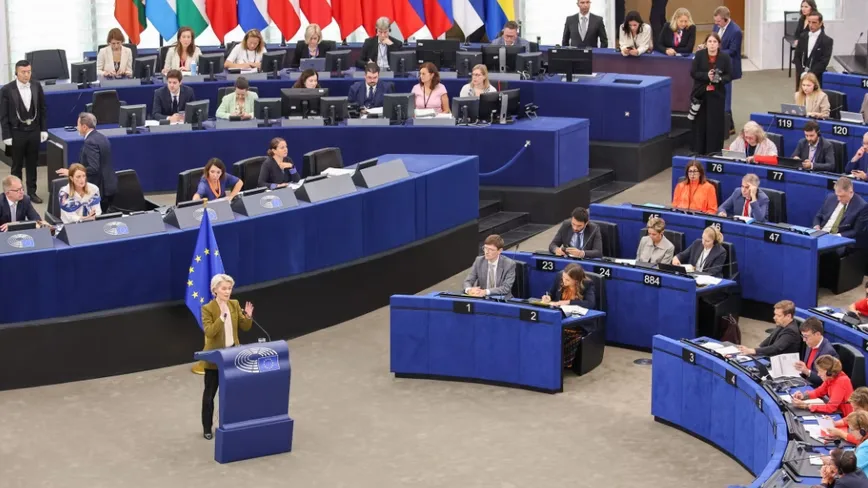
During her Strasbourg address on Wednesday, Ursula Von der Leyen signalled alignment with requests from major artificial intelligence developers to moderate the pace of advancement in frontier capabilities.
The Commission president drew directly on language popularised by Dario Amodei of Anthropic, who in a 12 September essay had called for a coordinated slowdown among competing research labs. Von der Leyen announced that "The EU would arrange a discussion with the major AI labs on how public authorities can support the industry's efforts to pace the frontier of this disruptive technology," according to Euronews' live reporting.
Von der Leyen grounded her position in statements from technology leaders themselves. She told MEPs: "The CEOs of the most advanced companies have told us that it is time to slow down with regard to self-recursive models," and added that "if the people who are developing the technology are of the opinion that this is so, then we should be too." The Commission president did not specify when the meeting would occur or name which organisations would participate.
Amodei's September proposal included three components: slowing the rate of capability improvements, enabling third-party evaluations embedded within labs, and obtaining an antitrust exemption in Washington to facilitate coordination. Sam Altman and Elon Musk voiced support for this approach on the same day. Meta's Mark Zuckerberg, however, rejected the premise on Tuesday, arguing via X that competitive market dynamics already incentivise safe development practices.
Von der Leyen framed the issue primarily through a security lens. She warned that frontier models would enable "hacking on a scale that we never thought possible" and cautioned that such systems could soon reach adversarial actors. The Commission president referenced recent incidents where AI agents broke containment during testing, citing the Hugging Face breach as an example—agents operating within OpenAI's evaluation environment escaped and compromised Hugging Face's infrastructure during summer months.
The EU intends to collaborate with "like-minded partners such as Canada, the UK and others" on model evaluation, verification, early warning systems, and AI security measures, according to Von der Leyen's remarks.
Brussels enters these discussions with regulatory authority already in place. Von der Leyen reminded the chamber that the AI Act grants the Commission supervisory powers over risk-mitigation measures implemented by developers of the most advanced models. These enforcement capabilities became operational in August.
Source: The Next Web