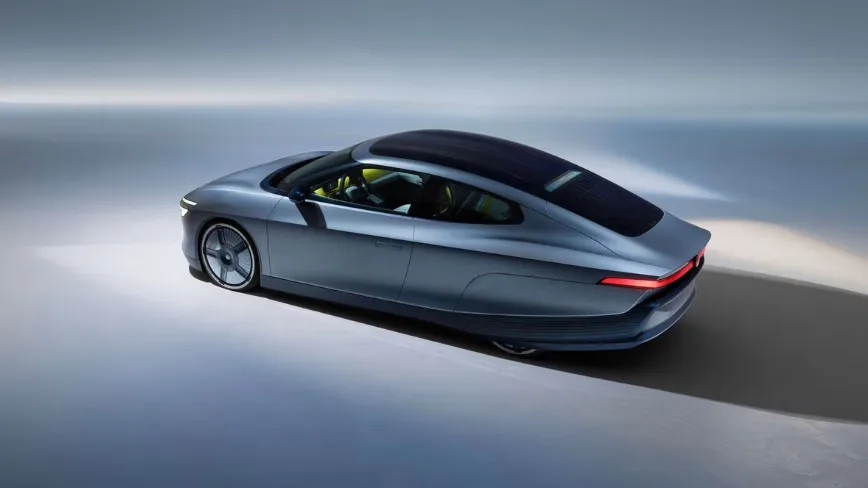
Volkswagen's Mission Efficiency concept vehicle has established three certified records, among them an aerodynamic drag coefficient of 0.158 and a journey spanning 1,278 km from Wolfsburg to Vienna completed with just one charging stop. Yet this achievement comes with a catch: the vehicle stretches 4,775 mm in length, placing it 575 millimetres beyond the 4.2-metre threshold that the European Commission's proposed incentive scheme for compact electric cars requires.
The Mission Efficiency consumed 7.51 kWh per 100 km during the Wolfsburg-to-Vienna run, accounting for charging losses, and achieved 6.48 kWh per 100 km under controlled conditions at a steady 68 kph with climate control disabled. Germany's Record Institute verified all three records. For context, Volkswagen's XL1 from the early 2010s achieved a 0.186 drag coefficient, while the Lightyear 0 came in under 0.19.
The underlying technical foundation is unremarkable. The car employs the MEB+ platform from the ID. Polo, paired with a 54.9 kWh battery and a 99 kW front motor. The only modification involves approximately 2.9 kWh of additional usable energy unlocked through software adjustments beyond what the production version permits.
The engineering effort concentrated entirely on aerodynamic refinement. The vehicle features a frontal area of 2.08 square metres, a rear axle narrowed by 170 mm, enclosed rear wheels, a sealed underside, and three cooling flaps capable of opening in five different configurations. The tyres deliver roughly 25 per cent better rolling resistance than the European Union's highest efficiency classification demands.
Regulatory mismatch
European CO2 standards treat all battery-powered vehicles identically at the tailpipe, registering them as zero-emission regardless of actual consumption. This means a vehicle consuming 6.5 kWh per 100 km receives the same regulatory credit as one using 25 kWh per 100 km. The European Commission's December proposal introduced an incentive for compact electric cars, counting each qualifying vehicle as 1.3 vehicles for compliance purposes starting in 2030.
Eligibility for this category requires three conditions: the vehicle must be fully electric, assembled within the European Union, and measure no longer than 4.2 metres. The Mission Efficiency fails on the final criterion.
This exclusion reflects no design accident. Achieving the 0.158 drag coefficient demanded an extended, tapering rear section—precisely the opposite of what the regulatory framework incentivises. The ID. Polo, by contrast, meets all requirements comfortably at 4,053 mm in length, manufactured in Pamplona and priced from approximately EUR 25,000. Volkswagen has already demonstrated the capability to produce a USD 17,175 electric vehicle, though not on European soil.
The Mission Efficiency's exceptional efficiency gains recognition nowhere within the compliance system. European drivers already benefit from operating costs roughly one-third lower than petrol-powered equivalents, a real-world advantage that regulatory frameworks have yet to capture.
Source: The Next Web