Industrial automation has long demanded substantial investment in infrastructure, closed systems, and extensive operator training. That landscape is shifting rapidly. Lightweight foundation models capable of running on edge hardware are converting spoken instructions into machine commands, transforming factory floors into environments where human intent flows naturally into mechanical action.
The transformation mirrors what has already happened in office work. When you describe a task to an AI agent at your desk, it manages the underlying complexity—calling APIs, retrieving data, orchestrating tools. Manufacturing is now experiencing the same paradigm shift.
Natural language is becoming the primary control interface for industrial equipment. Production line operators who once required specialized certifications to reprogram systems can now simply state their requirements. The AI translates human intent into executable machine commands.
From Speech to Motion: The Forgis and Arduino Demonstration
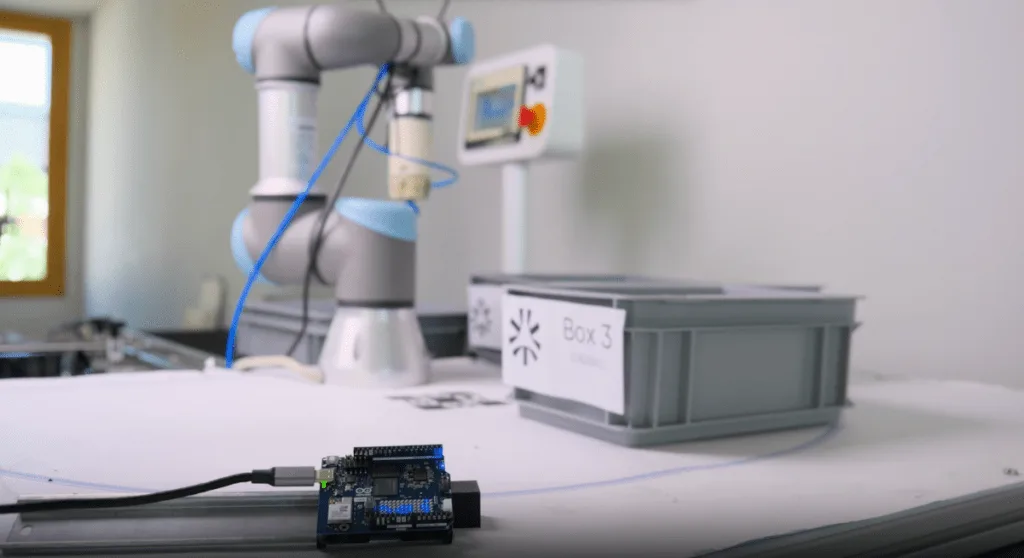
Swiss manufacturer Forgis, which develops physical AI models tailored to manufacturing environments, recently showcased this capability in action. Using a smartphone, an operator transmits a voice command to an AI agent deployed on the Arduino UNO Q board. Forgis's foundation model interprets the prompt, identifies which item to grasp and its destination, generates the complete motion sequence, and instructs the robotic arm to perform the action—all triggered by a single natural language statement such as "put each box in their respective compartments."
The foundation model processes multimodal factory information—the robot's CAD geometry, PLC I/O signals, production parameters—and converts it into structured, machine-executable code instantaneously. The robotic arm's visual sensor feeds directly into the board via USB, which executes the AI model locally with a response time of merely 20 ms. The UNO Q's LED display communicates the agent's operational status, keeping operators informed about system activity.
Why Edge Processing Matters on the Factory Floor
Crucially, this entire workflow bypasses cloud connectivity. The inference engine operates entirely on the edge device—a distinction with substantial implications for factory environments where network reliability, response delays, and data confidentiality present genuine operational challenges.
The advantages translate directly to operational improvements. Reduced manual intervention decreases mistakes—particularly valuable in sectors demanding high precision like aerospace, medical device manufacturing, and automotive production. Operators redirect their attention from repetitive floor operations toward monitoring and handling unexpected situations. Since the foundation model continuously absorbs insights from production activity, system performance should enhance progressively.
The Arduino platform's open architecture enables development teams like Forgis to deploy their proprietary models without becoming entangled in hardware compatibility issues. The distance between experimental systems and commercially deployable solutions continues to shrink.
The Broader Shift in AI Application
Agentic AI has spent recent years authoring software code and composing documents. It is now commanding physical machinery. The collaboration between Forgis and Arduino represents an early indication of how industrial AI functions when edge hardware possesses sufficient speed to match the pace of physical processes—and when the control mechanism is simply human speech.
Source: Arduino Blog