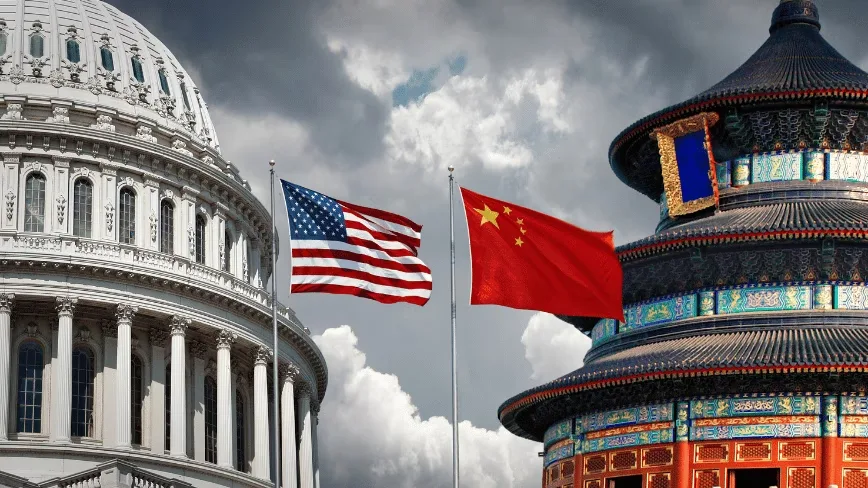
Researchers from the United States and China have unveiled proposals for governing military AI systems by adapting the framework that has long governed nuclear arsenals, with a central requirement: machines cannot make autonomous decisions about launching weapons. According to Reuters, the recommendations emerged from the US-China AI and National Security Dialogue, an ongoing initiative established in 2019 through collaboration between the Brookings Institution and Tsinghua University's Center for International Security and Strategy.
Melanie Sisson, a senior fellow at Brookings, and Tianjiao Jiang, an associate professor at Fudan University, authored the proposals released last week. To date, neither the American nor Chinese government has formally endorsed the recommendations.
Core safeguards
The framework establishes several critical boundaries for military AI deployment:
- AI systems must not autonomously determine whether to deploy nuclear weapons
- AI must not be weaponized to strike the adversary's nuclear command infrastructure
- Human operators must retain decision-making authority over significant cyberattacks targeting a rival's nuclear systems
Beyond these restrictions, the experts advocate for establishing a dedicated military communication channel between Washington and Beijing specifically for managing AI-related incidents. They also stress the need for both nations to develop a shared understanding of what "meaningful human control" entails—a concept frequently invoked in arms-control discussions but currently lacking a universally accepted definition.
Building on recent agreements
These proposals build upon commitments made in November 2024, when then-President Joe Biden and Chinese President Xi Jinping jointly declared that human judgment, rather than algorithmic systems, must govern decisions regarding nuclear weapons deployment.
However, the practical value of a dedicated hotline depends on both sides' willingness to use it. Carla Freeman, a researcher at Johns Hopkins University, cautioned that Chinese officials may be reluctant to engage through such a channel until top leadership has formulated an official position, a process that "may take days if not longer."
China's institutional approach
Beijing has been integrating AI considerations into its security strategy. Shen Jian, China's ambassador for disarmament affairs, has emphasized that military AI systems could amplify risks of miscalculation and unintended escalation. China manages AI policy through its Foreign Ministry's arms-control division. By contrast, Reuters notes, the United States lacks a comparable centralized coordinating body.
Strategic timing
The release of these recommendations is strategically timed. Donald Trump is scheduled to meet Xi in Washington on 24 September, and both governments are preparing a new round of official discussions on AI, where the US plans to address the threat of AI-directed cyberattacks.
The proposals also emerge during a period of heightened debate about AI development velocity. Laboratory leaders, including Dario Amodei of Anthropic, have advocated for restraint in advancing frontier AI capabilities, while China's commerce ministry has characterized such calls as attempts to maintain technological dominance.
The Brookings-Tsinghua initiative focuses on a more specific objective: ensuring that humanity retains authority over the most consequential military decisions.
Source: The Next Web