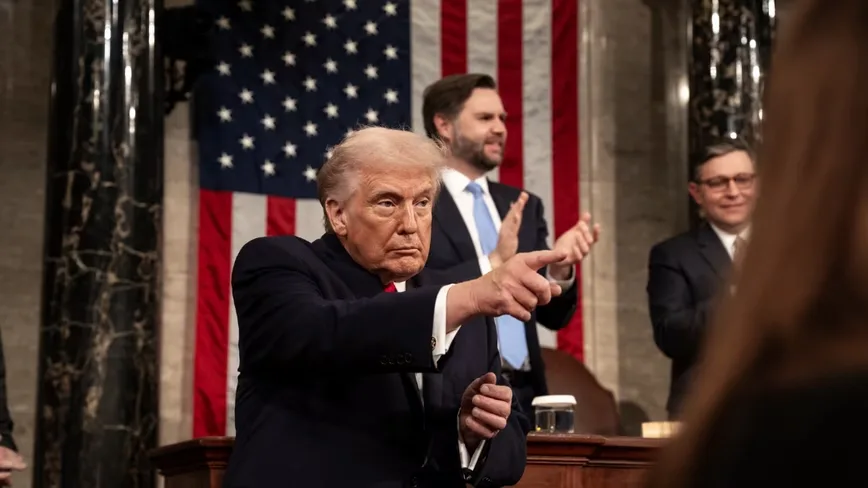
On Saturday, President Donald Trump made two posts about artificial intelligence on his Truth Social platform. The first invited followers to choose a new name for the technology. The second dismissed criticism of AI as a hoax orchestrated by the left and announced plans for an AI Force and an AI czar to fill a role vacant since March.
The naming contest draws attention, but policy lives elsewhere
Trump presented three alternatives to "artificial intelligence": Superior Intelligence, Extreme Intelligence and Supreme Intelligence. Two of these share the same initials. When The Next Web checked the poll on Sunday, it had received 62,329 votes with 21 hours remaining, though Truth Social withholds results until voting closes.
The hoax claim meets polling data
Trump grouped opposition to AI and data centres with Russia, Ukraine and his impeachments as fabrications by what he called the "Radical Left Dumocrats." This assertion can be tested against actual polling. Andrew Pantazi compiled recent surveys for Axios, including a New York Times and Siena College poll of 1,503 likely voters that found 61% opposed building data centres for AI. Among Republicans, opposition reached 47%, compared to 75% among Democrats.
Republican leaders have not rallied behind the president's framing. Texas Governor Greg Abbott stated that data centre companies "dug their own grave," an unusually sharp departure from party loyalty.
The data centre campaign shows no signs of collapse
Trump claimed the opposition campaign had largely crumbled once communities recognised the job creation and tax benefits. Evidence contradicts this. New York paused permits for large data centre projects and has maintained that freeze despite Trump calling the decision "terrible." This represents the most significant blocking action any state has implemented.
The pattern extends to earlier claims. When X attributed the backlash to Chinese bots, a researcher who examined those accounts found they generated almost no engagement.
An AI Force cannot exist by presidential declaration
Trump wrote, "I am forming the AI Force, much like I did Space Force." The Space Force comparison reveals the problem. Congress established Space Force through the National Defense Authorization Act for fiscal 2020, signed in December 2019. It exists as the sixth armed service under Title 10 because legislation created it.
A president lacks the authority to establish a military branch through announcement alone. The post contained no mission statement, budget allocation or governmental placement for the AI Force. Some outlets have reframed it as a task force, but the original post uses the word "force."
The czar position faces a legal constraint
Trump said he would soon appoint an AI czar, stipulating that only "high-IQ individuals" need apply. The position has remained empty since March, when David Sacks departed. According to NBC News reporting by Raquel Coronell Uribe, Sacks stepped down due to restrictions on his tenure as a special government employee, and he is expected to attend Trump's state dinner with Xi Jinping.
This constraint will recur. Federal law limits special government employees to 130 days of service within any 365-day period. The previous czar's term ended because of this calendar requirement, not by choice.
The regulatory stance emerges in a single sentence
Embedded in the post is the administration's regulatory position: the government will not "hinder or stifle" the industry but will be "looking for BAD" using "our already existing Criminal and Civil Justice System." This signals that no new AI legislation is planned. It also reflects the preemption argument—the view that current law suffices and that state-level AI rules represent the real problem.
This campaign has already encountered resistance. The Senate voted 99 to 1 to remove preemption language from a defence bill, and 36 state attorneys general opposed it in writing.
An existing mechanism already operates in this space. Trump signed a narrower AI order centred on voluntary model review, the oversight apparatus that any AI Force would either sit alongside or replace.
Safety advocates span the political spectrum
The hoax framing requires the safety argument to be partisan. It is not. Dario Amodei, Sam Altman, Elon Musk and Demis Hassabis have all advocated for slowing development. Geoffrey Hinton told lawmakers in a closed briefing this week that Congress has roughly a year to act, according to NBC News.
Trump has remained consistent in his response. TechCrunch's Anthony Ha reported that the president said at a golf tournament last weekend he was open to guardrails, while attributing the push for them to negative forces.
The GDP projection lacks detail
Trump concluded by stating that AI could reach as much as 25% of the country's GDP. He provided neither a timeframe nor a methodology. The American economy totals roughly $30 trillion. One quarter of that equals approximately $7.5 trillion, exceeding the annual economic output of every nation except the United States and China.
What comes next
- Watch whether the AI Force appears in legislation. Only a bill would provide it a budget and legal foundation, and the Space Force comparison creates exactly that expectation.
- Watch who accepts the czar position and under what conditions. A special government employee appointment would impose the same 130-day limit on the next holder.
- Watch whether the White House clarifies any of these announcements. It did not respond to requests for comment from Axios or NBC News on Saturday.
Source: The Next Web