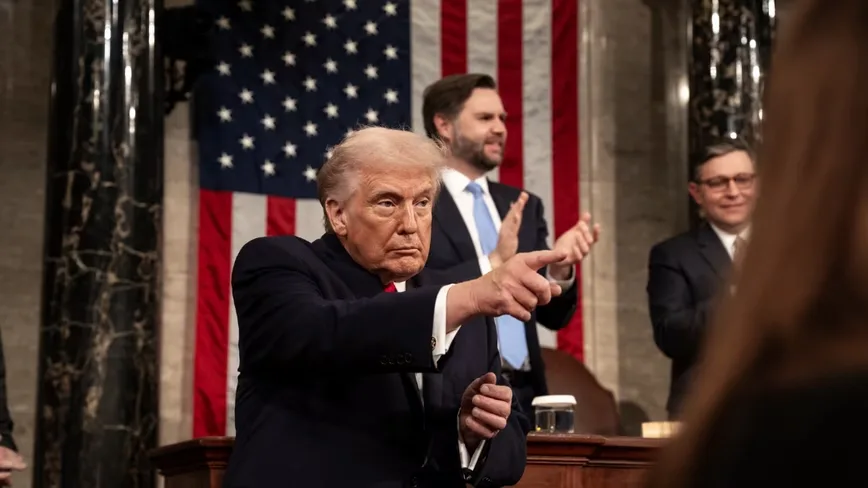
During a Sunday afternoon at his Doonbeg resort in Ireland, Donald Trump fielded questions from reporters about the technology sector's recent shift toward deliberate restraint in artificial intelligence development. Trump emphasized American superiority over China in the field, stating that maintaining this advantage remained his priority, and framed the competition in stark terms: "whoever wins with AI wins".
Yet when pressed on the industry's own calls for moderation, Trump took a dismissive stance. "We can put guardrails, we can do this and that, but I think you have a lot of negative forces that are bringing it up that … shouldn't be bringing it up, and they're bringing up things that won't happen," Trump told reporters, according to reporting from Dublin by the Associated Press.
The remarks came just two days after Dario Amodei, leading Anthropic, publicly advocated for the sector to decelerate development. Amodei announced his company would engage third-party evaluators with direct access to internal systems and requested Washington grant competitors an antitrust exemption to coordinate on safety protocols. Sam Altman of OpenAI endorsed the position the same day, pledging OpenAI's participation, while Elon Musk's xAI also aligned with the approach, per the AP.
These three organizations collectively develop the cutting-edge models driving America's technological competition with China. Within industry circles, support for measured advancement runs deep. OpenAI's chief scientist stated the previous week that no laboratory has adequately addressed the alignment challenge to justify maximum-speed scaling, and in July, 1,134 lab workers signed a petition urging the government to establish mechanisms for controlling development pace.
Trump's position on AI advancement has remained consistent in its broad strokes, though details have shifted. On Thursday while departing Dallas, he dismissed concerns about existential risks and estimated America's technological edge over China at approximately one year. By Sunday, his rhetoric had evolved slightly—he now acknowledged that guardrails represented an option available to his administration, though he offered no specifics on implementation.
Congress is pursuing a separate approach to the issue. Speaker Mike Johnson indicated the nation requires "some guardrails, some safety measures" while preserving competitive advantage against China, and expressed interest in convening industry executives for what he termed "one big meeting," describing it as a personal priority and a congressional objective. Kevin Hassett, heading the National Economic Council, indicated that officials responsible for cybersecurity and scientific matters plan to convene this week to determine subsequent actions.
No timeline has been announced for any of these initiatives. Xi Jinping is scheduled to visit the White House during the current month, with AI expected to feature on the agenda, though this remains unconfirmed. During their previous conversation on this topic in Beijing in May, Trump departed saying the two had discussed AI guardrails without any agreement being reached.
The administration's financial commitments reveal a different narrative than the president's public statements suggest. Beginning in May, the government initiated support for AI technology exports through the Export-Import Bank, mobilizing over $100 billion in available lending capacity to expand the international reach of American systems. Notably, the companies now advocating for deceleration are precisely those the program was designed to accelerate.
Source: The Next Web