The transformation of a Hollywood star into European royalty created one of the twentieth century's most compelling cultural moments. When such a figure crossed paths with America's young president, the symbolic weight seemed immense. Yet the historical record—preserved in the Kennedy Library—offers a more restrained account than popular memory has constructed around this encounter.
On 24 May 1961, at 1:00 PM, President John F. Kennedy and First Lady Jacqueline Kennedy received Prince Rainier III and Princess Grace of Monaco at a White House luncheon. Documentation of this event survives within the Kennedy Library's institutional collections, though what those materials actually demonstrate deserves careful examination.
What the archive preserves
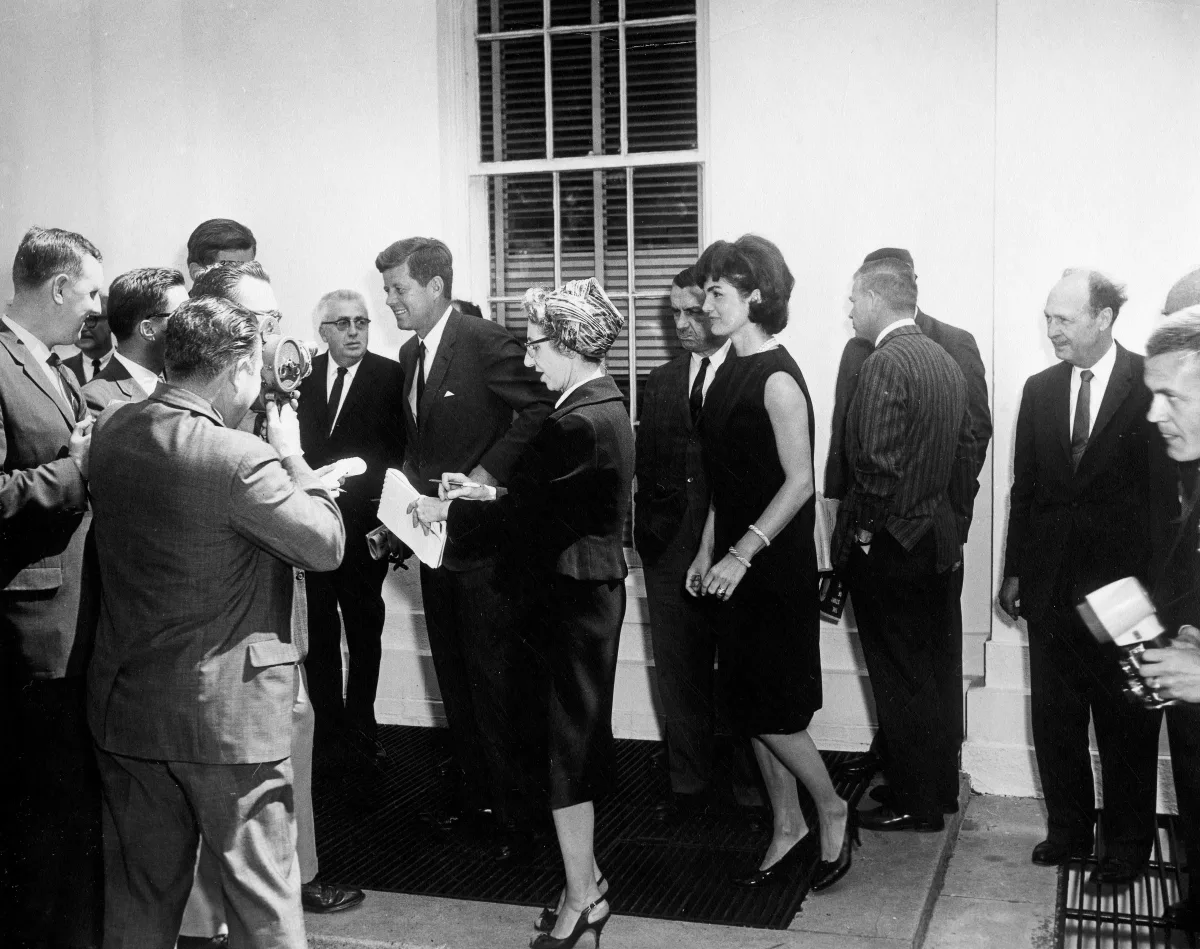
The Kennedy Library's White House Photographs collection holds material from this occasion under the digital identifier JFKWHP-1961-05-24-D. White House photographer Cecil Stoughton captured the event, which appears in the archive with collection codes AR07, ST02, and KN03.
The photographic record consists of a single black-and-white negative measuring 2¼ inches square. This detail matters considerably: the folder should not be treated as evidence of a comprehensive visual narrative without examining each image and its accompanying description individually. The archival entry confirms the luncheon occurred and identifies those present, but it contains no transcript, detailed timeline, or documentation of what transpired in conversation.
A separate White House social-events file for the same date encompasses 15 digital pages and includes a seating arrangement. Together, these photographic and written records demonstrate how an official state function entered the institutional archive through multiple document types.
An important caveat accompanies the collection. Materials created by United States officials in their official capacity belong to the public domain, though other archival items may remain subject to copyright or intellectual-property protections. The collection therefore cannot be described as entirely unrestricted without verifying the status of each specific item.
The significance of the five-year gap
The interval mentioned in historical accounts is precise. Grace Kelly married Prince Rainier in 1956 and assumed the title of Princess of Monaco, concluding a film career that encompassed an Academy Award and prominent roles in Alfred Hitchcock productions. According to TIME's retrospective on her filmography, she stepped away from Hollywood at age 26 upon becoming princess.
By the time of the May 1961 luncheon, she no longer participated in American public events as an active film performer. She arrived at the White House as Princess Grace, accompanying Monaco's reigning sovereign. Though her earlier work in cinema remained woven into her public identity, her official status had fundamentally shifted.
This transformation accounts for much of the intrigue that later attached itself to these photographs. The gathering assembled a former American film actress who had entered European nobility, the ruler of Monaco, a relatively young American president, and a first lady who was already establishing herself as an international arbiter of style. Even without embellishment or speculation about private feelings, the assembly carried extraordinary symbolic resonance.
How popular memory reshapes the record
Photographs from history frequently acquire meanings beyond their original archival context. When images circulate through digital channels stripped of their catalogue information, they become raw material for broader narratives about sophistication, statecraft, celebrity, or an imagined era of greater restraint in public life.
Such interpretations possess genuine appeal, yet they remain readings imposed upon evidence rather than conclusions derived from it. A facial expression cannot demonstrate genuine feeling, a glance cannot confirm connection, and a formal photograph cannot expose the room's actual interpersonal dynamics. The archive can confirm that an event occurred without endorsing every narrative subsequently constructed around it.
This distinction sustains the luncheon's enduring fascination. Within the Kennedy Library, the materials function as documentation of a presidential occasion. In broader public discourse, the same event becomes a symbolic convergence of entertainment, monarchy, and American political authority.
What persists when these layers of interpretation are stripped away remains straightforward yet significant. On 24 May 1961, at one o'clock in the afternoon, President John F. Kennedy and Jacqueline Kennedy hosted Prince Rainier III and Princess Grace of Monaco for a White House luncheon. Five years after Grace Kelly departed Hollywood to assume her role as princess, this occasion returned her to an American public stage, but under a completely transformed identity.
Source: Silicon Canals