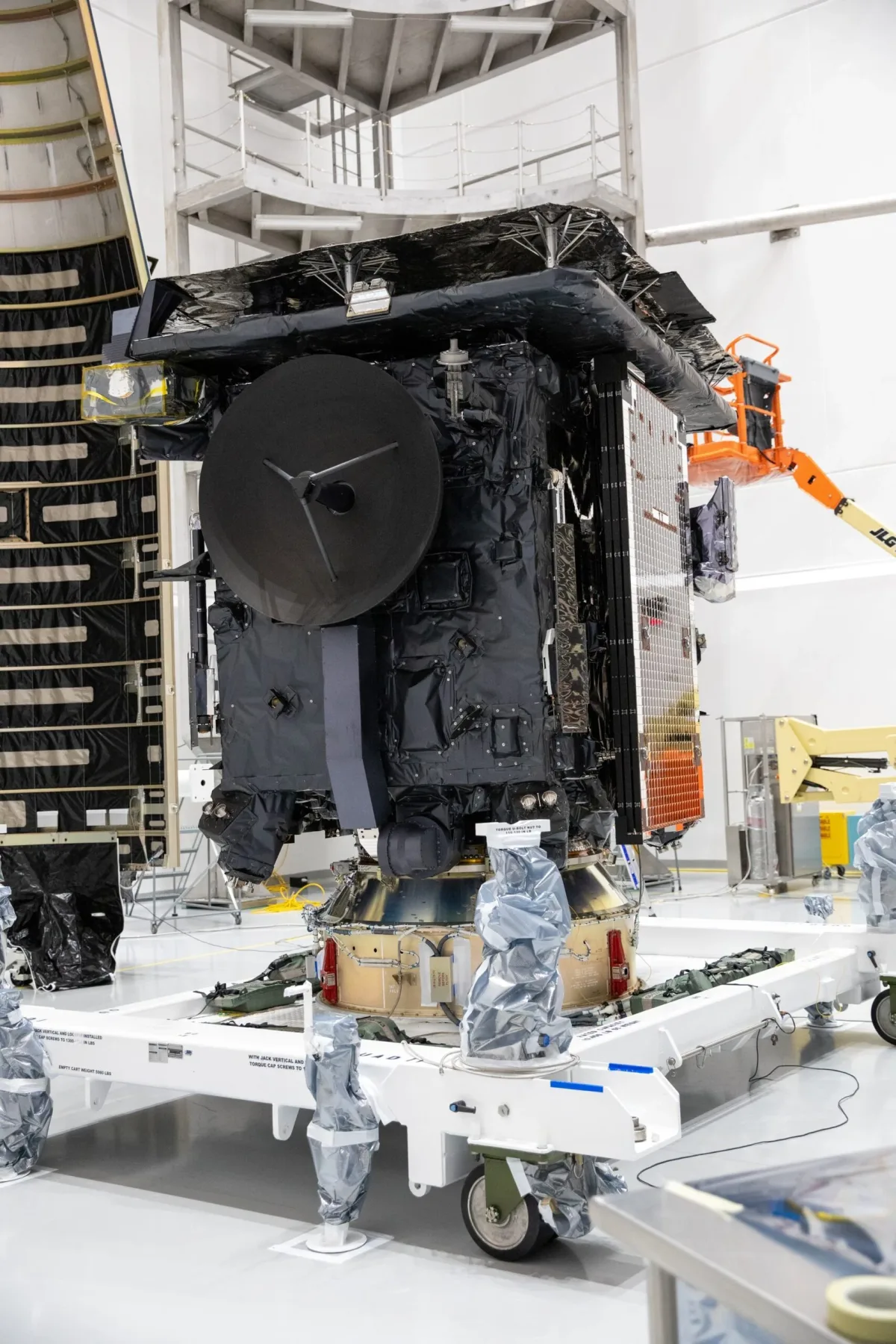
Researchers have found that their X-ray telescope was consistently underestimating the intensity of the sun's most violent eruptions by turning thousands of solar flares into calibration targets. The Spectrometer/Telescope for Imaging X-rays (STIX) aboard Solar Orbiter has undergone a new in-flight calibration that measures how effectively the instrument's tungsten grids transmit X-rays using solar flares themselves as reference points. Published on 10 September 2026 in Solar Physics under the title "In-Flight Self-Calibration of the STIX Grid Transmission," the study examined 91 suitable flares selected from approximately 25,000 events documented between January 2021 and February 2025.
The recalibration primarily affects STIX's photometric measurements rather than the physical understanding of solar flares. Photon spectra derived using the updated calibration are roughly 13% higher than those calculated with the previous calibration, and fitted emission measures increase by a comparable margin, though fitted flare temperatures show no change.
Why STIX required an in-flight grid calibration
STIX functions as an indirect hard X-ray imaging spectrometer. Its detectors operate across roughly 4–150 keV, with 30 pairs of tungsten grids that modulate incoming X-rays so that each detector-grid unit, or sub-collimator, captures a Fourier component of the source.
The 24 sub-collimators with the coarsest angular resolution employ grids constructed from tungsten foils measuring 33 or 50 µm thick, stacked to a nominal thickness of 400 µm. Before Solar Orbiter's launch, engineers performed optical characterization of the grids and conducted X-ray measurements, but the X-ray tests were not performed at the small incidence angles most applicable to solar-flare observations due to time and financial constraints.
Optical measurements alone cannot fully capture what occurs within a multilayer grid. They characterize the outer layers but cannot directly assess minor stacking and etching variations deeper in the structure, even though such variations can modify the effective slit width and consequently the quantity of X-ray flux reaching a detector.
The new approach employs the STIX Coarse Flare Locator, or CFL, as a reference standard. When flares occur at suitable positions, one or more large CFL pixels become fully illuminated and deliver an estimate of the incident total flux. Measuring this against the flux detected through an imaging sub-collimator yields an empirical calculation of the sub-collimator's effective transmission.
A self-consistency verification using adjacent fully illuminated CFL pixels enabled the authors to establish that the CFL total-flux measurements possess accuracy of approximately 2.3%, with both statistical and systematic uncertainties playing a role.
How approximately 25,000 flares became a 91-event calibration set
The initial archive held roughly 25,000 STIX flares recorded from 1 January 2021 through 28 February 2025. The team imposed requirements that each event must contain at least one fully illuminated large CFL pixel, a sufficiently dependable flare location, and adequate recorded counts to maintain statistical robustness in the analysis.
These criteria narrowed the selection to 91 events. The calibration was calculated from data in the 10–15 keV energy range, where the Solar Black coating on the front entrance window transmits roughly 91% to 97% of the radiation, minimizing the impact of coating irregularities on detector-to-detector comparisons.
The flight measurements revealed lower effective grid transmission than the model derived from pre-flight optical characterization. They also displayed less internal-shadowing variation with incidence angle than anticipated from an idealized grid with perfectly aligned layers.
Simulations offered a plausible mechanical explanation. When random stacking and etching imperfections with a standard deviation of roughly 2 µm were incorporated into the grid geometry, the simulated transmission decreased and the predicted internal-shadowing effect weakened. For sub-collimator 5, which has a nominal slit width of 83 µm, imperfections at that scale reduce the effective on-axis slit width by approximately 6 µm.
The independent test shows what improved
The team then validated the calibration against 25 additional flares recorded between March and December 2025 that were excluded from the 91-event calibration set. Using the new transmission model, the average normalized total-flux estimates from individual sub-collimators ranged from 0.98 to 1.02, bringing their mean measurements to within roughly 2% of the cross-detector average.
The event-to-event variation represents a distinct measurement. With the new calibration, the standard deviation of normalized total flux remained below 3.3% for all detectors except sub-collimator 1b, which showed a standard deviation of 6.7%.
The previous calibration performed differently. Its average normalized total-flux values ranged from 0.93 to 1.20 for the 24 coarse-resolution sub-collimators and from 0.48 to 0.86 for the six finest-resolution sub-collimators. In a separate comparison, the fluxes calculated with the new and old transmission values differed by 3% to 39% for the coarse sub-collimators and 48% to 175% for the finest ones.
A spectral examination using the X2.2-class flare of 8 December 2024 supplied an additional measure of improvement. Three coarse sub-collimators, 3a, 5a and 5b, were excluded because they exhibited an energy-dependent discrepancy the authors regard as more probably stemming from detector calibration than grid calibration.
For the remaining coarse sub-collimators, the standard deviation of the fitted photon spectra between 10 and 15 keV fell from 6.9% with the old calibration to 1.6% with the new one. Across the broader 8–20 keV interval, spectra obtained using the new calibration demonstrated a standard deviation of 2.3%.
The absolute spectral scale also shifts. Photon spectra produced with the old calibration were on average 13.2% lower than those produced with the new calibration, while the fitted emission measure increased by 13.7%. Fitted flare temperatures remained constant, and the authors note that conclusions from earlier STIX spectral studies are unaffected.
The calibration has clear limits
The new model applies chiefly below roughly 20 keV and within offset angles of approximately −0.5 to +0.5 degrees. At higher energies, grid transparency alters the effective slit width while the available CFL data lack sufficient counts for the same calibration technique to remain dependable.
Below roughly 8 keV, the spectra exhibit increased scatter that the researchers suspect relates to irregularities in the Solar Black coating. The paper identifies calibration of that low-energy effect as a potential direction for future investigation.
High-energy grid calibration also remains incomplete. This work holds significance for efforts to establish whether non-thermal hard X-ray emission from solar flares is anisotropic, a question demanding comparisons between instruments observing the same flare from different viewing angles. The authors emphasize that cross-calibration more precise than 10% is necessary for such comparisons to yield meaningful results.
The paper also highlights a practical instrument-design consideration. Future indirect X-ray imagers would gain from a dedicated total-flux monitor with sufficient collecting area to furnish a calibration reference for every flare and potentially extend the same method to higher energies. The Hard X-ray Imager aboard ASO-S already incorporates total-flux monitors employed for calibration.
For STIX itself, the authors indicate that the visibility-amplitude calibration based on these results will be included in an upcoming release of the analysis software. The broader outcome is more modest but valuable: the low-energy measurements from different sub-collimators are now substantially more internally consistent, while the physical conclusions derived from the mission's earlier flare spectra remain intact.
Source: Silicon Canals