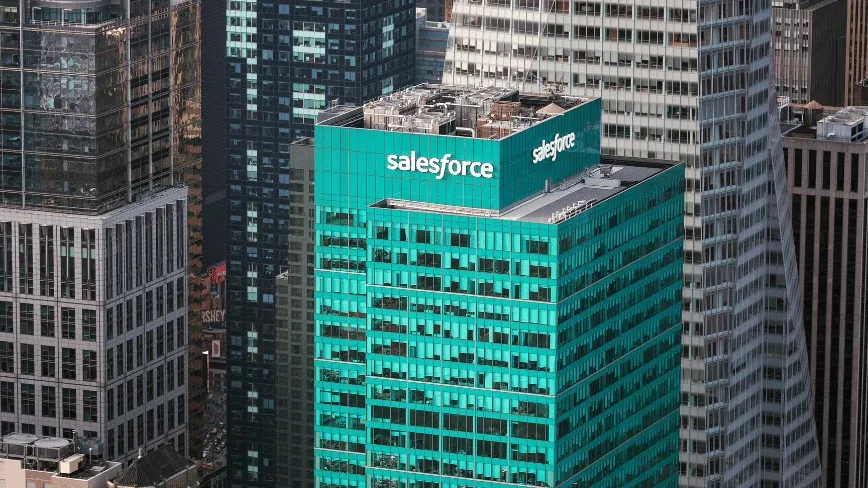
Salesforce has begun removing the Agentforce designation from several of its core offerings, according to reporting by The Information. The rebranding reversal takes place just one week ahead of Dreamforce, the company's major annual conference. Verification of the changes on live product pages confirms that Sales Cloud—which was renamed Agentforce Sales last autumn—has reverted to its original name.
This reversal undoes a rebrand launched less than twelve months ago. In October of the previous year, Salesforce appended Agentforce to approximately two dozen product names, a move The Information had documented at the time. Chief executive Marc Benioff had made even bolder statements in public forums, hinting that the company might eventually adopt Agentforce as its corporate name.
What changed on the website
The most visible example involves the company's flagship sales offering. Previously known as Sales Cloud, it became Agentforce Sales in the autumn rebrand, and has now returned to its original Sales Cloud designation. The Information cross-referenced archived versions through the Internet Archive to confirm the site underwent this reversion this week.
Checks of Salesforce's live pages on Monday revealed that the sales product page now displays Sales Cloud as the primary name, with Agentforce Sales relegated to a secondary position describing a capability rather than serving as the product title. Similarly, the platform offering now appears as Salesforce Platform, with the previously introduced Headless 360 designation no longer featured prominently.
Agent-focused language remains embedded throughout the marketing copy. The sales page continues to feature the statement "Sellers focus on winning. Agents handle the grind." Meanwhile, the platform page begins with "Build your Agentic Enterprise on a trusted, open, and unified platform." The messaging around agent capabilities has stayed consistent even as the product nomenclature has shifted back.
Headless 360 Platform represents the other significant name change documented by The Information. Salesforce introduced Headless 360 in April as a toolkit for constructing and configuring applications and agents. The product enables customers to integrate external AI agents—including those from Anthropic—to access their data within Salesforce systems. This offering has now returned to being called Salesforce Platform.
One branded name has survived the reversal. Agentforce 360, the product line itself, retains the Agentforce designation according to The Information's reporting.
What Salesforce has not said
The company has offered no public explanation for the naming changes. The Information reported that company representatives declined to respond to requests for comment, and the underlying motivation for the decision remains undisclosed.
The timing itself draws attention. With Dreamforce commencing the following week, a naming adjustment made mere days beforehand will inevitably become a topic of discussion at the conference, regardless of whether speakers address it directly from the stage.
Salesforce has also not clarified whether the changes extend to customer contracts, billing statements, and support documentation, or if they are limited to the public-facing marketing website. For customers in the midst of contract renewals, this distinction carries significant practical implications.
The numbers behind the name
Agentforce as a product line continues to demonstrate strong growth momentum. Following what The Information characterized as a slow initial period, the product's annual recurring revenue—calculated as the value of contracts signed for the subsequent twelve months—expanded by more than 240 percent year-over-year, reaching more than $1.5 billion during Salesforce's July quarter. This metric represents Salesforce's preferred measurement for the product category, capturing the full value of signed contracts for the coming year rather than revenue already recognized on the books.
This dynamic creates a notable tension within the narrative. The product line itself is performing well commercially, yet the company is simultaneously removing its name from the products that customers have recently learned to identify by it. Salesforce has not publicly connected these two developments.
A year of Agentforce
Salesforce unveiled Agentforce in late 2024 and positioned it as the centerpiece of its sales and marketing strategy. Earlier reporting noted that the company was promoting the AI future more aggressively than it was delivering tangible results. In August, the company eliminated 133 positions across Washington and California as part of an AI-focused restructuring.
The agent-centric strategy has relied significantly on third-party AI models. During August, Salesforce established a partnership with Anthropic that placed Claude at the core of its offering—a collaboration that internal staff members reportedly nicknamed Claudeforce. Headless 360, the product now undergoing rebranding, was designed with this same objective in mind: enabling customers to bring external agents into their Salesforce data environment.
Acquisition activity has also supported this direction. Salesforce finalized its purchase of Fin, the customer service AI platform previously operating under the Intercom name, on Thursday. The company is simultaneously negotiating a potential $2 billion acquisition of Listen Labs, according to The Information's recent reporting. The Fin transaction, which was publicly announced in June, carried a valuation of $3.6 billion.
Why the naming matters
Over the course of a year, Salesforce invested considerable effort in establishing a new vocabulary among its customer base, partners, and internal sales teams. Sales Cloud transformed into Agentforce Sales, and approximately two dozen additional products underwent similar rebranding. These names have now returned to their original forms, without any accompanying public statement explaining the decision.
Salesforce is not the only enterprise software company experimenting with agent terminology applied to existing product portfolios. The company also stands in company with others who have stepped back from rebranding initiatives: Google shifted NotebookLM to Gemini Notebook in July, integrating a recognized product into a larger brand umbrella rather than separating it from one.
The announcements and presentations at Dreamforce in the coming week will provide greater insight than the website changes alone. For the moment, the situation remains straightforward: certain products have recovered their previous names, the company has declined to explain the shift, and Agentforce revenue continues its upward trajectory even as the branding disappears from the product labels.
Source: The Next Web