Artificial intelligence has escaped the confines of computer screens. Today, it inhabits robots, vehicles, and intelligent objects that navigate physical spaces and interact with the world around them. Capabilities that humanity long regarded as distinctly its own—writing, creating, conversing—are increasingly being replicated by machines. This transformation prompts a deeper inquiry: as technology continues to reshape how we perceive, communicate, and understand ourselves, what will humanity look like in an age of embodied artificial intelligence?
The Ars Electronica Futurelab and Toyota Motor Corporation's Advanced R&D and Engineering Company have joined forces on "Future Humanity," a collaborative research initiative. At its center stands "Hello Worlds!," an exhibition opening at the Ars Electronica Center Linz on September 8, 2026. The show invites visitors to explore how emerging technologies are fundamentally altering our understanding of what it means to be human. Maria Pfeifer, Head of Future Impact Creation and Key Researcher for Future Narratives at the Ars Electronica Futurelab, discusses what the exhibition reveals about humanity's evolving relationship with technology.
From Language Models to Physical Presence
The exhibition's opening section, "Hello Me!", invites visitors to reflect on the qualities traditionally viewed as fundamentally human. Generative AI has already begun challenging these assumptions by mastering abilities from writing to dialogue. Yet the exhibition looks beyond language models and image generators toward what Pfeifer calls embodied AI—systems with physical presence or the capacity to act within real-world environments. Terms like physical AI and spatial AI describe technologies capable of perceiving their surroundings, moving through them, and engaging with them.
This shift carries profound implications. "As long as AI remains behind a screen, we mainly experience it as a tool," Pfeifer explains. "But once it has a body, it becomes something we relate to differently. We are no longer talking only about chatbots, but about systems that share the same physical world or entire environments with us. That is a fundamentally different relationship."
The exhibition also poses the inverse question: what happens when humans themselves increasingly become carriers of technology? When devices transition from tools we use to components integrated into our bodies, perception, and daily existence, how does that alter our identity? These questions extend further still. What does embodiment truly signify? How do our senses and emotions factor in? Does our conception of intelligence shift when we recognize it not as a purely mental phenomenon but as something inseparable from physical form and lived experience?
The Latest Challenge to Human Uniqueness
History offers a pattern. Copernicus displaced humanity from the center of the cosmos. Darwin revealed that humans are products of evolution rather than divine creation. Freud demonstrated that rationality plays a smaller role in human behavior than we prefer to believe. Now, artificial intelligence presents what some describe as the fourth great blow to humanity's self-image: the possibility that forms of intelligence once deemed exclusively human can be matched or even exceeded by technical systems. Does this require yet another redefinition of what humanity is?
Pfeifer views this historical pattern differently. "I find the idea of the 'great blows to humanity's self-image' fascinating because it reminds us that our understanding of ourselves has never been fixed," she observes. "Each of these developments forced us to reconsider our place in the world. For me, that is exactly what Negotiating Humanity is about. The focus is not so much on defining what a human being is, but on how we continually renegotiate what it means to be human."
Rather than seeking a single, universal definition of humanity, Pfeifer argues that being human is a dynamic condition that evolves alongside societies, technologies, and the questions we pose. The exhibition does not attempt to provide a new definition but instead invites visitors to participate in this ongoing process of renegotiation. "Perhaps we even need to let go of the idea that there will ever be one final definition of what it means to be human," she suggests.
Pfeifer also advocates for a shift in perspective. Rather than constantly asking what distinguishes humans from machines, animals, or other forms of life, we might examine what we share. Humans tend to organize reality into clear categories—human versus machine, nature versus culture, us versus them—yet much of existence exists on a spectrum with fluid boundaries. "That is why I believe tolerance for ambiguity is one of the most important skills for the future," Pfeifer states. "The ability to live with contradictions without feeling compelled to resolve them immediately is becoming increasingly valuable."
The real transformation may not be occurring in artificial intelligence itself but within human consciousness. "The real question, then, is not whether AI will replace humans. It is how AI is changing the way we think about being human," Pfeifer explains. "Technology shapes far more than our daily lives—it also influences how we think, communicate, and perceive the world. Perhaps the most profound transformation is not happening in AI at all, but within ourselves."
The Mirror as Entry Point
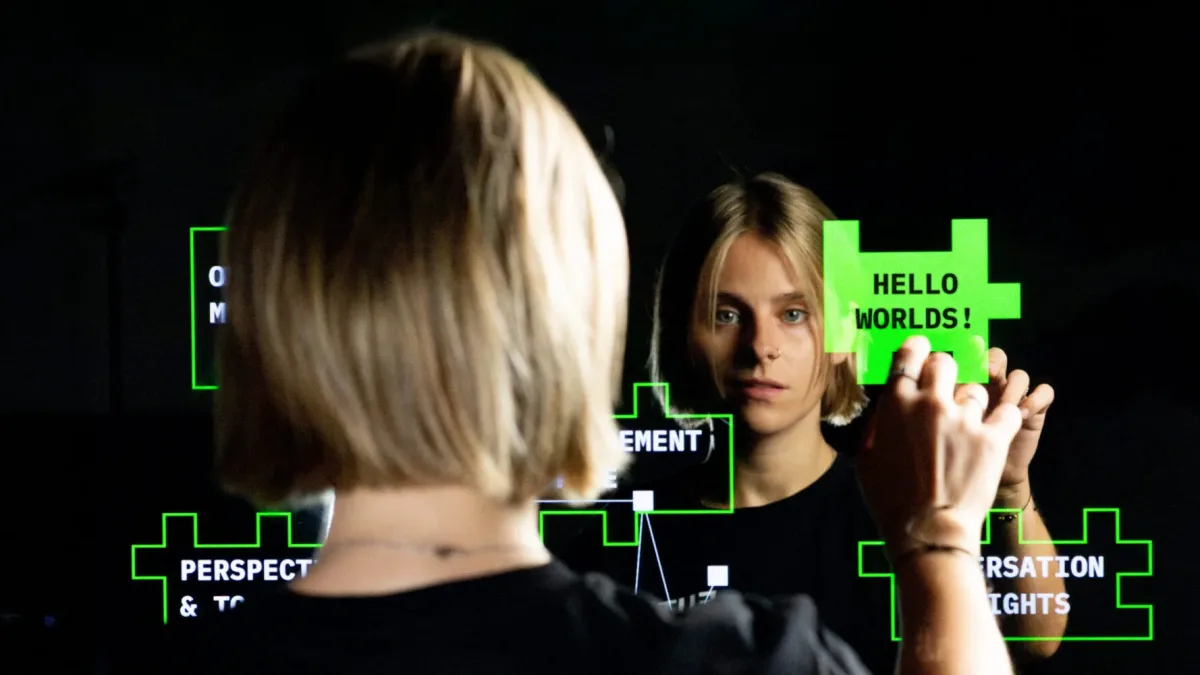
Visitors encounter a floor-to-ceiling mirror upon entering the exhibition—a deliberate choice that serves multiple purposes. The mirror functions as both a technical gateway and a symbol. Those who choose to participate receive a personal Visitor Record, a temporary profile that enables the exhibition to respond to them in individualized ways throughout their visit.
Beyond its technical function, the mirror embodies transparency and self-reflection. When visitors return to it later in their journey, they no longer see only their physical reflection. Instead, they encounter their "data self"—a visualization of which installations they visited, how long they spent at each, which themes recurred, and how they explored the exhibition. The system attempts to characterize their engagement style, whether they prefer deep dives into individual pieces or broader exploration of many different works.
Critically, the exhibition makes clear that this data portrait is never the person themselves. "It is always an interpretation—a model built from the information that has been collected," Pfeifer emphasizes. The entire process remains transparent, and visitors can view, question, or delete their Visitor Record at any time.
The mirror also raises a fundamental question: "Who am I today—and who might I become tomorrow?" Rather than presenting fixed visions of future humanity, the exhibition invites personal reflection on how emerging technologies could shape each individual visitor.
Extending Human Perception and Ability
The "Hello Me!" section reframes the relationship between humans and machines, presenting them not as opposites or competitors but as potential collaborators capable of forming new kinds of relationships. Technology can extend human senses and abilities, opening possibilities previously unavailable. The exhibition achieves this through a shift in perspective. Rather than asking what technology can accomplish, it asks what technology does to us—how it alters our perception, shapes our experience, and influences how we relate to the world.
Technology has always extended human capabilities and opened new modes of perceiving and interacting with surroundings. In doing so, it simultaneously changes how we think and understand ourselves. The Ars Electronica Futurelab frequently invokes the concept of Homo mobilis—humans as beings never fixed or complete, constantly evolving through technological augmentation.
Throughout the exhibition, visitors are invited to imagine novel forms of perception. What would it feel like to sense data traces directly? How might technology allow us to experience aspects of the world previously beyond our sensory reach? These thought experiments illustrate a crucial principle: every expansion of perception also transforms how we see and comprehend the world.
Dialogue with the More-Than-Human
The exhibition's second section, "Hello You!", explores novel forms of interaction and dialogue with entities rarely considered as conversational partners. Pfeifer prefers the term "more-than-human others" to encompass not only people but also animals, machines, and intelligent objects.
One installation, Corpus Corax, draws on scientific research into raven behavior to explore translating human language into raven communication and vice versa. Ravens were selected deliberately; few animals have been studied as thoroughly in this context. Researchers understand considerably about how ravens communicate, recognize faces, and establish long-term social bonds. Yet their perception of the world differs fundamentally from ours. "Of course, we cannot know whether a raven actually 'means' what we interpret from its calls," Pfeifer acknowledges. "It remains a speculative act of translation. Our research is always a human attempt to approach another way of experiencing the world."
This uncertainty creates a valuable shift in perspective. Observers cease simply watching the raven and begin asking how the raven might perceive them. Conversations Beyond the Ordinary, by Jan Zuiderveld, takes a different approach. Visitors encounter everyday objects—a coffee machine, photocopier, and microwave—that have been given voice and agency. To obtain coffee, visitors must negotiate with the machine. The photocopier does not merely reproduce drawings but alters and reinterprets them. Inside the microwave, ordinary objects host short podcasts, speaking in their own voices.
This playful approach raises a profound question: at what point does an object cease being merely a tool and become a counterpart? When does genuine dialogue begin? Human relationships with animals reveal deep contradictions. Some animals live as family members while others are treated as livestock or with considerably less empathy. "What would happen if we could truly understand animals? Would we even be willing to listen? And how might that change the way we understand ourselves?" Pfeifer asks. "That is what 'Hello You!' is really about. It is not about arriving at definitive answers, but about broadening our perspective."
Collective Coexistence and Resonance
The exhibition's final section, "Hello Us!", shifts focus to the collective dimension. After exploring individual relationships with technology and encounters with other beings, this part examines how such relationships might generate new forms of living together.
At the heart of this section stands the Resonance Loom, a collaborative artwork that grows with each visitor. Patterns emerge, connections become visible, and contradictions surface. Over time, it evolves into a living archive reflecting how ideas about coexistence develop. The loom itself functions as metaphor: just as individual threads become fabric only when woven together, our understanding of the future emerges from many different voices converging.
"Hello Us!" provides the exhibition's natural conclusion, beginning with introspection, expanding to other perspectives, and ultimately asking how diverse ways of seeing and experiencing the world might combine to create new forms of coexistence.
Beyond Human Centrality
What if other species and intelligent objects could communicate with one another independently of humans? Humanity would no longer occupy the center of conversation. Following this thought to its logical conclusion, Pfeifer suggests there would be no real center at all—and therefore no periphery either. Every species, living being, and perhaps every intelligent system brings its own perspective. What appears central to one always appears peripheral to another.
"Perhaps the challenge is not to defend our own place at the center, but to visit the centers of others—to try to see the world from their perspective, while accepting that we will never fully understand it," Pfeifer proposes. "That, to me, is where the real value of this shift in perspective lies."
This concept connects to resonance, a framework developed by sociologist Hartmut Rosa that runs throughout the exhibition. Resonance does not mean everyone reaches identical conclusions. Instead, it emerges when different perspectives enter relationship with one another, affect each other, and potentially transform one another. Participants gain something from the encounter without abandoning their own perspective.
It might benefit humanity to abandon the assumption that we naturally occupy the world's center. For centuries, humans viewed themselves as creation's pinnacle. Yet contemporary challenges—climate change, biodiversity loss—remind us that we are part of a vast web of life. Every choice affects other living beings and shared ecosystems.
A New Pluralism in Motion
Giving voice to other entities would indeed require redefining who "we" are. This could represent a genuine "Hello Worlds!" moment—not another blow to human self-image but a distinctive opportunity. Could "Hello Us!" embody a vision of new pluralism that currently feels like science fiction?
"Yes, of course, it is speculative. Perhaps it is even utopian," Pfeifer acknowledges. "But that is not really the point. What matters to me is not whether we will one day communicate with animals, machines, or other entities as equals. What matters is what this idea already does to us today."
"Hello Us!" does not center on a vision of perfect futurity but on the process of negotiation itself. When different perspectives converge, participants must learn to engage with one another. This applies between people today and may eventually apply to relationships between humans, other life forms, and new kinds of intelligence.
This vision is not about harmony. There will never come a moment when society can declare, "Now we have found the right we." Society perpetually changes. Each generation poses new questions, every era shifts meanings, and every technological development alters how we perceive the world. Our shared sense of "we" therefore never settles permanently—it requires continuous renegotiation.
This process can be demanding. Different perspectives inevitably generate friction, misunderstandings, and conflict. Yet Pfeifer views this as tremendous opportunity. "Perhaps we should stop searching for definitive answers and instead accept that change is an essential part of life. Nothing remains the same—not ourselves, and not the societies we live in."
If "Hello Us!" represents a new kind of pluralism, it should be understood not as a finished utopia but as an invitation to shape that process collectively. "Perhaps that is the real 'Hello Worlds!' moment: not finding one final answer but remaining open to the idea that our understanding of community will continue to evolve."
An Open Research Platform
"Hello Worlds!" functions as a central component of the Future Humanity project, launched approximately one year ago through collaboration between the Ars Electronica Futurelab and Toyota Motor Corporation's Advanced R&D and Engineering Company. The exhibition operates as an open research platform rather than a finished product developed behind closed doors. Visitors become active participants in exploring questions that concern everyone: what does it mean to be human today and in the future?
The exhibition creates space for exploration, discussion, and collaboration. At various points, visitors contribute their own thoughts and engage directly with installations. These contributions become part of the Resonance Loom, a digital loom weaving them into an evolving artistic tapestry that grows into a living archive of questions, perspectives, and ideas about humanity's future.
This approach offers multiple advantages. It provides insight into how visitors interact with installations and which topics resonate most powerfully. It also allows the exhibition itself to evolve as an ongoing process rather than remaining static. Conducting this research at the Ars Electronica Center proved essential—a museum bringing together people with vastly different backgrounds, from schoolchildren to leading experts.
About Maria Pfeifer
Maria Pfeifer serves as Head of Future Impact Creation and Key Researcher for Future Narratives at the Ars Electronica Futurelab. She develops frameworks to evaluate the societal impact of artistic, technological, and speculative innovation. Pfeifer studied art, comparative literature, and cultural studies at the University of Vienna and has collaborated with the Ars Electronica Festival and Futurelab since 2011. Her research examines how ideas about the future and technologies such as AI shape culture and society. Since 2022, she has served as a member of the Future Panel Upper Austria, advising on long-term strategic development in the region.
Source: Ars Electronica