In manufacturing and industrial operations, budgets rarely align with intuition. Maintenance and servicing typically drain far more resources than the machinery itself, which means any alteration to working equipment faces steep scrutiny. The risk of disrupting serviceability often outweighs the perceived benefits of modernization. This reality left Michael Bryan Ross searching for a way to bring legacy equipment into the digital age without the dangerous gamble of physical intervention.
The challenge was straightforward: equipment with analog gauges needed their readings available in digital format for real-time monitoring and historical logging. The conventional fix—swapping the analog dial for a microcontroller equipped with an ADC (analog-to-digital converter)—seemed logical. Yet plant managers and manufacturing engineers rarely approve such modifications. Beyond the immediate production downtime, the approach introduces risk to both the equipment and its long-term maintainability.
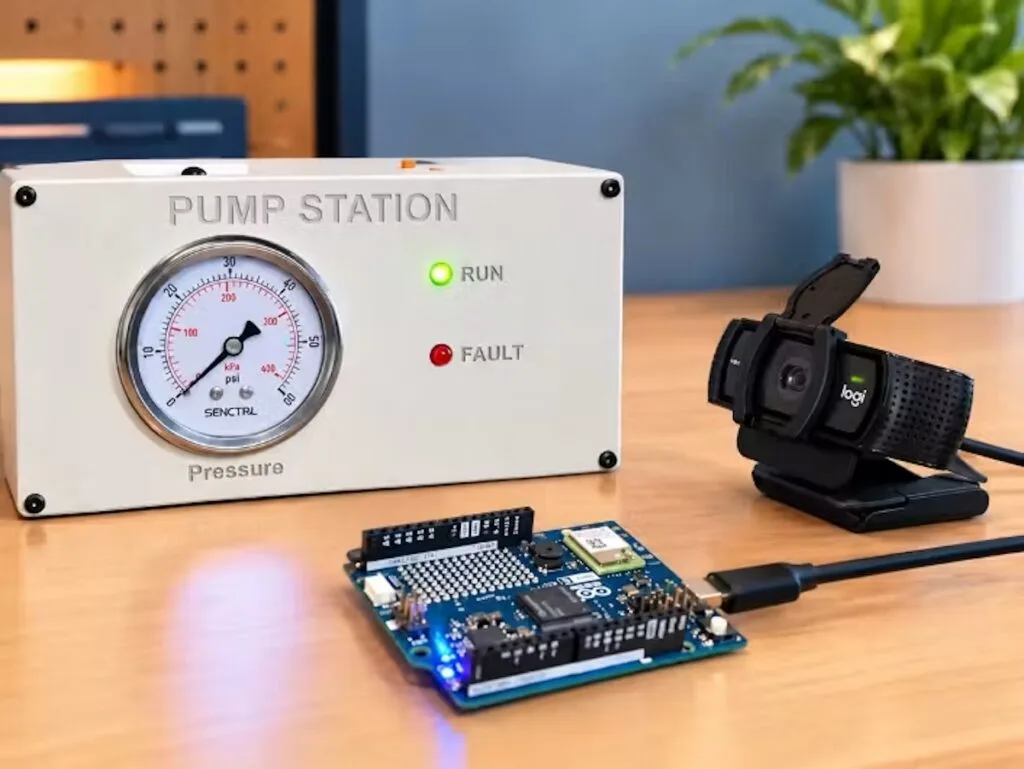
Ross' alternative required no equipment changes whatsoever, and demanded no physical contact. His method pairs a standard USB webcam with an inexpensive Arduino UNO Q running edge AI. The device captures images of the analog gauge and processes them through a MobileNetV3-Small model via ONNX Runtime, extracting the needle position and translating it into a digital value.
To validate the concept and generate training data, Ross constructed a test rig featuring a genuine analog gauge connected to an actual pressure sensor. He photographed the needle across its full range of positions, then used GPT-5.6 to read the black tick marks and assign numeric classifications to each image.
The resulting model has limitations. Accuracy degrades noticeably at the extreme high and low ends of the gauge's measurement range. Ross recognizes this as a training problem rather than a fundamental flaw in the approach. The core insight remains valid: digitizing analog gauges becomes feasible through computer vision and edge inference, with minimal cost and zero equipment modification.
Source: Arduino Blog