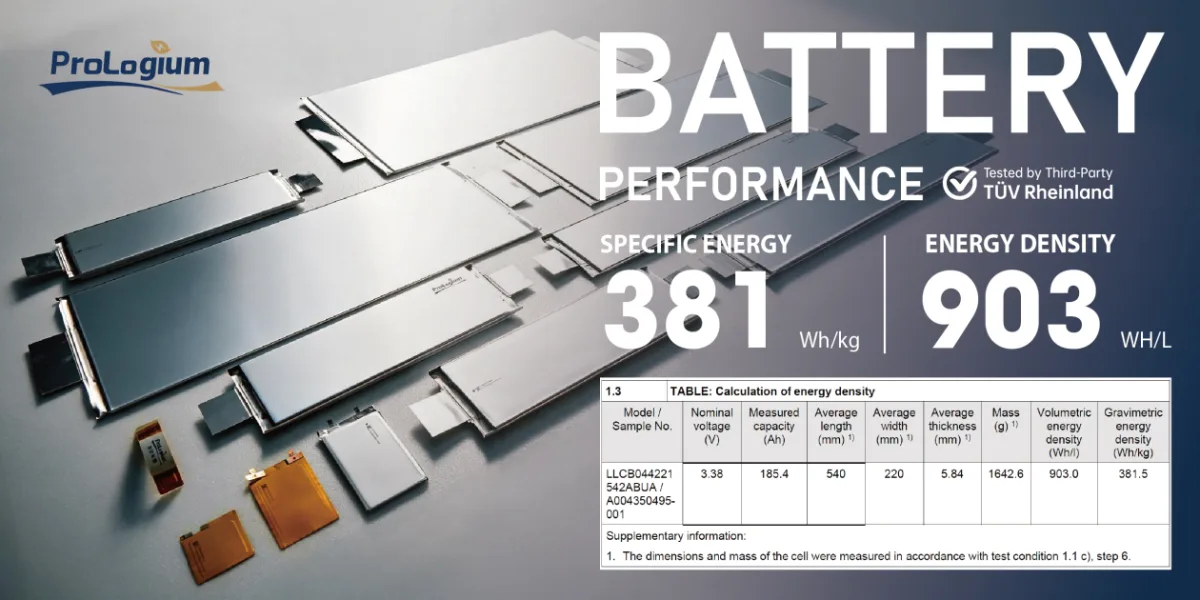
Taiwan-based ProLogium is now producing its Generation 3.5 solid-state battery at commercial scale. The large-format lithium ceramic cells, rated at 185.4 Ah, deliver a gravimetric energy density of 381 Wh/kg according to independent TÜV testing, with volumetric energy density reaching 903 Wh/L.
A Decade-Long Manufacturing Journey
ProLogium's approach rests on its proprietary Logithium cell architecture, which pairs a ceramic separator with an edge structure that enhances separation, sealing, and electrode insulation. The company first developed this architecture in 2012 and moved into commercial production the following year. Over the past decade, ProLogium reports having delivered more than 2.4 million cells to customers.
The manufacturing process evolved further when the company introduced continuous roll-to-roll production in 2017. Starting in 2024, ProLogium began operating a Giga-scale manufacturing platform capable of handling large-format cells.
Next Generation Retains Existing Production Methods
Alongside its current output, ProLogium is advancing Generation 4 technology, which will employ a fully inorganic electrolyte while preserving the existing cell architecture and core manufacturing processes. The company estimates that only about 10 percent of its current production equipment would require modification to support this next iteration.
ProLogium has identified electric vehicles, data centers, maritime applications, and aerospace as primary markets for its batteries. Beyond Taiwan, the company plans to establish production capacity in France and eventually in North America.
Success at scale will hinge on factors beyond raw energy density and battery classification. Manufacturing yield, unit costs, longevity, and consistent performance metrics derived from high-volume production will prove equally critical to market adoption.
Source: Battery-News