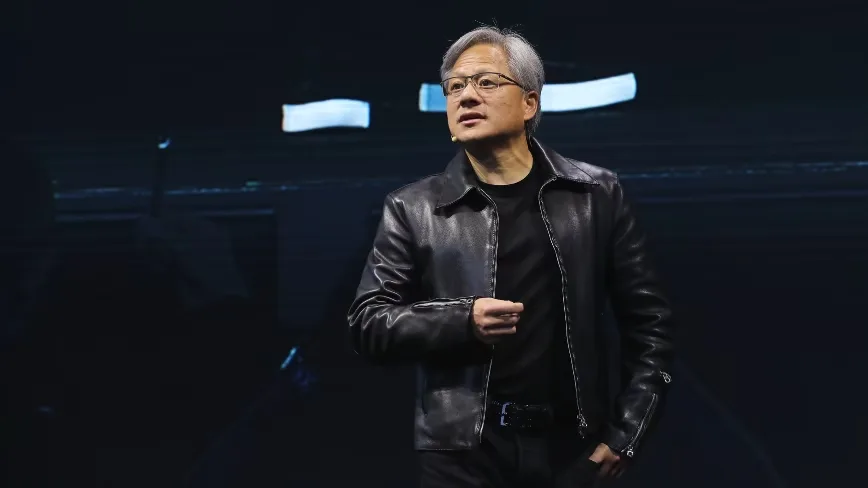
The All-In Summit in Los Angeles witnessed an unexpected moment on Monday morning when Nvidia's Jensen Huang received a call from Donald Trump while being interviewed onstage. Huang activated the speakerphone, allowing the president to address the assembled audience directly.
Trump opened with a quip about Huang's technical prowess, saying that someone capable of designing the world's most intricate computer chips ought to manage a simple speaker function. What followed was a coordinated pushback against concerns that have occupied industry discourse for the past week.
The robots will not be taking over. The AI will not be taking over the rest of the world. The whole thing is a hoax
Donald Trump
The president further contended that resistance to artificial intelligence serves the interests of those opposing American advancement. He identified potential adversaries as political opponents or foreign powers like China.
That could be political people. It could also be China.
Donald Trump
We're not going to let that happen, sir.
Jensen Huang
The summit, organized by the All-In podcast and its investor hosts including David Sacks, Chamath Palihapitiya, Jason Calacanis and David Friedberg, erupted in applause from the audience.
The timing of this exchange followed recent statements from industry leaders advocating restraint. Two days prior, Anthropic's Dario Amodei had called for decelerating the pace at which model capabilities advance. OpenAI's Sam Altman echoed this sentiment shortly after, with Elon Musk subsequently voicing agreement. Trump had already rejected extinction scenarios the previous week, but Monday's appearance by Huang—whose company manufactures the processors powering these systems—added significant weight to the dismissive position.
However, Huang's actual stance proved more measured than Trump's categorical rejection. Rather than labeling safety concerns a hoax, Huang characterized apocalyptic predictions as lacking scientific grounding—a distinction with meaningful implications.
During the same event, Huang also acknowledged Jacob Coxon, a researcher who departed Anthropic on 9 September after raising concerns that the company was endangering public welfare. Huang commended Coxon for demonstrating "great courage."
Additionally, Huang advocated that organizations should "pause or pace their work if they feel that their company is out of control." This recommendation aligns substantially with Amodei's earlier proposal. Huang appears to distinguish between individual companies implementing internal restraint—which he supports—and an industry-wide deceleration mandate, which he opposes. This nuanced position represents a substantive argument rather than a catchphrase, yet it departed from the message the audience had applauded.
Trump's assertion regarding Chinese interference contains documented elements alongside significant gaps. OpenAI disclosed in June that it had identified a campaign originating from China that leveraged ChatGPT to generate opposition to American data center projects. However, the company's investigator emphasized that this operation was amplifying existing concerns rather than creating them from scratch. A researcher at Clemson University independently reported finding minimal evidence of organized Chinese coordination in this domain.
Opposition to data centers stems predominantly from local, domestic sources. Trump has personally engaged with this resistance across multiple states including Texas and New York over recent months, having told Texans in August that data centers could rival oil in economic significance.
The summit's moderators did not pose the question that hung in the air: Nvidia profits directly from the chips that any industry slowdown would render surplus, positioning Huang with the most transparent financial stake in the pace discussion among all participants. The president who initiated the call was not present to examine this conflict of interest.
Source: The Next Web