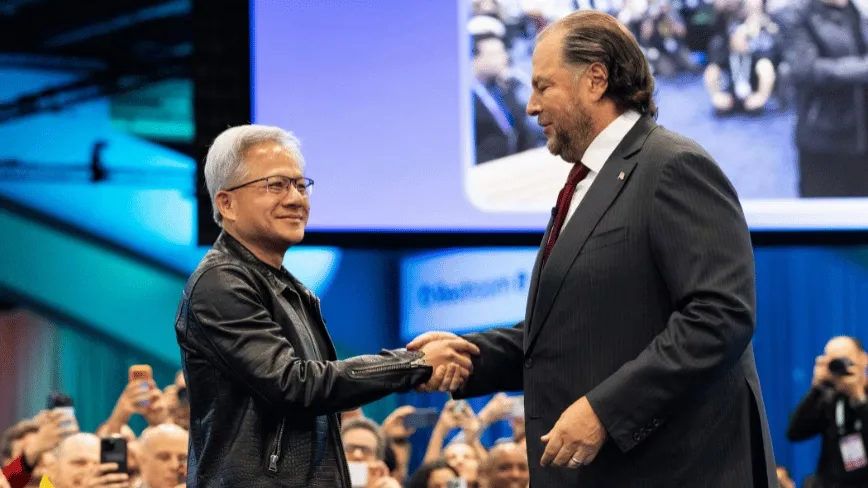
At Salesforce's Dreamforce conference in San Francisco on Tuesday, two of the AI industry's most prominent figures offered starkly different perspectives on regulation and safety. Jensen Huang, chief executive of Nvidia, declared that the sector requires no additional legislation, while Dario Amodei, leading Anthropic, advocated for the industry to deliberately moderate its pace. Marc Benioff, Salesforce's chief executive, moderated conversations with both men before an audience of 10,000 attendees and approximately 10 million online viewers.
Amodei's case for industry-led standards
Benioff posed a question to Amodei about the current state of artificial intelligence development and its velocity. Amodei responded by drawing a parallel to the automotive sector. He described a scenario in which a competitor experiences a safety failure—perhaps involving brakes—while your own organization believes it maintains superior safety practices.
Obviously it's very tempting to attack your competitor and say these guys are unsafe, we're safe. But I think the more responsible way to respond to it is to say, hey, first of all, let's look at our own record. We may not have had this big high-profile incident, but I'm sure we're not perfect.
Dario Amodei
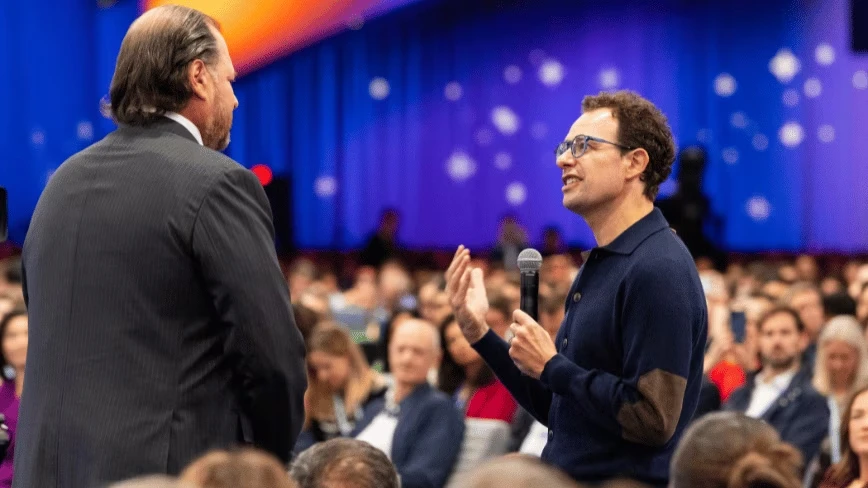
Amodei outlined a three-step approach: first, companies should recommit to openness and allocate resources toward safety measures. Second, the sector should establish shared benchmarks applicable across all players. Third, these efforts should incorporate an international dimension. Anthropic has already undertaken the initial step, Amodei noted, while remaining open to dialogue with peers on the remaining phases.
When asked about what has most surprised him, Amodei highlighted the velocity of advancement. "It's been the pace of the progress, not just of the technology, but of the economic side of it," he explained. Anthropic had anticipated the sophistication these systems would achieve, he said, but underestimated how rapidly the organizations developing them would expand.
Amodei emphasized that even with technology remaining static, organizations would be tapping only between 5 and 10 percent of available capabilities. His proposal, he stressed, does not involve halting development. "Pacing the Frontier is not doing that at all," he said.
Huang's argument for market-driven safety
Huang moved across the stage as he engaged with Benioff in conversation. He framed the current moment as a transformative period. "We're going through a new industrial revolution," he stated.
When Benioff raised the topic of ongoing discussions about development speed and security, Huang responded by emphasizing that protection remains essential.
Well, safety is paramount. In a lot of ways, it's job one. However, safety is an engineering problem. We're developing software after all. We're developing computing systems after all.
Jensen Huang
According to Huang, organizations must establish secure experimental environments and rigorously evaluate their systems. He stated that companies should refrain from releasing any offering unless they possess confidence in its performance, capabilities, and security. Huang contended that market mechanisms already provide sufficient incentives for responsible development, making new legislation unnecessary.
Huang rejected the notion that rapid innovation and product safety represent conflicting objectives. "It's a false choice. You could definitely have both at the same time," he asserted.
So run as fast as you can, but if you feel at any given point in time the company's out of control or the product's not going to be safe, you know, take a pause and make sure you get it right.
Jensen Huang
Huang also dismissed concerns that artificial intelligence will eliminate employment opportunities. "That's also completely nonsense," he said, predicting that every organization and nation would eventually become an AI-driven enterprise.
Huang on coordination and antitrust
Later that same day, Huang appeared on CNBC's Mad Money with Jim Cramer, where he elaborated on his regulatory stance. He dismissed the concept that AI companies require new legal frameworks, including antitrust exemptions, to collaborate on safety initiatives. He characterized such proposals as "completely unnecessary".
In his recent essay, Amodei had suggested that certain coordination mechanisms around development pacing present legal obstacles and would require governmental intervention. US antitrust regulations typically prohibit competitors from agreeing to restrict competition, as CNBC noted.
"We have plenty of laws," Huang told Cramer. He also dismissed alarmist predictions about artificial intelligence posing existential threats. "We're not going to die in 2030," he said. Anthropic declined to provide a statement to CNBC regarding these remarks.
Benioff's call for accountability
Away from the main presentation, Benioff spoke with journalists about his perspective. He suggested that companies should be permitted to determine their own development trajectories, whether faster or slower, but must subsequently face consequences for their decisions, according to CNBC's reporting.
During a Q&A session between the two interviews, Benioff stated that organizations must adhere to existing legal requirements. He drew a comparison between artificial intelligence and social media, emphasizing that "we must hold companies and technology executives responsible for the technology they build," as Politico reported.
He reiterated this comparison during his appearance on Mad Money. "A lot of companies got hurt, a lot of individuals got hurt through social media," Benioff told Cramer. "We don't want that to happen in AI."
A broader week of AI policy debate
The Dreamforce exchanges occurred amid a week of heightened discussion around artificial intelligence governance. On Monday, US President Donald Trump contacted Huang while the Nvidia executive was appearing at the All-In Summit in Los Angeles, characterizing concerns about AI as exaggerated.
Amodei's position has garnered support from other industry figures. OpenAI's Sam Altman and Elon Musk both endorsed his call for measured development the previous week. On Tuesday, OpenAI announced backing for a bipartisan House proposal requiring independent safety evaluations, while Musk advocated for the largest labs and Chinese organizations to assess one another's systems, Politico reported.
Meanwhile, Jack Clark, a co-founder of Anthropic, told the BBC on Monday that permitting artificial intelligence to remain "totally unregulated" would constitute an enormous gamble with potentially catastrophic consequences.
Salesforce maintains close partnerships with both Nvidia and Anthropic. The company launched Claudeforce alongside Anthropic in August. During the same keynote presentation, Salesforce unveiled Koa, a reasoning model for customer relationship management built on Nvidia's Nemotron technology.
Source: The Next Web