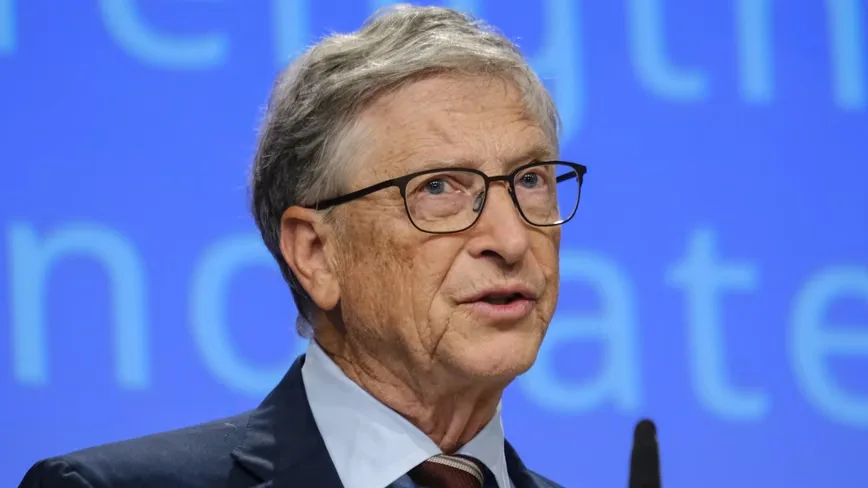
The Gates Foundation is pledging at least $1bn over the coming two years to broaden AI access, targeting partners in education, healthcare and agriculture alongside efforts to build training datasets that would enable large language models to function across languages beyond the few they currently handle well. The announcement came alongside a sharp critique of government readiness for the technology.
In remarks to Reuters published Tuesday, Bill Gates offered a direct assessment of regulatory capacity: "I don't think any government is nearly as deep on this as they have to be. Governments are way behind on this one."
The language work represents the more challenging piece of the foundation's strategy. English dominates web content at roughly 49 percent, while Chinese—spoken by over a billion people—comprises only 1.3 percent of online text. Spanish accounts for 6 percent and Japanese for 5 percent. The languages the foundation intends to address fall even further down the distribution, and for most of them, training-ready text simply does not exist at scale.
Beijing's National Data Administration has already begun constructing validated training datasets to address the Chinese language gap, recognizing the constraint this creates for model development.
Gates's concerns about AI have broadened considerably since he first engaged with the technology. In August, he proposed what he termed Human Reserved jobs—occupations deliberately protected from automation and capped at around 40 percent of total employment—alongside a tax on AI tokens and robots that he described as "a bigger change to the tax system than any in his lifetime."
His current worries encompass employment disruption, security risks and addiction potential. On the geopolitical front, Gates invoked an analogy to frame the stakes: "AI is kind of like this alien intelligence." He suggested that the technology might compel the United States, China and other nations to transcend their differences, much as an extraterrestrial arrival would. Gates has raised these concerns with Donald Trump's team and hopes to meet with Xi Jinping later this year.
The direction of international relations on AI, however, points elsewhere. Trump dismissed arguments for slowing AI development last week and told Jensen Huang by phone on Monday that concern about the technology amounts to a hoax. Beijing has spent recent months promoting affordable models internationally through a proposed global AI cooperation framework, while the G7 has discussed limiting access to American models.
Gates's claim that governments lack sufficient depth on AI regulation carries additional weight given parallel developments in Washington. Senators Thune, Cruz and Klobuchar are negotiating legislation that would establish a duty of care for developers and grant the federal government authority to block model releases. Whether such measures constitute adequate regulatory depth depends on one's view of what sufficiency requires—and Gates's answer is that private foundations must fill gaps the market leaves unaddressed.
The Gates Foundation has not yet disclosed a timetable, list of target countries, or named partners for the initiative. The foundation has also not specified how the $1bn will be divided among the three sectors and language development work.
Source: The Next Web