Europe faces a critical juncture as its climate policies reshape the landscape for clean technology investment. The EU's commitment to decarbonisation depends heavily on startups driving innovation, yet recent policy decisions suggest the regulatory framework may be working against them rather than for them.
Regulation (EU) 2021/1119 established two foundational targets: climate neutrality by 2050 and a net greenhouse gas reduction of at least 55% by 2030 compared to 1990 levels. In February, the European Parliament raised ambitions further, agreeing to a 90% emissions cut by 2040, a decade-long extension that forced Brussels to design new policy mechanisms to bridge the gap.
On 17 July, the European Commission released its Emissions Trading System (ETS) proposal package, introducing revised heat and fuel benchmarks, an Electrification Action Plan, and updated ETS directives. The ETS, established in 2005 as the world's first carbon market, was designed to channel capital toward net-zero initiatives and fund the clean energy transition. Climate Commissioner Wopke Hoekstra stated the review would turn the ETS into a "genuine engine for innovation and investment", yet market signals suggest otherwise.
Carbon prices surged approximately €7 following the proposal's publication, reaching €86 by 22 July. This counterintuitive movement—where pollution should become more expensive under a stricter framework—raises red flags for downstream actors whose survival depends on industrial adoption of clean technologies.
Policy Changes and Their Market Effects
CBAM allowances
The Carbon Border Adjustment Mechanism (CBAM) obliges importers of carbon-intensive goods—steel, cement, aluminium, fertiliser, electricity, and hydrogen—to pay charges reflecting embedded carbon content. Implemented on 1 January 2026, CBAM aims to prevent companies from circumventing carbon costs on imports. The July proposal extended several free allocation phase-out timelines for CBAM-covered sectors, delivering an immediate €6 billion allocation boost to heavy industry.
The extension carries a condition: recipients must demonstrate plans for decarbonising their EU operations. However, declarations of intent differ fundamentally from concrete action. By prolonging the period during which steel, cement, and fertiliser producers can maintain low-cost emissions, the policy weakens incentives for these industries to invest in startup-developed decarbonisation solutions.
Electrification Action Plan
The Electrification Action Plan, part of the EU Clean Industrial Deal, targets 46% electrification of EU energy consumption by 2040, up from 23% currently. The strategy emphasises accelerated electric vehicle deployment and heat pump adoption in buildings. Post-2030, the ETS emissions cap will decline by 3.7% annually between 2031 and 2035, then 1.7% from 2036 to 2040. Like CBAM provisions, free allowances hinge on companies investing in decarbonisation.
This approach offers clearer advantages for electrification-focused startups. By establishing guaranteed, large-scale demand for electrification, industries gain visibility to plan infrastructure changes before rising carbon costs force their hand.
Funding Mechanisms and Implementation Gaps
The Industrial Decarbonisation Bank (IDB), a proposed €100 billion initiative dedicated exclusively to financing industrial green transition, draws from four sources including the Innovation Fund, the EU's primary cleantech grant programme for carbon-focused startups. The IDB distributes capital through carbon contracts for difference (CCfDs), instruments that guarantee companies the spread between the carbon price required for project viability and the actual market price.
A pilot programme on industrial heat decarbonisation begins in October 2025, with broader rollout planned thereafter. Yet decarbonising Europe's four largest energy-intensive industries alone requires an estimated €500 billion—meaning initial funding covers only a fraction of actual need. More troubling, the funding struggles to reach recipients.
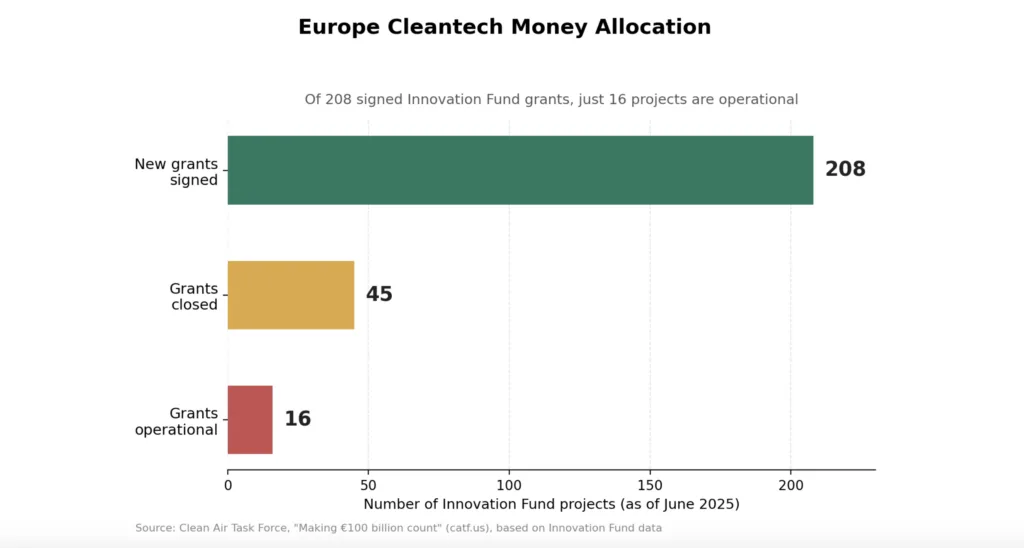
Of 208 Innovation Fund projects approved, only 16 were operational as of mid-2025. The Innovation Fund has awarded €7.1 billion in grant agreements since 2021, but merely 5% has been disbursed. A "bankability problem" explains much of the delay: financial institutions assess new climate technology ventures as carrying excessive credit risk.
Technology startups face inherent vulnerabilities—novel products, limited equity cushions, and unproven market demand. Consequently, of 208 signed grants, only 45 reached financial close and just 16 are currently operational. The Commission signed 54 additional grant agreements in March 2026 worth €2.7 billion, with no timeline for project commencement.
Even assuming funds eventually materialise, a severe shortfall persists in EU green transition investment overall. Approximately 20% of European climate tech funding targets growth-stage companies. Private venture capital, which might compensate in other sectors, is retreating from climate tech. EU cleantech venture capital investment fell to €1.3 billion in Q1 2026 from a 2024 average of €2.2 billion, with later-stage deals hit hardest.
Critical Decisions Ahead
The European Parliament will begin ETS proposal discussions imminently, with a political agreement on directives scheduled for Q1 2027. Two September deadlines carry substantial implications for climate tech funding.
- 15 September marks the deadline for two Horizon Europe Industrial Deal calls, representing a €275 million funding opportunity for industrial decarbonisation pilots in carbon capture, electrification, and clean energy
- The same week, the European Parliament's plenary session will address CBAM's "crisis safety valve" position, determining whether the carbon-pricing mechanism underpinning industrial decarbonisation pressure survives political pressure
The European Environmental Bureau has criticised the ETS proposal for rewarding polluters at the expense of businesses committed to fossil-free production. Cleantech for Europe, the Brussels-based body representing European climate tech startups, scaleups, and investors, warned that weakening the ETS would disproportionately harm early-stage startups already developing decarbonisation solutions. Delayed phase-out schedules undermine pressure on large industrial players to adopt clean energy, leaving startups piloting these technologies vulnerable to market failure.
The ETS proposal package signals what fuel, energy, and sustainability policies will resemble over the next decade. Currently, climate tech startups are not positioned as the sector poised to benefit.
Source: Startup Reporter