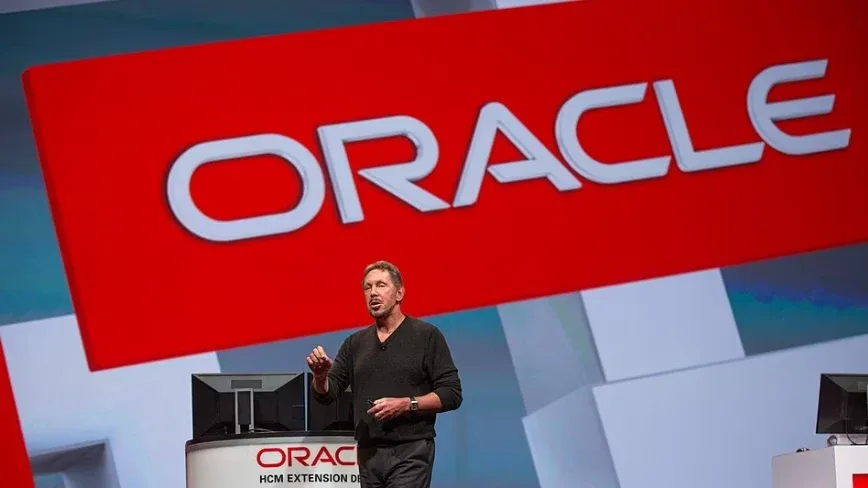
Oracle's legendary founder has largely disappeared from the company's public calendar this year. Larry Ellison will not be appearing at next month's user conference in Las Vegas, and his absence from earnings calls has become notable enough to draw media attention. This marks a significant shift for a figure who has dominated Oracle's external communications since establishing the company decades ago.
The transition reflects structural changes at the top. Last September, Oracle elevated Clay Magouyrk and Mike Sicilia to the role of co-chief executives, while Safra Catz moved into the position of executive vice chair. Ellison, now 82, retains his titles as chairman and chief technology officer and maintains roughly 40% ownership of the company, preserving his influence behind the scenes.
The shift in who appears before investors and customers matters because Oracle's story has fundamentally changed. The company is simultaneously cutting jobs—a $2.8 billion initiative that has reduced headcount by 13% over the past year—while borrowing heavily to construct new data centres. These are narratives that demand explanation, and they belong to the new leadership team.
The European Sovereign Cloud Advantage
The generational handover carries particular weight in Europe, where Magouyrk's vision for cloud infrastructure has created a competitive moat. Magouyrk arrived at Oracle in 2014, the same year Ellison stepped down as chief executive, bringing six years of experience from Amazon and AWS. He has since expanded Oracle Cloud Infrastructure to operate across more than 100 public regions globally.
Among his key achievements is the development of Oracle's EU Sovereign Cloud, which launched in June 2023. This offering addresses a critical market need for customers operating under strict data residency and sovereignty requirements. The service maintains separate EU legal entities managing regions in Frankfurt and Madrid, with support provided exclusively by EU-based personnel.
The infrastructure separation goes deeper than organisational structure. Equinix operates the Frankfurt facility while Digital Realty manages Madrid, and both remain isolated from Oracle's standard commercial cloud infrastructure. This isolation extends to networking, control planes, and identity services—a comprehensive approach to sovereignty that competitors have taken longer to replicate.
Amazon launched its own European sovereign cloud offering in Brandenburg in January of this year, more than two and a half years after Oracle's launch. The timing underscores how Magouyrk's early execution in this space has given Oracle a head start in a market segment that Ellison never personally championed.
A Different Oracle to Sell
The contrast between Ellison's era and the present day is stark. Ellison built Oracle's reputation by winning public arguments about databases and applications—products he could explain and defend in front of audiences. The company he led sold software and won through technical superiority and commercial acumen.
Today's Oracle sells something different: cloud capacity, often concentrated with a small number of major customers, financed through debt that has pushed the company's credit rating to just one notch above junk status. This is fundamentally a different business requiring different skills and a different public persona. It is a business that belongs squarely to Magouyrk and Sicilia.
Source: The Next Web