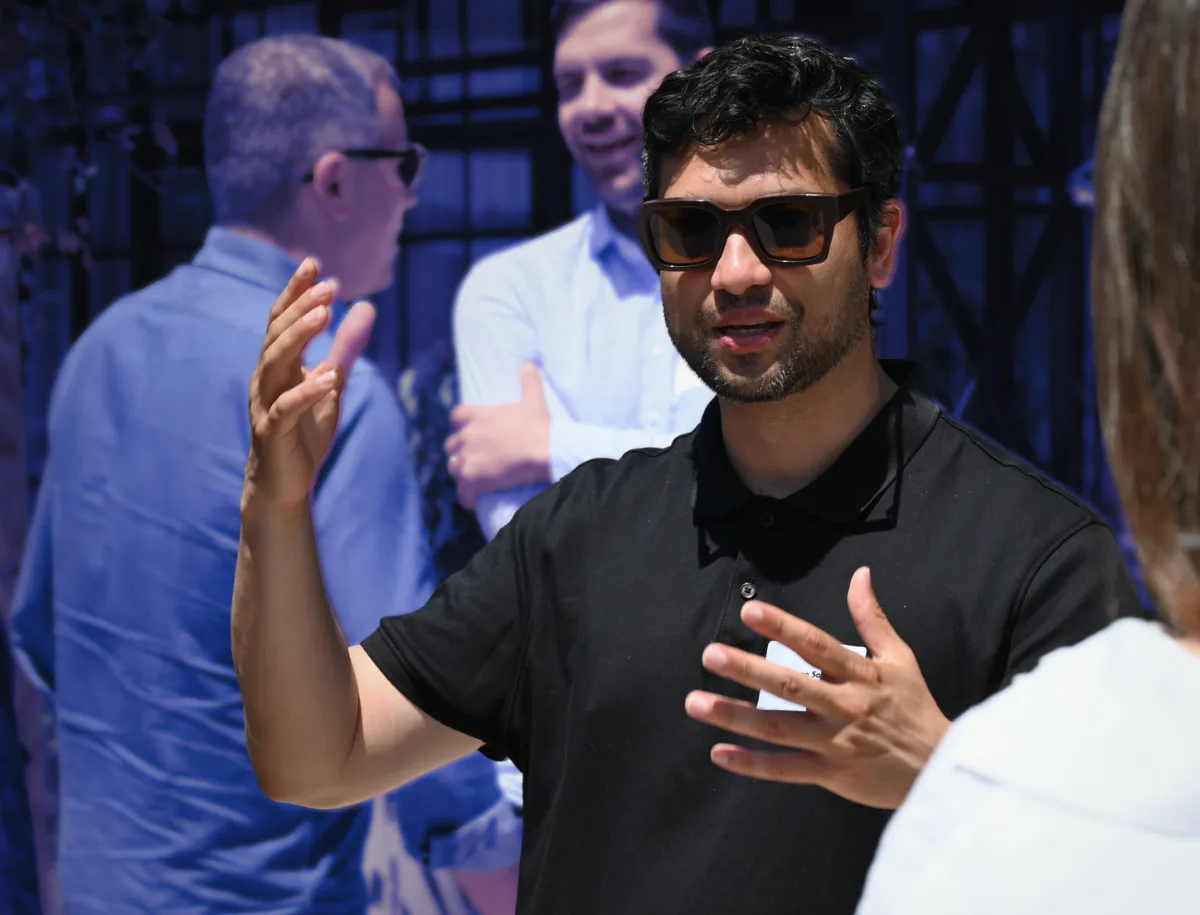
The technology industry races toward Artificial General Intelligence, yet few pause to consider what lies beyond that milestone. At the Hellen's Rock Founder Retreat 2026, Sumon Sadhu—a serial AI entrepreneur, angel investor, and scientist—presented a provocative answer: humanity enters the "Post-Biology Era," a period in which we transcend evolutionary constraints. Over the coming three decades, Sadhu argues, our species will transition from merely pursuing biological advancement to actively authoring it, propelled by a single organizing principle he terms "the loop."
It thinks on 20 watts
While the industry fixates on supercomputing power, Sadhu redirects attention to an overlooked fact: the organ between your ears outperforms any machine humanity has built. Your brain executes roughly a billion operations each second while consuming approximately 20 watts—the equivalent of a refrigerator bulb's energy draw.
"You're actually running the most powerful computer on Earth, about a billion operations per second on roughly 20W of power, the same amount as the bulb in your fridge."
Sumon Sadhu
The world's fastest supercomputer may achieve comparable raw throughput, yet demands 20 megawatts—a million times greater energy expenditure. When measured by the metric that truly matters, efficiency per watt, biology surpasses silicon by roughly a million-fold margin. "That gap is the hidden engine of this whole talk," Sadhu observes. This represents no mystical property but rather engineering excellence, with specifications that evolution perfected across billions of years: systems detecting photons at the quantum level, molecular turbines operating near 100 percent efficiency, and countless other marvels encoded in our cells.
It's not the smartest mind, it's the fastest loop
According to Sadhu's framework, both living systems and intelligence itself operate through an identical mechanism: a cycle of perception, modeling, action, measurement, and refinement. The AGI revolution transforms this loop into a commodity—as accessible and abundant as electricity from a wall socket.
This transformation rewrites competitive dynamics. The decisive advantage no longer belongs to the organization with the single brightest individual, but rather to the one executing its loop most rapidly. "When your loop closes in days and your rivals close in quarters, you don't out-argue them and you don't outspend them, you out-evolve them," Sadhu contends.
For company leaders and founders, this insight demands a structural shift: treating their organizations as living systems and systematically compressing the cycles of creation, distribution, and knowledge capture. As artificial systems handle execution, the distinctly human contribution becomes determining purpose—establishing objectives, exercising aesthetic judgment, and guiding the loop's direction.
When the loop gets a body
The period immediately following AGI's arrival, Sadhu forecasts, belongs to physical intelligence—the moment when the loop acquires physical form.
Robotic systems will transition from digital environments into the material world, where they encounter what roboticist Hans Moravec identified as a fundamental paradox: activities trivial for humans—folding cloth, navigating terrain—prove extraordinarily difficult for machines, while challenges humans struggle with—playing chess, solving equations, formal reasoning—come easily to them.
The explanation lies in temporal depth, Sadhu explains. Humans refined sensorimotor capabilities across 500 million years of evolution. The genuine bottleneck is not mechanical strength but computational sophistication. Viewed through this lens, a robot comprises a physical form paired with a processing system—a nervous system constructed from silicon rather than neurons. The entire endeavor, therefore, centers on decoding how the brain achieves its 20-watt efficiency miracle and translating that breakthrough into semiconductor architecture.
Hacking the source code of life
If replicating biology in metal and circuits proves futile, perhaps the solution involves abandoning that approach entirely.
This pivot opens the gateway to the Post-Biology era. Rather than reconstructing life through mechanical means, we begin modifying the original blueprint, deploying AI and robotics to engineer improvements beyond what natural selection produced.
"A genome is editable information, which means biology's givens, whatever laws, they're just parameters,"
Sumon Sadhu
This capability unlocks possibilities once confined to fiction. Sadhu cites research teams engineering enzymes capable of degrading plastic waste, de-extinction initiatives targeting woolly mammoth resurrection by 2028, and emerging applications in bioelectric manipulation.
Drawing on biologist Michael Levin's research, Sadhu described how electrical signaling instructs tissues regarding their construction. A cancerous cell represents tissue that has severed itself from this electrical network; restoring that connection might reprogram it to its original function, potentially offering cancer treatment without chemotherapy's toxicity. In this emerging paradigm, Sadhu notes, "medicine is no longer a chemical that you swallow. It's a program that you write."
Such capability demands corresponding ethical weight. Researchers working in this domain have already imposed two separate moratoriums: one restricting heritable modifications to human embryos, another limiting work on molecules capable of circumventing immune defenses. Yet capability itself persists. As nature's constraints transform into human choices, the consequences grow more consequential than ever.
"We spent 3.5 billion years as a result of biology. We're about to spend the next century as its authors. So we better learn how to write well."
Sumon Sadhu
Source: The Recursive — Events tag