What is Physical AI in robotics?
Physical AI moves beyond mere observation. Rather than stopping at perception, it creates systems that sense their surroundings, process what they perceive, and respond through action in a continuous feedback loop. This distinction separates passive monitoring devices from robots that genuinely interact with their world.
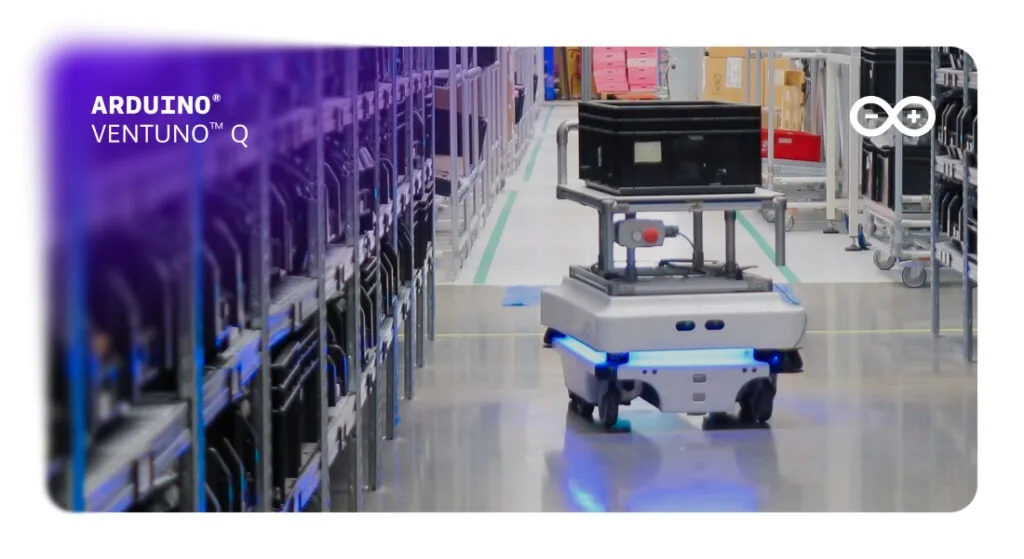
Autonomous mobile robots exemplify this principle. Consider a delivery robot navigating a warehouse: it must identify its location, detect obstacles when someone blocks its path, recalculate routes when equipment moves, and adjust its behavior as conditions change. The robot reads sensors without pause, controls its wheels with precision, and reacts instantly to nearby hazards—managing multiple demands simultaneously.
Two processing architectures, unified on one board
Autonomous mobile robots typically demand two distinct computing approaches. Navigation, computer vision and artificial intelligence thrive on the adaptability and raw power of Linux systems. Motor control and time-critical sensor operations, by contrast, need the predictable responsiveness only a microcontroller can provide.
Traditional AMR prototypes distribute these responsibilities across multiple boards. A Linux machine runs ROS 2 and processes camera and LiDAR feeds on one device, while a separate microcontroller handles motors, wheel encoders and nearby sensors. This separation demands integration effort: developers must wire the boards together, establish communication protocols, maintain distinct development toolchains and troubleshoot interactions between independently designed systems.
The Arduino VENTUNO Q consolidates this architecture. Its microprocessor unit hosts Linux, ROS 2, navigation algorithms, computer vision and AI tasks. Its microcontroller stays close to the robot's mechanics, overseeing wheel control, encoder signals, motion measurements, proximity sensing and motor driver communication. The division of labor becomes straightforward: the MPU determines where movement should occur, the MCU translates that intent into actual controlled motion. Together they enable the complete cycle of sensing, deciding and acting.
Sense: Building environmental awareness
As a delivery robot moves through warehouses, hotels or public spaces, it must continuously construct a mental model of its surroundings. No single instrument provides complete information, so the system layers multiple complementary data sources.
A 2D LiDAR establishes the geometric baseline for navigation, with laser scans capturing walls, hallways, furniture and structures. Combined with measurements from wheel rotation and motion sensors, SLAM algorithms build maps and help the robot pinpoint itself within them. Yet a single-plane laser scan cannot capture every obstacle—a shelf edge, an open drawer or an object jutting into the robot's trajectory may sit above or below that plane.
A stereo-depth camera adds three-dimensional perception, revealing shapes and barriers that might not register clearly in a flat scan. A MIPI camera supplies visual data for specialized tasks: identifying people, recognizing delivery zones or confirming whether a tray sits in place.
Closer to the chassis, an Arduino Modulino Distance node watches blind spots and detects immediate obstacles. A Modulino Movement sensor tracks acceleration and rotation rates, supporting motion estimation and flagging collisions or unusual vibration. Wheel encoders complete the sensory picture by measuring actual movement. The MCU uses their signals to regulate wheel speed, while the resulting odometry feeds into the navigation software on Linux. Rather than depending on a single sophisticated sensor, the robot gains awareness by fusing geometric, visual, inertial and mechanical signals.
Decide: ROS 2 as the decision-making framework
On the MPU, ROS 2 furnishes a unified software platform for coordinating all sensor inputs. The LiDAR publishes scan data. Camera systems deliver images or depth maps. The robot broadcasts odometry and motion measurements. Navigation modules consume this stream to calculate position, chart routes and adapt when the environment shifts.
During initial exploration, a ROS 2 SLAM package merges LiDAR readings and odometry to construct a map. Once available, the robot can determine its location and employ Nav2 to travel between waypoints.
When an application directs the robot from warehouse to packaging station, Nav2 computes an optimal path and refreshes it continuously as fresh sensor data arrives. It then produces velocity commands specifying forward speed and rotation rate. These commands express the desired movement but do not directly energize the motors. That task transitions from the Linux realm to the MCU.
Act: Converting commands into motion
When Nav2 issues a velocity command, an MPU-to-MCU interface transfers the instruction to the real-time control routine. The MCU converts the requested linear and angular motion into speed targets for each wheel. It then signals the motor controllers—potentially via CAN—and monitors encoder feedback to sustain the commanded wheel speeds.
This control loop executes with consistent timing, independent of the larger ROS 2 graph running on Linux. Data also flows backward: encoder values, motion data, short-range distance measurements and drivetrain status travel from the MCU to the MPU, where they become accessible to ROS 2.
This bridge between the two computing domains ranks among the architecture's most critical features. It permits high-level navigation logic to command the physical robot without requiring Linux to oversee every time-critical electrical and mechanical operation.
It also enables rapid local responses. If a close-range sensor spots an obstacle directly ahead, the MCU can halt the drive system in a controlled manner and alert the MPU. The navigation layer can then reassess, modify the route or inform the application. The outcome is a robot where intelligence and quick reaction reinforce each other.
Adding intelligence with edge AI
LiDAR, odometry and Nav2 already enable navigation through known spaces. AI becomes valuable when the robot must grasp the significance of what it observes. The navigation system might detect an obstruction, but a vision model could classify it as a person, a chair or a delivery cart. This semantic understanding drives more fitting responses.
When a person approaches, the robot might decelerate, pause or announce an incoming delivery. Upon arrival, a visual classifier could identify the drop-off location or verify that someone has collected the tray. The same hardware could scan the path for hazards or use vibration analysis to spot mechanical problems.
Edge Impulse presents one workflow for building such application-focused intelligence. Through its ROS 2 connection, an inference model processes image data and shares results with other robotic components. ROS 2 guides navigation decisions. Edge AI interprets the context surrounding those decisions. With the integrated Edge Impulse platform, deployment to Arduino App Lab requires just a single click.
Building capability incrementally
Although the reference design encompasses navigation, depth sensing and AI, developers need not activate all features simultaneously. An initial prototype could concentrate solely on the mobile base, with the MCU controlling motors and reading encoders. Once basic movement functions reliably, the control layer could connect to ROS 2 on the MPU, allowing the robot to accept standard velocity commands and transmit odometry.
Introducing LiDAR adds mapping, localization and self-directed navigation. Depth cameras and short-range sensors then enhance obstacle detection. Visual AI finally transforms the generic platform into a delivery robot capable of recognizing people, destinations and domain-specific situations. This staged method keeps each phase manageable while maintaining a clear trajectory toward greater capability.
VENTUNO Q does not eliminate the engineering challenges inherent in AMR development. Mechanical engineering, power distribution, motor selection, navigation calibration, sensor positioning and safety protocols all demand rigorous attention. Its contribution lies in furnishing a more integrated foundation from which to start.
Beyond food delivery
A food-delivery robot represents just one application of this architecture. Warehouse vehicles, inspection platforms, hospital transport systems, agricultural robots and other autonomous machines could employ the same computing model.
Sensors, propulsion systems and AI models will vary, but the fundamental problem persists: linking sophisticated reasoning with responsive mechanical action. By pairing a Linux-capable MPU and a real-time MCU, VENTUNO Q equips developers with a platform for prototyping this entire chain. ROS 2, navigation, perception and edge AI operate on the MPU. The MCU manages the sensors and motors that translate software choices into physical reality.
From environmental perception to wheel control, VENTUNO Q provides a cohesive starting point for the intelligent mobile robots of tomorrow.
Source: Arduino Blog